


- Crude oil prices have been relatively steady but sensitive to developments in negotiations, with traders showing caution ahead of the US-Iran talks in Geneva as markets weigh potential impacts on supply and geopolitical risk premiums.
The crude oil price struggles amid the US-Iran talks, which are set to resume on Tuesday. Crude oil breaks below the uptrend line, signaling that negative pressures are resurfacing. A consolidation period might last in the near-term as long as the price sits below the trend line. The United States markets are closed today for Presidents’ Day, so there will be no settlement. On the other side, Asian trading activities are subdued as China, South Korea, and Taiwan celebrate the Lunar New Year Holidays.
This article examines the latest crude oil price outlook, key developments in the US-Iran talks, and the most recent OPEC+ decisions shaping market sentiment.
The Technical Outlook for Crude Oil Price:
Crude oil remains in a broader recovery structure that started early in January, supported by the ascending trendline connecting higher lows. This upward slope reflects improving bullish momentum over the past several weeks. However, the price is now hovering very close to that support line, but below the sloping trend line. The red-highlighted area doesn’t signal short-term weakness unless the trend line break is confirmed below 62.16 support.
Aclear break below the 62.16 level would weaken the short-term bullish structure and likely signal a transition into a consolidation phase. Such a move could also trigger near-term selling pressure, especially if uncertainty regarding the US-Iran talks fuels concerns about potential supply shifts and softer geopolitical risk premiums.
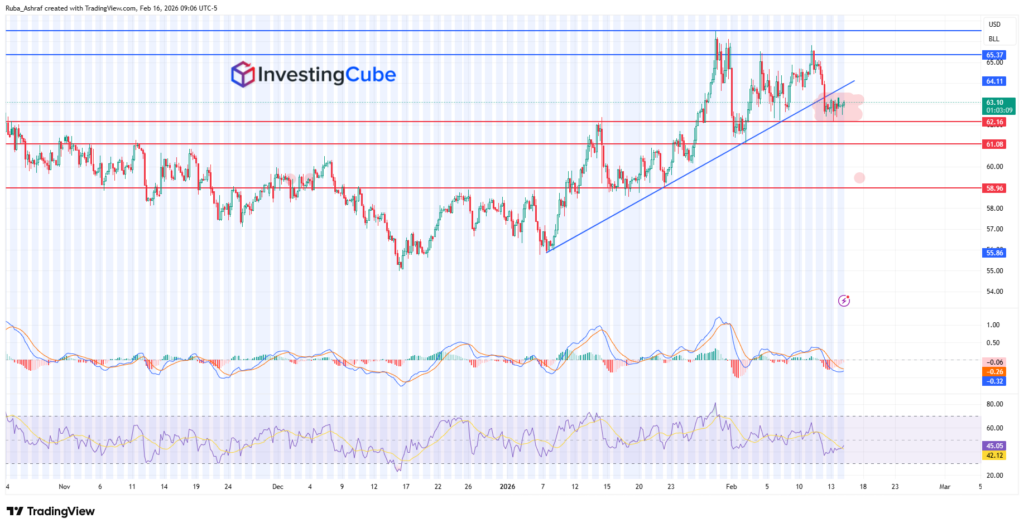
From a technical level perspective, the immediate resistance stands around 64.11, followed by a stronger ceiling near 65.37, which previously capped upside attempts. A sustained break above 65.37 would freshen bullish momentum and open the door toward fresh highs.
On the downside, immediate support is located at 62.16, aligning with the trend line area. A break below this level could expose 61.08 as the key support, followed by 56.96 as a more critical demand zone.

From a momentum indicator perspective, the MACD indicates fading upside momentum and increasing downside risk in the short term. Meanwhile, the RSI is hovering around the mid-40s, below the neutral 50 level. This suggests that the bullish momentum has cooled, and sellers are gradually gaining control.
Overall, crude oil remains technically constructive above the ascending support line, but a decisive break below it could shift the short-term bias toward consolidation or a corrective pullback, particularly if geopolitical developments from the US-Iran talks weigh on market sentiment.
Crude Oil Price | The key Developments in US-Iran Talks:
- Iran’s foreign ministry said that the second round of high-level talks will be in Switzerland on Tuesday. It will be over the country’s nuclear development.
- On Sunday, Iran’s Foreign Ministry confirmed via social media that Abbas Araghchi had left Tehran for Geneva to join the meeting.
- The first round of talks was on February 6; it ended with Washington and Tehran agreeing to continue discussions.
- Speaking from Slovakia on Sunday, US Secretary of State Marco Rubio confirmed that special envoy Steve Witkoff and Jared Kushner will join the talks with Iran.
- Iran’s Deputy Foreign Minister Majid Takht-Ravanchi told the BBC that Tehran is prepared to discuss matters related to its nuclear program, provided Washington is also willing to address sanctions. He added that the “ball is in America’s court.”
- Meanwhile, the Trump administration announced last week that it will deploy a second aircraft carrier to the Arabian Sea near Iran, adding to the nuclear-powered carrier already stationed there. The move is widely viewed as an effort to increase pressure on Tehran.
OPEC+ May Raise Oil Output from April:
- OPEC+ plans to gradually increase production starting from April. This move aims to meet stronger summer demand and respond to higher prices amid US-Iran tensions.
- Saudi Arabia and the UAE aim to regain market share, while Russia, Iran, and Kazakhstan face sanctions or operational limits.
- This would be a strategic shift, balancing supply with geopolitical and market factors.
- Previously, OPEC+ paused production increases for Q1 2026, keeping output steady due to seasonal demand and market uncertainty.
Traders are cautious because any progress in negotiations could lead to eased sanctions and potentially increase Iranian oil supply, which may put downward pressure on prices.
If talks collapse or tensions escalate, geopolitical risks could rise, supporting higher oil prices due to fears of supply disruptions in the region.