

- The Fed easing expectations and BoJ normalization will play a part in determining USD/JPY forecasts. However, geopolitics cannot be ruled out.
This article looks at the USD/JPY forecast for 2026 and how the expectations of Fed easing in 2026 and the normalization policy of the Bank of Japan (BoJ) marry into these forecasts. But as we shall see in this article, geopolitics will also have a say as long as Donald Trump is the US president.
USD/JPY Live Chart
The pair ended 2025 on a higher note despite the greenback posting three-month lows in December due to the Fed’s commencement of additional easing. However, the weekend invasion of Venezuela, which has effectively put the US in charge of the country’s oil flow, has introduced a measure of geopolitical impact in early January trading. The USD/JPY started the trading day on 5 January 2026 0.3% higher. However, the pair has lost its early gains and is now 0.11% lower as of writing.
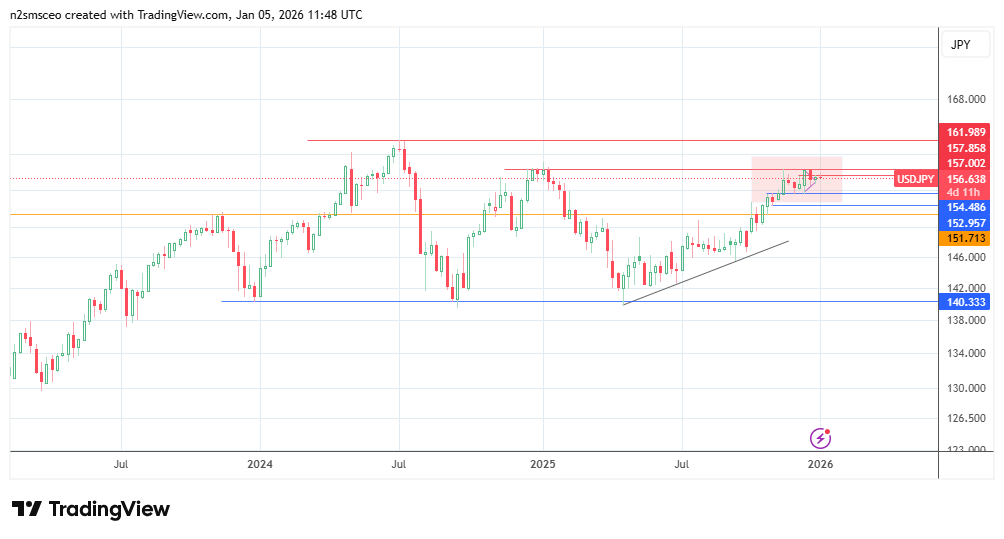
The USD/JPY is presently in a long-term range, with price action tilting towards the top end of the range. The July 2024 high at 161.98 remains the upper boundary of the range, while December 2023, September 2024 and April 2025 lows around 140.33 form the lower boundary of this range. Price has tested the 158.10 price cluster formed by the late December 2024/early January 2025 highs but has been unable to breach it.
USD/JPY Forecast: What are the Fundamental Drivers?
The core price drivers for USD/JPY forecasts in 2026 are:
- Fed easing expectations
- BoJ normalization pathway
- Yield differential plays (carry trade)
- Intervention risks
- US-driven geopolitics
1. Fed easing expectations
A Reuters report on the recent RBA minutes indicates that the apex bank will keep rate hikes on its table for 2026 if inflationary risks remain. Any market repricing that sees rates staying higher for longer, or signals a new rate hike, will be supportive of the Aussie Dollar. This will pressurize the EUR/AUD.
Bearish EUR/AUD forecasts will also be reinforced if the European Central Bank maintains its “hold” bias. The most recent Flash Manufacturing data from Germany and the Eurozone (December 2025) were underwhelming. Growth activity was more substantial than expected, which could leave the ECB with room to maintain a neutral interest rate stance.
Policy divergence such as is currently playing out, will influence EUR/AUD forecasts in 2026.
2. BoJ actions (normalization path and intervention risks)
Several sell-side outlook reports are in consensus that 2026 is the year of JPY strength as the Bank of Japan continues to raise rates gradually. This is expected induce higher yields on Japanese government bonds, making the Yen an attractive asset. The December 2025 rate hike projected by UBS played out as expected, while the Bank of America is looking toward another hike in June 2026.
The USDJPY continues to face exposure to the Ministry of Finance’s interventionist rhetoric. Such interventions are likely to cap upside momentum and amplify pullbacks in a thin-liquidity environment.
3. Yield differentials (carry trade)
Even as the Fed eases and the BoJ heads toward normalization, the real rate structure still creates a differential that can support the carry trade, even if not to the degree seen in the last 2-3 years.
4. US-led geopolitics
The USD/JPY is susceptible to US-led geopolitics. The unfolding situation in the Middle East, where the US is said to be moving military assets on the heels of its action in Venezuela, could produce some heightened volatility.
The currency pair is also exposed to changes in oil prices. Following the capture of Venezuelan President Maduro and the announcement by US President Donald Trump that the US now controls the country’s oil, Brent crude spiked 1.66% in Monday’s trading. This scenario has led to a heightened move in USD/JPY and could set the stage for the geopolitical tone the pair will face in 2026.
High-signal news events that will drive central bank rate expectations on both sides of the divide are:
- US inflation and employment data (Non-Farm Payrolls, ADP Employment, etc).
- BoJ meetings and statements from the BoJ Governor, especially comments regarding wage and inflation dynamics.
- US fiscal/monetary policy headlines
- Commentary from Japan’s Ministry of Finance (intervention risks)
Current USD/JPY Forecasts 2026
MUFG has provided an explicit quarterly USD/JPY forecast pathway indicating a gradual decline in USD/JPY. The Q1 2026 USD/JPY forecast stands at 150, while subsequent quarters will see the pair declining to 148, 146, and 144, in that order. MUFG’s outlook is part of a broader outlook indicating a weakening of the US Dollar Index throughout 2026.
NAB has a directional bank call that indicates a decline in the pair towards 145 in 2026. UBS and JP Morgan have more JPY-constructive published targets. UBS may have lifted its price forecasts, but the bank still sees a decline to 140 by March 2026 and 136 by September 2026. JP Morgan’s note indicates a USD/JPY forecast target of 130 for March and June 2026.
USD/JPY Forecast: Technical Outlook
The daily chart reveals various price levels, with the most notable being the 1.8152 and 1.7501 price levels. These are the borders of the medium-term range that has been intact since June 2025.
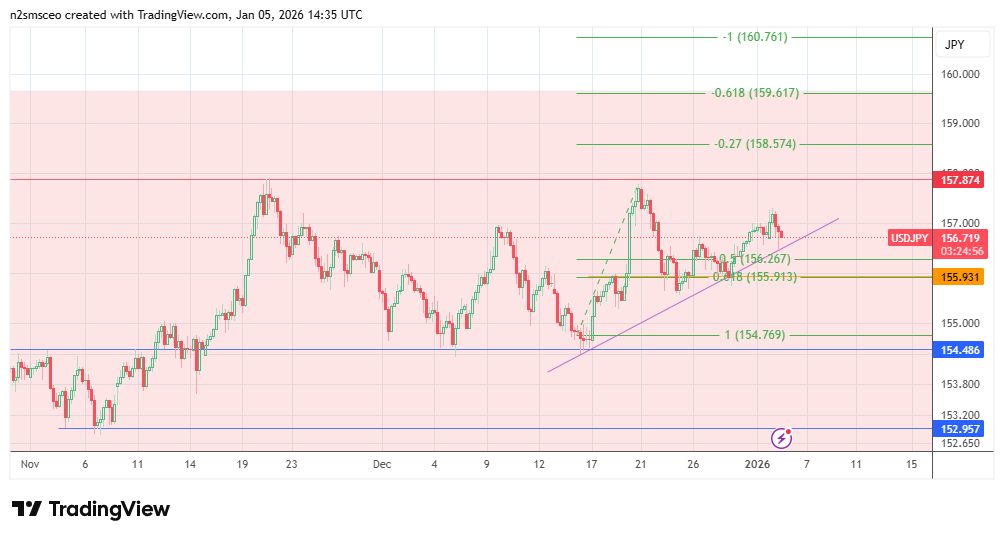
The price is testing the ascending trendline. The bears need to force a decline below the trendline for the 155.93 support to come into view. Additional support is seen at 154.48, with 152.95 (4-6 November) serving as an additional pivot.
On the flip side, a bounce on the trendline at the point of intersection with the 50% Fibonacci retracement level at 156.26 allows for a push towards the 157.84 barrier. If this barrier is uncapped, the 158.57 price mark, formed by the 27% Fibonacci extension of the 16 December 2025 – 19 December 2025 price swing, becomes the new upside target. Additional targets to the north are found at 159.61, the 61.8% Fibonacci extension, and the 160.76 price mark (100% Fibonacci extension).
FAQ
What is USD/JPY exchange rate today?
Answer: The closing price on Monday 5 January 2026 was 156.33.
What are the current USD/JPY forecasts for 2026?
Answer: Many bank sources project a weakening of the USD/JPY to levels ranging from 150 to even as low as 136.