
Live Chart
The EUR/PLN forecasts for 2026 are governed primarily by central bank actions and growth patterns in the Eurozone on one hand, and Poland on the other.
The EUR/PLN pair has two price feed systems. The European Central Bank (ECB) reference rates and the market-history rates. The current reference rate for the EUR/PLN based on the market history prints at 4.2064.
EUR/PLN Forecast for 2026: Macro Drivers
The following macro drivers govern the EUR/PLN forecasts for 2026:
- NBP policy
- Poland’s growth/inflation mix
- Euro direction
- Risk sentiment
- Regional politics
1. National Bank of Poland policy pathway
Poland’s central bank appears to have gone from an aggressive easing pathway to one of “fine-tuning.” The latest data show that the NBP cut rates to 4.00%, with the NBP governor signaling that the bank would wait to see the impact of cuts, a likely pause. A shift to a data-dependent pathway is supportive of the Zloty.
2. Poland’s growth/inflation
The European Commission has released its growth and inflation expectations for Poland. Poland is expected to have 2.9% inflation and 3.5% growth in 2026. The Zloty will benefit if Poland’s growth numbers show the economy’s robustness.
3. Euro direction
The EUR/PLN mirrors the risk premium of the Central European FX currencies vs the Euro. The Euro’s direction is determined by the European Central Bank’s (ECB) monetary policy. If the market reprices ECB rate actions, the Euro could gain and push EUR/PLN higher. In other words, what happens to the Euro will automatically impact the EUR/PLN.
4. Risk sentiment
The Zloty is a risk-sensitive currency that tends to firm when Europe is in risk-on mode. Risk-off setups from geopolitical shocks and equity market selloffs can send the EUR/PLN soaring.

5. Regional politics
Poland appears to have toned down its desire to join the EU, according to previous Financial Times reportage. The relatively stronger performance of Poland’s economy in 2025 relative to the Eurozone appears to have fed this economic rationale. Therefore, any news suggesting that Poland will not adopt the Euro or will not join the Eurozone is bearish for the EUR/PLN.
EUR/PLN Forecast for 2026: Institutional Targets
Various institutional traders have put out their EUR/PLN forecasts for 2026.
ING has published a quarterly forecast schedule for EUR/PLN for 2026. The target prices are 4.21, 4.23, 4.24, and 4.22 for the four quarters of 2026. This forecast path was published in January 2026 and essentially calls for the EUR/PLN pair to trade in a consolidation between 4.2 and 4.25 throughout the year.
MUFG has also lent its voice to the EUR/PLN forecasts, calling for implied quarterly targets of 4.20, 4.19, 4.17, and 4.17 for Q1, Q2, Q3, and Q4 2026, respectively. This framework sees the Zloty strengthening modestly versus the Euro in 2026, with values derived from the EUR/USD and USD/PLN reference crosses.
UBS also lists a quarterly EUR/PLN forecast schedule, with prices expected to range between 4.20 and 4.23.
Base case: The EUR/PLN remains range-bound in 2026, with a slight downside bias. This scenario is cemented if the NBP pauses rates and turns entirely data-dependent. The downside bias could see the pair flirting with the 4.17-4.20 price zone.
Bull case: The EUR/PLN bull case is enhanced in a risk-off environment or if the NBP continues to cut rates. The NBP Governor usually indicates the NBP’s rate stance in periodic press conferences. This will see the pair rise above 4.25, driven by increased volatility.
Bear case: The bear case scenario arises in a risk-on environment, with a cap on NBP cuts. This compresses the risk premiums and allows the pair to break below 4.20. We also see this scenario play out if the Eurozone’s growth data outperforms Poland’s.
EUR/PLN Forecasts: Technical Outlook
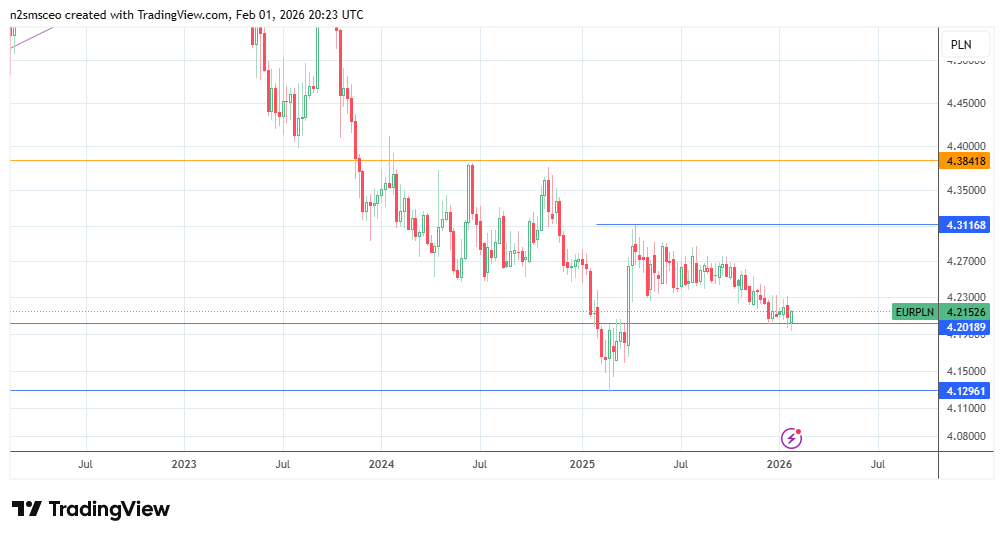
The primary trend remains bearish, despite the slip into consolidation following the downtrend move from mid-2022 to mid-2024. The sideways base has formed around 4.13 – 4.31. Below 4.31, the trend is bearish-to-neutral with 4.20 being the line in the sand. If 4.20 holds, the range continues. Below 4.20, the trend resumes lower to 4.13 or 4.11.
However, a relief bounce from 4.20 will see a market push to retake the 4.25 resistance. Above this, 4.31 comes into the picture as the key resistance. A clean break and hold above 4.31. If this barrier gives way, there will be more room to march towards 4.38.