


- US military action against Iran could disrupt supplies along the Strait of Hormuz, which accounts for transiting a third of the world's oil
- Harsh winter conditions in the US and production halts in Kazakhstan have taken away a substantial volume of supply
- The oil market faces downward pressure in 2026 in the absence of geopolitical risks, as supply could outstrip demand by 2.3-3 million bpd
The oil market, after a calm end to 2025, is active again in January 2026. This week, West Texas Intermediate (WTI) crude futures went above $64 a barrel, and Brent went past $69, the highest since late September. So why the sudden hyperactivity around oil?
Why is Crude Oil Price Rising?
The main reason for this price jump is the growing tension between the U.S. and Iran. President Trump’s strong words on nuclear talks have traders worried about possible supply problems in the Strait of Hormuz, a key shipping route for a third of the world’s oil.
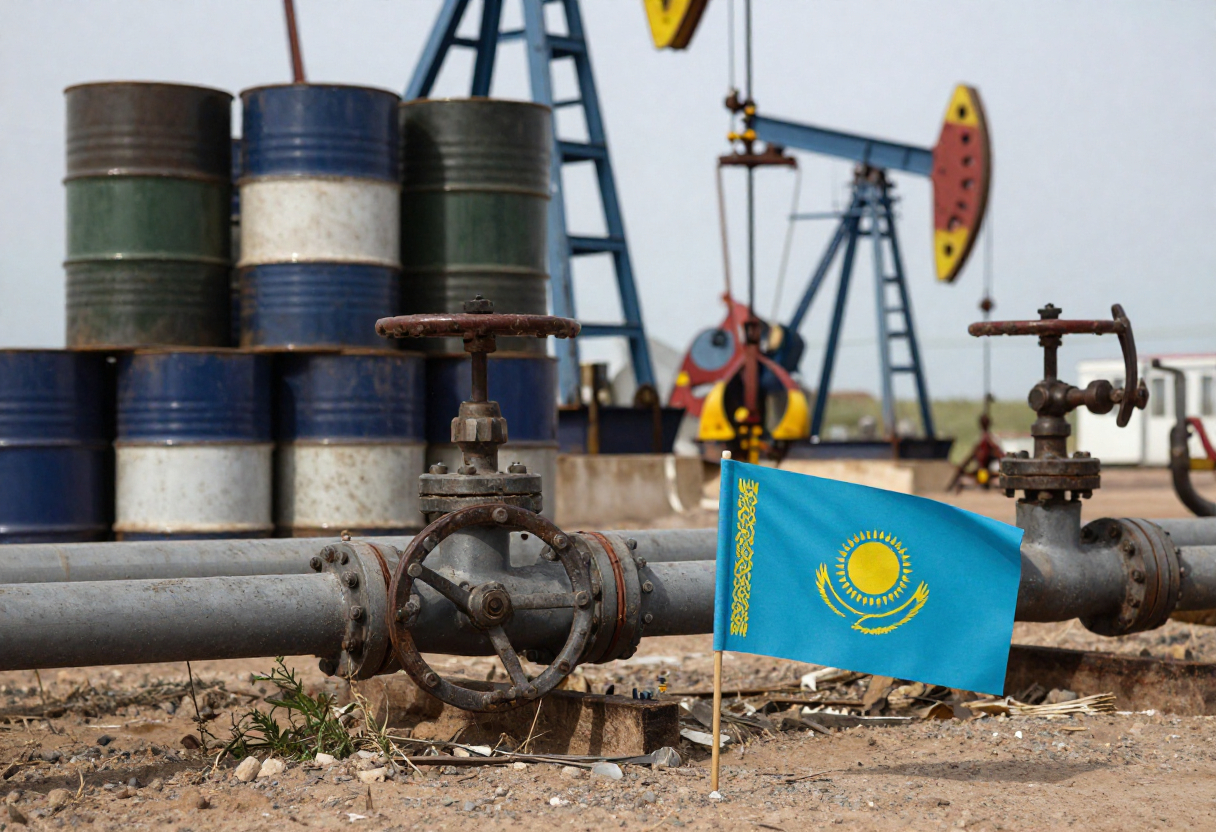
But it’s not just about Middle East tensions. A bad winter storm in the U.S. cut production by almost 2 million barrels a day, based on EIA data. At the same time, Venezuelan shipments dropped to about 300,000 barrels a day in early January because of U.S. blockades on sanctioned tankers. Also, U.S. limits on Russian oil and production issues in Kazakhstan have tightened the short-term supply, according to Citi’s note released on Wednesday.
Still, this rally feels more like a short-term spike than a lasting trend. The market expected an oversupply in 2026, and these disruptions have just delayed the pressure from high production levels.
Has Oil Price Outlook Changed for 2026?
Sustainability of the current rally appears limited. While geopolitical risks could keep prices up, the basic market conditions suggest prices will fall. The U.S. Energy Information Administration’s Short-Term Energy Outlook predicts Brent will average $56 a barrel in 2026, a 19% drop from 2025, as global production exceeds demand, leading to more inventories. ING Think agrees, forecasting a big surplus peaking in the first half of 2026, with Brent at $57 a barrel.
The Risks Ahead
The biggest uncertainty is the potential of new tariffs. While tariffs on China often dampen demand, the threat of secondary sanctions on countries doing business with Iran could actually tighten the market further by scaring off buyers of Iranian crude. For now, the market is balancing between a physical surplus and a geopolitical nightmare.

Global oil demand is expected to grow by 930,000 barrels a day, slightly up from 850,000 in 2025, which shows normal economic activity, according to the IEA. OPEC is more optimistic, estimating 1.3 million barrels a day, but past overestimates reduce confidence.
On the supply side, increases of 1.4 million barrels per day are expected, driven by OPEC+ and non-OPEC nations like Brazil and Guyana, per the EIA. This difference could raise inventories by 800 million barrels, as the Baker Institute calculates, leading to surpluses of 2-3.8 million barrels a day. So, while current tensions have caused an oil price increase, the general trend is downward.
Brent Crude Price Forecast
Brent crude is currently showing strong upward movement. The first resistance level is at $69.30, with a stronger one at $70.00. On the downside, support is at $66.32, which was previously a resistance level. A stronger bearish hold could push the price lower to test $64.30. The MACD shows a clear bullish signal, but the price is currently between the 50-day and 200-day EMAs, suggesting prices might move sideways before going towards $75.
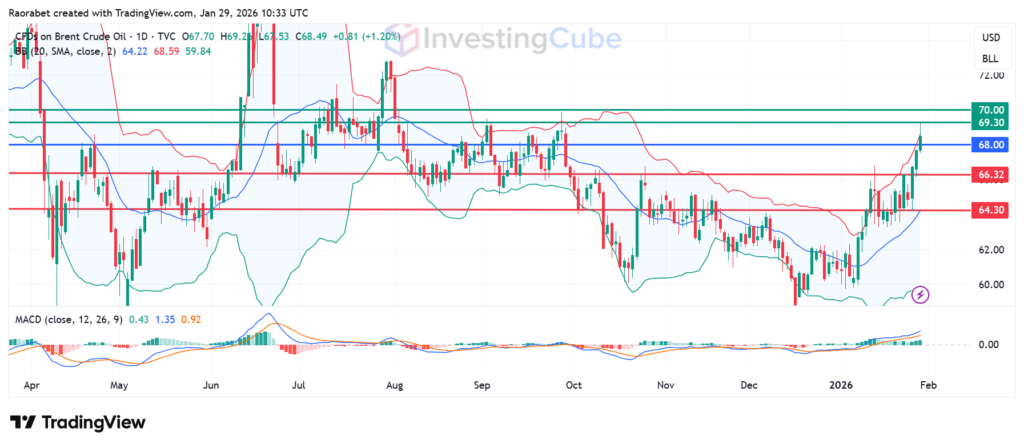
Brent price on the daily frame on January 29,2026, showing main support and resistance levels. Created on TradingView
The main reasons are rising U.S.-Iran tensions and a large U.S. naval presence in the Gulf. Also, a weaker U.S. dollar and a surprise drop of 2.3 million barrels in U.S. inventories have supported prices.
The uptrend is unlikely as oversupply is expected with only moderate demand growth. EIA and OPEC+ forecasts suggest a negative outlook, with production growing faster than consumption.
The biggest risk is a global economic slowdown caused by trade tariffs, which could reduce demand. Also, if the current Middle East tensions ease, the geopolitical risk premium in the price would likely disappear.