



Archived Article This article was published more than 5 months ago. The market data, prices, forecasts, and analysis were accurate at the time of publication but may have changed since then. Please use this article for historical reference only and refer to our latest content for current market information.
- The US-China talks in Busan ended on a positive note, easing trade tensions as both leaders agreed on renewed cooperation in trade, energy, and global security.
- Brent crude oil prices remained cautious ahead of the OPEC+ meeting, with traders awaiting clarity on potential production changes and sanctions impact.
- Technically, Brent faces resistance near $66.88–$69.90, while support holds at $60.06–$62.17, suggesting a possible bullish rebound if prices break above current consolidation levels.
Brent Crude oil continuous contract opened 0.73% lower from its previous close, while the WTI crude oil front-month contract declined by 0.78%. Oil prices edged slightly lower as traders remained cautious following the recent conclusion of the United States-China meeting.
U.S. President Donald Trump and Chinese President Xi Jinping held a meeting on the sidelines of the Asia-Pacific Economic Cooperation (APEC) summit in Korea. The meeting focused on several key concerns:
- Energy and Russia-related issues: The US urged China to reduce its purchases of Russian oil, aligning with Washington’s sanctions on two major Moscow-based producers.
- Bilateral trade and technology issues: Discussions also covered tariffs on rare-earth exports, soybean trade, and the TikTok deal.
This article provides a summary of US-China talks, the upcoming OPEC+ meeting expectations, and the technical outlook for Brent Crude oil prices.
Key Points from the US-China Talks in Busan
Here’s a quick breakdown of the main outcomes from the high-stakes Trump-Xi meeting at the APEC Summit in Busan, South Korea:
- Trump announced that the longstanding dispute over rare earths was resolved. China will resume buying U.S. soybeans. In return, the U.S. will reduce tariffs on Chinese goods.
- Xi promised that China would work hard to limit fentanyl production. Trump agreed to cut fentanyl-related tariffs from 20% to 10%, lowering the overall tariff burden from 57% 47%.
- Trump said he would visit China in April, and Xi would visit the U.S. later in the year. This signals renewed diplomatic engagement.
- Both leaders agreed to work together on the Ukraine conflict. Trump mentioned that the issue came up strongly during the meeting.
- Xi said both sides reached a consensus on trade. He called for swift implementation to reassure global markets.
- Trump confirmed that Taiwan was not discussed, despite growing regional tensions.
- The talks were described as optimistic and constructive. This contrasts with recent months of sharp trade rhetoric.
- After the meeting, China’s yuan fell from near one-year highs. Investors found few trade incentives, despite the positive tone.
- Oil prices are still trying to digest the impact of the talks and Russian sanctions before the American trading session starts.
Brent Crude Oil Price Predictions | Trades are cautious on the upcoming OPCE+ meeting:
The EIA reported that US crude oil inventories dropped by 6.86 million barrels over the last week. This decline came mainly from the Gulf Coast, where crude inventories fell by nearly 10 million barrels. Lower imports caused the inventory decrease, with total crude imports declining by 867,000 barrels per day week-on-week, reaching the lowest level since February 2021.
Gasoline and distillate stocks dropped by 5.94 million barrels and 3.36 million barrels, respectively. Gasoline inventories fell even though exports declined by 363,000 barrels per day. Domestic demand remained strong, with implied gasoline demand rising by 470,000 barrels per day week over week. At the same time, refiners lowered their utilization rates by 2 percentage points to 86.6%.

Traders will be waiting for this weekend’s OPEC+ meeting. The Organization of the Petroleum Exporting Countries and its allies, like Russia, are thinking about a small output increase in December.
This is a part of its ongoing monthly increases to regain market share. OPEC+ members have raised their output targets over several months by more than 2.7 million barrels per day. This potential increase is still under half of the 5.85 million bpd cuts made in previous years.
The potential output increase could weigh on Crude oil prices. This could pave the way toward $60.00 per barrel or even the great support of $58.00 per barrel for Brent crude oil price.
The Technical Outlook for the Brent Crude Oil
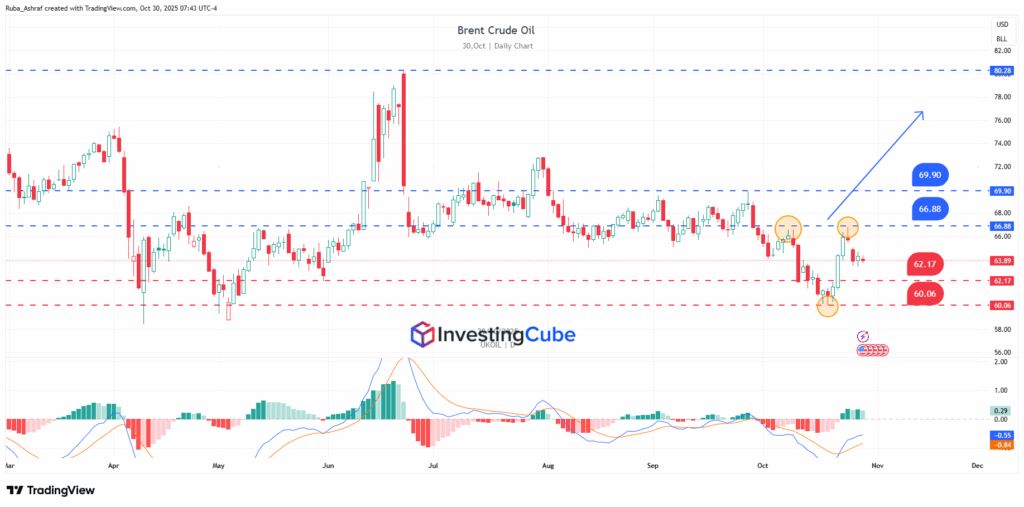
Brent crude oil started the day lower, trading around $63.80 under pressure from recent bearish trends. On the daily chart, the price is consolidating between a key resistance zone at $66.88-69.90 and a support area near $60.06.
The price action forms a potential inverse head and shoulder pattern, marked by the yellow circles. This pattern indicates a possible rebound if the price breaks above the $66.88 resistance level, eyeing the $72.00 level.
The MACD indicator shows early signs of bullish momentum recovery. The MACD line has crossed above the signal line, indicating that selling pressure may be easing, and a potential upward move could follow.
A clear daily close above $66.88 could pave the way toward $69.90 and $72, respectively. On the other hand, a drop below $60.06 could invalidate the bullish momentum and pave the way toward the $58.00 support level.
Brent Crude Oil is an important global standard for oil pricing, mainly sourced from the North Sea. It acts as a reference for two-thirds of the world’s oil trade. Recognized for its light and sweet qualities. Brent is commonly used to set prices for oil exports from Europe, Africa, and the Middle East.
OPEC influences the price of Brent crude oil through its production policies. When OPEC and its allies cut output, the global oil supply tightens, and this often drives the Brent oil price higher. Conversely, increasing production can lower oil prices.