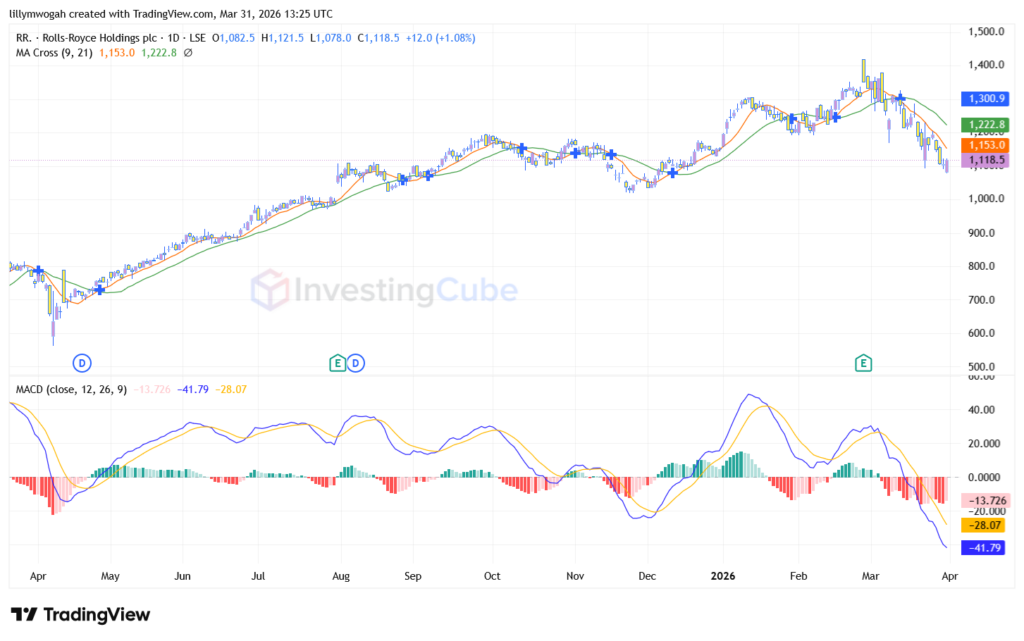
Rolls-Royce Holdings plc (LSE: RR) has navigated a challenging technical correction over the past month, with the stock sliding from its record high of 1,420p recorded in late February. Despite this volatility, the engineering giant’s fundamental trajectory remains upward, driven by surging civil aerospace demand and a massive capital return initiative. This analysis explores whether the current weakness is a “buy-the-dip” opportunity or a sign of deeper structural headwinds.
Why Rolls-Royce shares are retracing
The recent Rolls-Royce share price decline is largely attributed to a “perfect storm” of macroeconomic pressures. Brent crude oil prices surging past $115 per barrel have raised concerns about the aviation sector’s recovery. Since a vast portion of Rolls-Royce’s revenue is derived from “Power-by-the-Hour” service agreements, any reduction in airline flight capacity due to fuel costs directly impacts the company’s bottom line.
Furthermore, after a multi-year rally that saw the shares gain over 900% in five years, the market is witnessing significant profit-taking. The current forward price-to-earnings (P/E) ratio of roughly 33 to 38 suggests the market has already priced in substantial growth, leaving the stock sensitive to any near-term “bad news”.
Is the bull case for Rolls-Royce still intact?
Operational results suggest the turnaround under CEO Tufan Erginbilgic is far from over. For the 2025 fiscal year, Rolls-Royce reported an underlying operating profit of £3.46 billion, surpassing analyst expectations.
- Raised guidance: The company now expects 2026 operating profits to reach £4.2 billion, hitting prior mid-term targets two years earlier than planned.
- Buyback momentum: On March 31, 2026, the company continued its aggressive share reduction, announcing further transactions as part of its £2.5 billion buyback for the current year.
- New growth frontiers: Beyond aviation, Rolls-Royce is expanding its Small Modular Reactor (SMR) business, recently signing collaborations in Sweden to support future nuclear power deployment.
Rolls-Royce share price forecast
Technically, the stock is testing key psychological support levels. The RSI has moved toward oversold territory following the 19% slide from the March highs.
- Immediate support: 1,080p – 1,100p.
- Resistance: 1,200p, followed by the previous high of 1,420p.
- Goldman Sachs reiterated a “Buy” rating on March 25 with a target of 1,400p. The broader market consensus among 15 analysts remains a “Strong Buy” with an average 12-month target of 1,442p.

Why analysts maintain a strong buy rating for Rolls-Royce
As reported by major brokerage desks, the conviction in Rolls-Royce remains high despite the 20% price retreat. Analysts cite several structural factors that suggest the current sell-off is a technical correction rather than a shift in fundamentals:
- Margin resilience: Under CEO Tufan Erginbilgic, the “Power-by-the-Hour” contracts have been renegotiated with higher price floors, ensuring profitability even if global flight hours slightly dip due to fuel costs.
- Deleveraging success: The company’s rapid transition from a debt-laden firm to an investment-grade balance sheet has significantly lowered its risk profile.
- Infrastructure synergy: Rolls-Royce is no longer just an “engine company”; its growing Power Systems division is seeing record demand from AI data centers, providing a vital hedge against aviation volatility.
- Earnings visibility: The upgrade to 2028 operating profit targets (£4.9bn–£5.2bn) suggests a compounded growth rate that justifies a premium valuation compared to its industrial peers.
Conclusion
Rolls-Royce is currently caught in a classic “tug-of-war” between record-breaking internal performance and a “risk-off” global macro environment. While the $115 oil price remains a tactical headwind for airlines, the company’s massive £2.5 billion buyback provides a significant safety net for the share price. For long-term investors, the disconnect between a 20% price drop and a raised £4.2 billion profit forecast presents a compelling case for a relief rally as the new financial year begins.
Rolls-Royce Stock Price Forecast FAQs
The company reinstated its dividend with a total payout of 9.5p per share for 2025. Based on current prices, the prospective dividend yield is approximately 0.86% to 0.9%.
Rolls-Royce plans to return between £7 billion and £9 billion through a multi-year share buyback program and dividends between 2026 and 2028.
The biggest risk is a slowdown in global travel. If high oil prices or geopolitical tensions cause airlines to ground fleets, Rolls-Royce’s maintenance revenue, which is billed per engine flying hour, could decline significantly.