


- Rolls Royce forecasts for the week could be radically shifted by the reopening of the Strait of Hormuz, allowing focus on coy fundamentals.
Live Chart and Current setup
Rolls-Royce is currently in a relief rally following de-escalatory war headlines that have brought down oil prices by as much as 11.19% this Tuesday.
Predating the oil shock was a stock that had just received a very strong results upgrade amid a remarkable post-pandemic turnaround. Recent price tape has been volatile due to the energy shock’s impact on the company’s stock. Rolls-Royce makes aircraft engines, and any impact on the aviation industry immediately affects the company in a run-of-the-mill manner.
The recent price volatility has seen the company’s stock oscillate wildly. The biggest news of the day is the 2-week ceasefire agreed between the US and Iran, with the latter announcing it would open the Strait of Hormuz. The de-escalatory headline has had an immediate impact on Rolls-Royce’s forecast pieces and price action. The stock is up 10.45% as of writing, as investors applaud the reopening of the blockaded Strait and position themselves bullishly.
Despite the relief rally, the stock remains in a corrective trend after an exceptional run in 2025.
Rolls-Royce Forecasts: Key Drivers
1) Earnings/Guidance Upgraded: The core driver of the mostly bullish price moves in the stock is the full-year results, backed by the upgraded guidance. During the earnings call, the company indicated operating profits of £3.5 billion and free cash flow of £ 3.3 billion. It also upgraded guidance to £4.0–£4.2 billion profit and £3.6–£3.8 billion free cash flow for the 2026 fiscal year. Mid-term targets were also upgraded. The response to this core driver has been bullish.
2) Rerating due to Capital Returns: A shareholder return plan of £7 billion to £9 billion was announced by the company, to run from 2026 to 2028. This is in addition to the £2.5 billion in buybacks expected in 2026. Such a capital return of this magnitude has supported bullish sentiment in the stock, leading to a positive rerating that has driven the larger upside.

3) Energy Macro Risk
The recent weakness is not due to company-specific factors. Rather, the US-Iran war and the accompanying oil shock have led to sectoral de-risking, resulting in a steep fall in UK and European equities in March 2026. Before the Hormuz reopening announcement on April 8, the stock fell 3.86% as investors turned defensive. That decline created a dip-buying opportunity that has led to a relief rally. Rolls-Royce remains a player in a sector that is increasingly vulnerable to oil prices, inflation fears, and potential rate repricing.
Rolls-Royce Forecasts: This Week’s Scenarios
Base case: the base case scenario would be a consolidation following the surprise Hormuz announcement reopening. There is still a threat of escalation, which will keep investors nervous and not too committed to any outlandish bullish positioning. Volatility is still expected as the price action remains a battle of company fundamentals (bullish) and the yet-unresolved geopolitical impasse (bearish).
Bull case: an upside renewal has to come from a broader improvement in risk appetite. A further de-escalation in geopolitical tensions will allow investors to re-focus on the company fundamentals (earnings, free cash flow, and buybacks), which are currently bullish. broader risk appetite improves, and investors re-focus on. Furthermore, the promise of greater profitability in the civil aerospace sector heading into the Q2 holiday season could be a bullish trigger in the near term.
Bear case: War remains bad for business. Higher energy costs will force airlines to raise ticket prices, which may push down tourism numbers in the holiday season. Furthermore, energy-driven inflation fears could force a hawkish repricing of interest rate policy across the board, with attendant rises in the cost of credit, margin compression, and tighter financial conditions, all negatives for equities. Rolls-Royce could trade lower despite upbeat company fundamentals.
Rolls Royce Technical Outlook
Rolls-Royce is presently in a relief rally in the midst of the corrective move from the 26 February peak at 1420.0. In the medium term, the stock remains range-bound, with 1021.0 as the price floor and 1420 as the price ceiling. Between these two price extremes, several support and resistance levels exist.
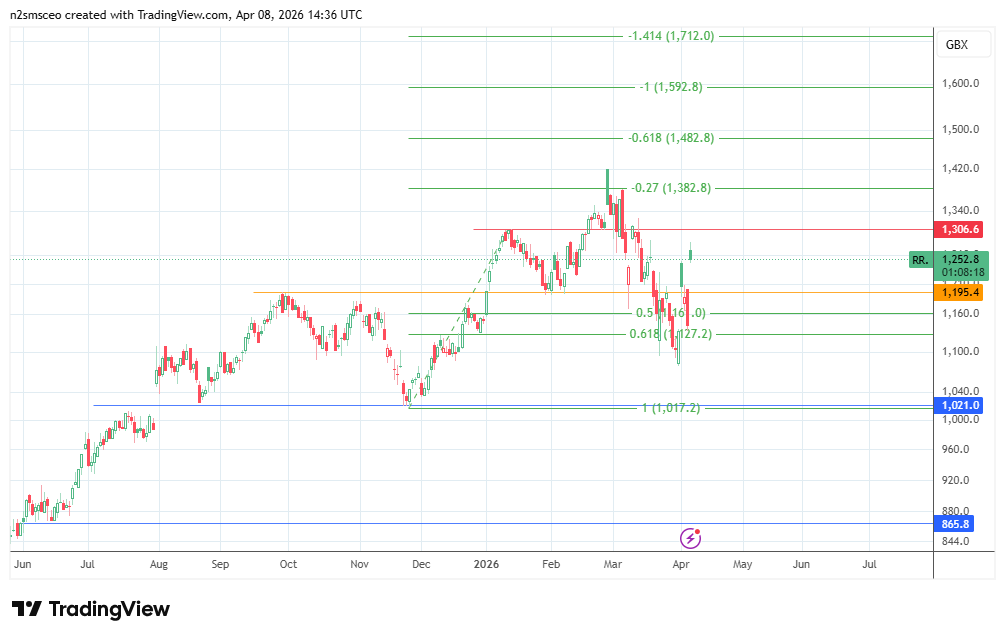
The price is currently approaching the 13 January high at 1306.6. A break above this point will give the bulls a chance to reclaim the 1420 price ceiling. If this ceiling is uncapped, the 1482.8 price mark becomes the next target for the bulls, as it is the 61.8% Fibonacci extension level of the 25 November 2025 – 13 January 2026 upswing.
However, failure to sustain the relief rally could bring the 1195.4 support under renewed pressure, as it is the prior low of 29 January 2026 and the prior top of 29 September 2025, which was uncapped and now serves as a role-reversed support. If this key pivot is degraded, a further dip towards 1127 (61.8% Fibonacci extension) cannot be ruled out.