- PayPal shares plunged over 20% after weak earnings, cautious guidance, and a surprise CEO transition.
- Heavy volume selling suggests a loss of investor confidence rather than a simple valuation reset.
- Competitive pressure and stalled user growth continue to weigh on PayPal's fundamentals.
Overview
PayPal Holdings, Inc (NASDAQ:PYPL) is entering one of the most defining periods in its corporate history. The stock experienced a sharp sell-off of more than 20% in early February 2026, as the company delivered both news of a major leadership shake-up and disappointing earnings accompanied by weak forward-looking guidance. The sell-off pushed PayPal shares to the lowest level since early 2017, erasing roughly half of the company’s market value over the past year.
This article analyses the recent PayPal specific developments, evaluates what is driving the selling pressure, and provides a forward-looking price outlook based on fundamentals sentiment and technical factors.
Key Catalyst Behind the Sell-Off
The most immediate driver of PayPal’s stock decline was a combination of earnings disappointment and an unexpected CEO transition. Fourth-quarter results came in below market expectations on both revenue and adjusted earnings-per-share. More importantly management issued weaker profitably guidance for early Q1 2026, reinforcing concerns that the company’s long anticipated turnaround has yet to materialize.
At the same time, PayPal announced that Enrique Lores will become CEO in March 2026, succeeding Alex Chriss. Leadership changes are not uncommon, but the timing raised eyebrows given current market conditions. A press report later highlighted internal conflicts at PayPal, and in one instance, even misspelled the surname of a member of eBay’s board, which has reportedly been dissatisfied with the pace of execution and strategic progress over the past two years. The announcement was widely interpreted as confirmation that investor concerns over unresolved internal challenges may be deeper and more persistent than previously assumed.
The market reaction was severe. Trading volume surged to several times its three-month average, suggesting broad capitulation rather than a simple valuation reset. Moves of this magnitude typically reflect a loss of confidence rather than routine profit-taking.
Structural Challenges Facing PayPal
Beyond the headline events, PayPal continues to face structural headwinds. Competition in digital payments has intensified, with Apple Pay, Google Pay, and other fintech platforms steadily eroding PayPal’s dominance in branded checkout services. While the company has invested heavily in AI, stablecoin initiatives, and new product offerings, these efforts have yet to translate into consistent revenue acceleration.
User engagement metrics have also stagnated. Growth in active accounts has slowed, while monetization per user remains under pressure. In an environment increasingly focused on efficiency, operating leverage, and execution discipline. PayPal has struggled to deliver the consistency required to sustain long-term investor confidence.
Short-Term Price Analysis: Oversold but Weak Rally Appetite
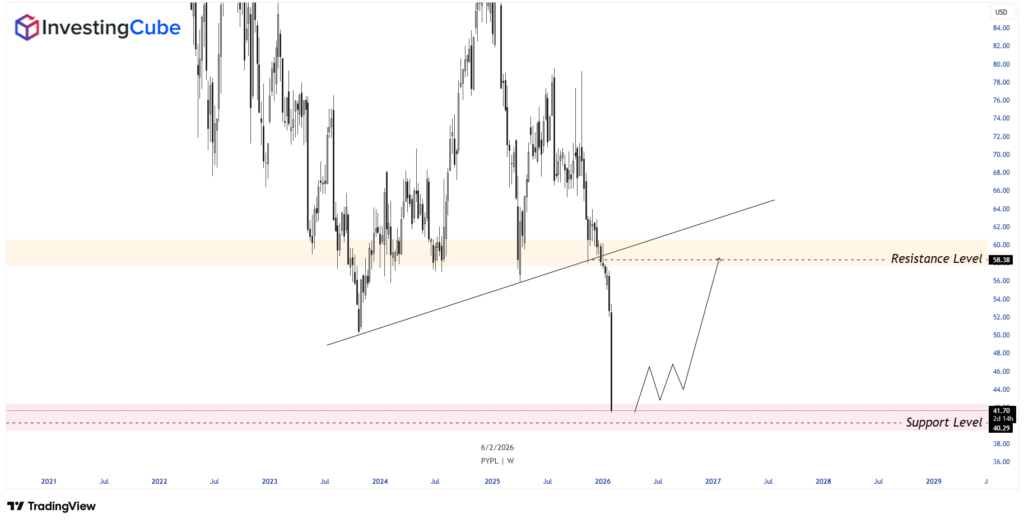
From a technical standpoint, PayPal is deeply oversold in a short-term, following the sharp sell-off. Historically, steep declines accompanied by unusual high volume often lead to periods of consolidation or short-lived relief rallies, as selling pressure temporarily exhausts itself and short sellers take profits.
A technical rebound toward former minor support levels — now acting as resistance — cannot be ruled out over the coming days or weeks. Bargain-hunting and tactical positioning could generate short-term upside, assuming broader market sentiment stabilizes.

However, any rebound is likely to be corrective rather than a start of a new trend. Without fresh positive catalysts — such as a clearly articulated strategic shift from incoming leadership or materially improved forward guidance — upside momentum is likely to fade.
Medium-Term Outlook: Waiting for Proof of Execution
The medium-term direction of PayPal’s share price will depend less on macro factor, and more on whether the new leadership team can restore credibility. Investors will closely scrutinize early communications from the incoming CEO, particularly around cost discipline, capital allocation, and product prioritization.
If PayPal can demonstrate improved execution, stabilize margins, and accelerate growth within its core payments ecosystem, current valuations may ultimately prove too pessimistic. At present, the stock is trading at a deep discount to historical multiples, which could appeal to long-term value investors if operational performance improves.
Conversely, a continued lack of tangible progress over the next several quarters may result in prolonged range-bound trading or renewed downside pressure, as institutional patience wears thin.
Key Risks to the Outlook
Several risks continue to cloud Paypal’s price outlook. These include intensifying competition, macroeconomic uncertainty that could dampen consumer spending, and execution risk related to leadership transition. In addition, broader risk aversion toward technology and fintech stocks may continue to weigh on valuation multiples, regardless of company-specific improvements.
Conclusion
PayPal’s recent plunge reflects a significant erosion of market confidence driven by weak earnings, cautious guidance, and leadership uncertainty. While the stock may experience short-term bounces after falling deeply into oversold territory, a sustained recovery will require clear evidence that new management can resolve execution challenges and reignite growth. Until such proof emerges, PayPal’s price prediction remains cautiously neutral to bearish, with elevated volatility likely to persist.
Frequently Asked Questions
PayPal stock tumbled after the company reported earnings that fell short of expectations, issued weak profit guidance for 2026 and announced a surprise CEO transition. The twining served to heighten fears of execution issues and slowing growth, causing investors confidence in the company to collapse.
Valuation ratios indicate PayPal is significantly undervalued compared to its historical average. Yet the discount represents execution risk and uncertainty about growth going forward. The stock might look cheap, but a sustained rebound is likely to be determined until we see signs of operational improvement under new management.
For a sustainable rally, investors would probably need to see clearer strategic vision from the new chief executive, better margins and signs of revived growth in a payment firm’s core business. Without those catalyst, the upside is probably more technical or temporary than a complete turnaround.