

- Oracle stock is down by 11% year-to-date and has been on a downtrend since October 2025
- Investors are concerned that its cloud business margins are comparatively slim relative to peers like Microsoft's Azure and Amazon's AWS
- The Bring Your Own Chip (BYOC) model could help alleviate the high capex pressure that has driven Oracle into over $100 billion in debt
Oracle (NASDAQ: ORCL) was an AI rally star in 2025, but now it’s facing tough times. After hitting almost $345 in September 2025, the stock has fallen fast and is down 11% this year and 48% from its all-time high. For a company that almost entered the $1 Trillion Club, investors worry that its AI plans might turn into a debt problem. Let’s examine what’s causing the drop, what chances it has to recover, and the main risks it faces.
Slim Cloud Margin and Debt Erode Confidence
The main issue isn’t a lack of demand but the high cost of keeping up with it. Reports show Oracle’s cloud infrastructure gross margins are about 14%. Compared to Amazon Web Services (AWS) and Microsoft Azure, which have 30% to 40% margins, investors wonder if Oracle is overpaying for growth.
Also, investors are concerned about Oracle’s rising debt. The company now owes over $100 billion, which it borrowed to pay for AI infrastructure, leading to cash flow problems. It’s also dealing with a bondholder lawsuit that claims it didn’t reveal risks when it raised $18 billion in debt.
Missed earnings expectations in Q2 FY2026 exacerbated the slide. Oracle’s latest quarterly revenue was a bit below what analysts expected, and it increased capex projections to $50 billion, causing worries about an AI bubble. Data center delays for OpenAI due to shortages impacted confidence too.
Prospects for a Reversal
A turnaround is possible if Oracle makes the most of its AI opportunities. Analysts are still optimistic. Wedbush predicts $250 by the end of the year, mentioning cloud growth. UBS has a buy rating, expecting recovery through data center improvements and better OpenAI sentiment in H1 2026.
The good news is Oracle’s Multicloud plan. By adding its database services to AWS, Azure, and Google Cloud, Oracle is becoming a cloud-neutral option that businesses will find difficult to avoid. Also, the Bring Your Own Chip (BYOC) model could change things. If customers supply their own GPUs, Oracle’s cash needs could drop, which could raise gross margins
Potential Risks
One risk for Oracle is its focus on OpenAI. Analysts at Wells Fargo estimate that OpenAI could bring in up to 30% of Oracle’s earnings in the next few years. Having the world’s most popular AI startup as a main customer is a great thing, but it also creates risk. If OpenAI has financial problems or changes its infrastructure plans, Oracle’s $523 billion backlog could be at risk.
Oracle Stock Forecast
Oracle stock is trading below its 10, 20, 50 and 100-day SMA and has recently broken its 200-day SMA ($218.11), which usually means a change from a correction to a long-term bearish trend. Immediate support is now in the $160–$170 range.
If it can’t hold this level, the stock could fall toward the major support at $150. The RSI at 32 shows that the stock is getting close to being oversold. On the upside, the first resistance is likely to be at the 10-day SMA at $191.63. A break past that level could see it return to the psychological $200 mark and could mean a bullish reversal.
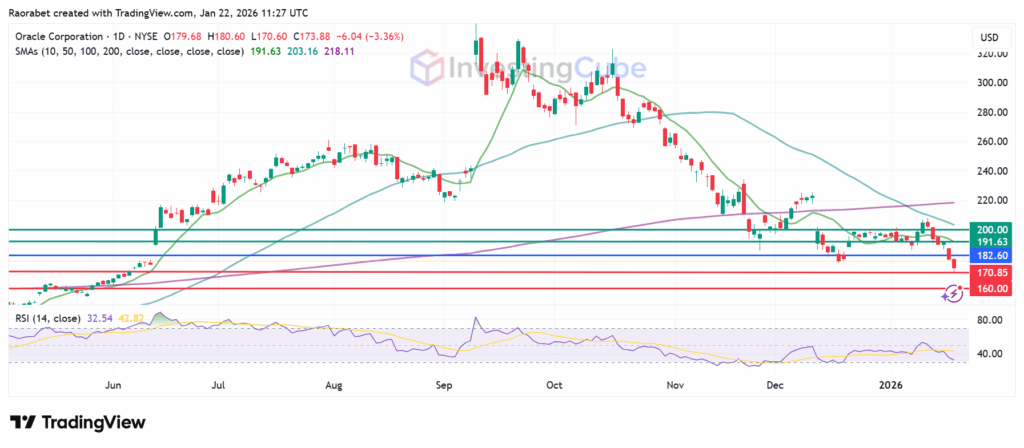
Oracle stock on the daily chart on January 22, 2026, with key support and resistance levels. Created on TradingView
The drop is due to concerns about low cloud margins (14% vs. 30%+ for competitors), large debt to fund AI, and a bondholder lawsuit about the company’s financial transparency.
Risks include high debt, downgrades, customer dependence on OpenAI, and delays amid AI bubble fears.
BYOC lets customers provide their own GPUs for Oracle to host. This lowers Oracle’s capital costs and could greatly improve its gross margins.