


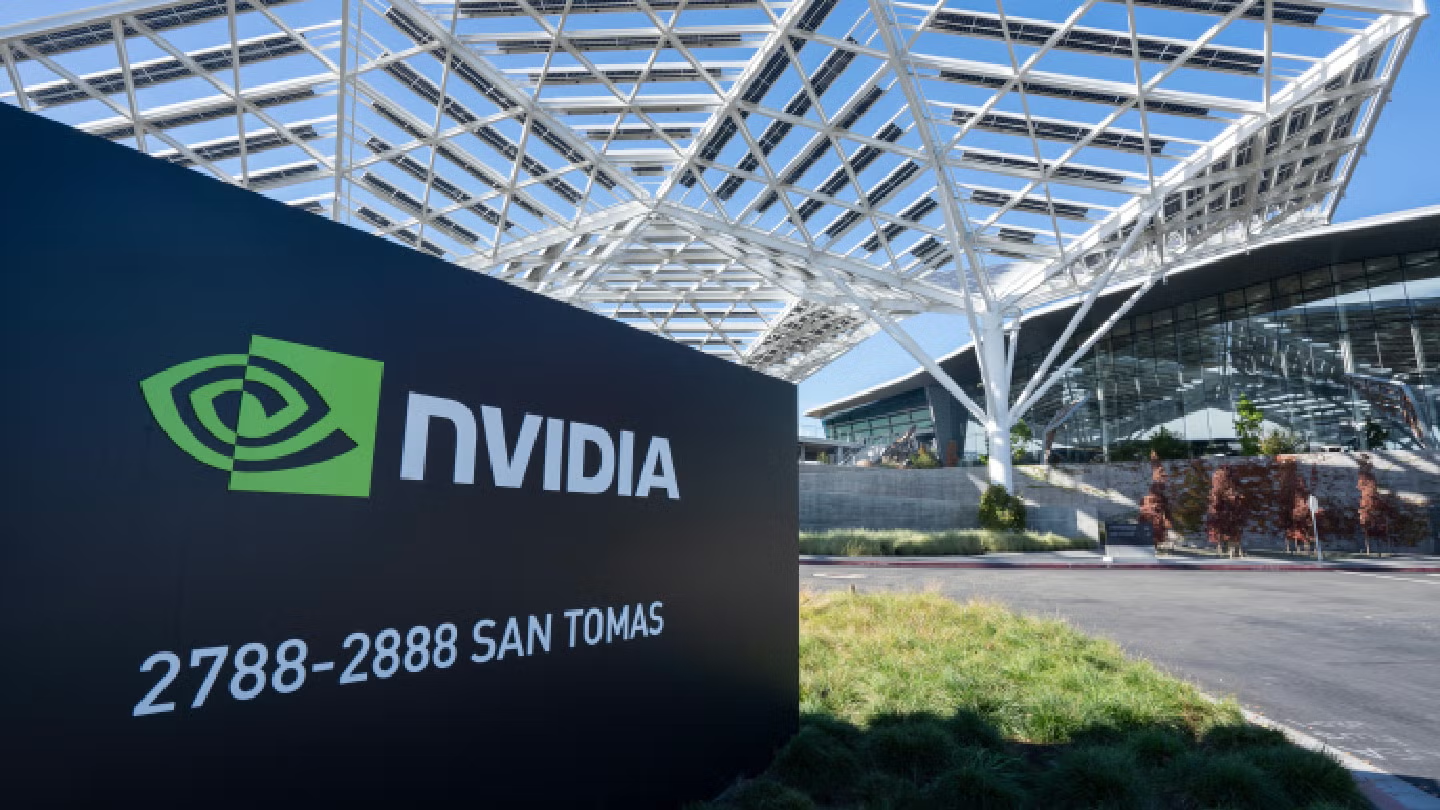
- Nvidia takes a $2 billion strategic stake in Marvell Technology Inc. to integrate custom AI silicon with its proprietary networking platform.
- The partnership focuses on silicon photonics and optical interconnects to solve critical data bottleneck and energy efficiency issues.
- Investors reacted bullishly, with Marvell shares surging 9% and Nvidia gaining 1.5% in premarket trading following the announcement.
Nvidia Corp. is doubling down on its “moat” strategy, announcing a massive $2 billion investment in Marvell Technology Inc. on Tuesday as reported by Bloomberg. This strategic move aims to merge Marvell’s custom application-specific integrated circuit (ASIC) expertise with Nvidia’s dominant networking and CPU ecosystem.
As Big Tech players like Alphabet and Meta forecast an infrastructure spend exceeding $630 billion this year, Nvidia’s tie-up with Marvell ensures it remains the central nervous system of global AI compute, even as competitors pivot toward custom silicon.
Nvidia and Marvell target faster, energy-efficient AI data centers
Beyond the capital injection, the two firms have agreed to a deep technical collaboration on silicon photonics. Traditional copper wiring is increasingly becoming a bottleneck for the massive data loads required by modern LLMs. By using light to move data, Nvidia and Marvell aim to create high-speed, energy-efficient interconnects that drastically lower the power consumption of sprawling data centers.
Together with Marvell, we are enabling customers to leverage Nvidia’s AI infrastructure ecosystem and scale to build specialized AI compute,”
said Jensen Huang, CEO of Nvidia.
Marvell’s custom chips will now be natively compatible with Nvidia’s NVLink Fusion, while Nvidia provides the supporting CPUs and network interface cards (NICs).
Oversubscribed debt deal signals strong demand for data centers
The news follows a record-breaking debt deal led by JPMorgan Chase & Co., which saw $14 billion in orders for a $3.8 billion junk bond sale. The funds are earmarked for Tract Capital to construct a 30,000-acre data center backed by Nvidia hardware. The massive oversubscription of this “Nvidia-tied” debt illustrates that investor confidence in the AI build-out remains unshaken, despite broader market volatility and rising interest rates.
Nvidia technical outlook
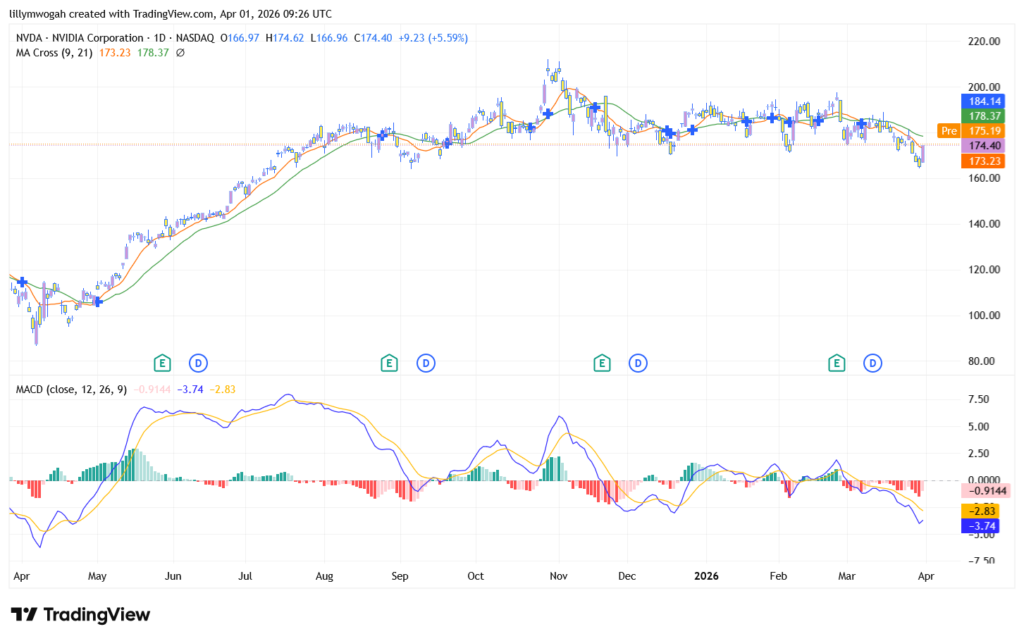
Nvidia is currently trading at $174.40, representing a daily gain of 5.59% as it rebounds from recent consolidation levels.

Based on the technical chart analysis, here are the critical levels to monitor:
- Immediate resistance: The stock is currently facing overhead pressure at $184.14, which aligns with its recent local peak and the 21-day Moving Average at $178.37.
- Key support levels:
- $173.23: This level represents the 9-day Moving Average and serves as the primary tactical floor.
- $166.96: This is the recent intraday low and acts as a secondary psychological support level if volatility persists.
Conclusion: A strategic lockdow n of the supply chain
Nvidia’s $2 billion bet on Marvell is more than a simple investment; it is a calculated effort to neutralize the threat of “custom silicon” from rival cloud providers. By bringing the world’s leading custom chip designers into its own ecosystem, Nvidia ensures that even when companies choose specialized processors, they must still use Nvidia’s networking and platform standards.
For investors, the massive demand for Nvidia-linked debt and the aggressive expansion into silicon photonics reinforce the narrative that the AI infrastructure cycle is still in its high-growth phase.
It signals that Nvidia is moving to dominate the “custom AI chip” space by integrating third-party specialized silicon into its own networking platform, preventing competitors from bypassing Nvidia’s ecosystem.
Silicon photonics uses light instead of electricity to transmit data. It is crucial for AI because it allows for much faster data transfer speeds with significantly lower heat and power consumption, which is the primary challenge for modern data centers.
Investors are viewing any debt backed by Nvidia-related infrastructure as high-quality, despite the “junk” rating. This reflects the “Nvidia halo effect,” where the market’s trust in the AI growth story outweighs traditional risk assessments.