



- Palantir stock is down despite recently reporting forecast-beating Q4 2025 earnings
- Meta and Google also reported strong earnings, affirming stable fundamentals in the AI industry for now
- The recent dip by Palantir could be a good buying opportunity but its high valuation calls for caution
The sea of red next to Palantir Technologies (NASDAQ: PLTR) may seem a little startling to those who have been following it recently. Palantir stock surged over 130% in 2025, which could only be called a victory lap. However, the first few weeks of 2026 have been a downer. As of early February, the “AI darling” was down about 23% year to date, and many are wondering if it has finally reached a breaking point.
Recent Performance and the Impact of Earnings
In January, Palantir shares fell 18% because some investors worried its price was too high compared to its earnings. They weren’t sure if the company could keep growing without faster income. However, the Q4 2025 earnings report on February 3 gave the stock a boost. Revenue went up 70% to $1.41 billion, and adjusted earnings per share (EPS) of $0.25 beat expectations.
Even though Palantir stock jumped 11% before the market opened on earnings call day, it ended the day down 11.6%. This suggests investors took their profits and weren’t sure if the company could maintain its projected 61% revenue growth for 2026. Instead of buying the dip, this could point to bigger concerns, like competition from free AI tools. To stay informed, keep an eye on the Economic Calendar for other tech earnings that could shift the market.
Alphabet and Meta as the North Star for Palantir
To get a sense of Palantir, let’s look at Alphabet (NASDAQ:GOOGL) and Meta (NASDAQ:META). Their Q4 2025 earnings were much better than expected. Alphabet’s Google Cloud revenue increased by over 30%. Meanwhile, Meta plans to spend over $115 billion in 2026, showing that the AI infrastructure phase is ending, and the implementation phase is beginning.
When these AI giants invest heavily in hardware, it helps Palantir’s Artificial Intelligence Platform (AIP). If Big Tech sees strong demand for AI processing power, Palantir is likely to benefit as companies try to use that power effectively.
Why Palantir Stock’s Dip is Different
Many say Palantir is too expensive because of its high P/E ratio. But those critics are focused on the past. Palantir’s February 2026 guidance projects 61% revenue growth for the year. Morgan Stanley analysts consider this projection conservative.
One could argue this dip offers a buy window for Palantir stock, but deeper correction looms if growth decelerates. For investors, position sizing should be conservative. Consider limiting it to 2-3% of portfolio to mitigate volatility. A prudent stop-loss would be placed just below the $135 mark. A break below this could signal a slide toward the $120 psychological support level.

While the broader Economic Calendar shows upcoming interest rate decisions that could shake high-growth tech, Palantir’s U.S. Commercial revenue grew by a mind-blowing 137% in the last quarter of 2025. This isn’t just hype; it’s a fundamental acceleration. Most “overvalued” stocks see growth slow down, but Palantir is seeing it speed up.
Palantir Stock Forecast
From a technical standpoint, PLTR stock is currently at a critical crossroads. The MACD is still negative, but the histogram is getting shorter, which could mean the selling is slowing down.
The stock is testing a key support area between $135.68 and $130. It will need to go above the $141 pivot to signal a bullish takeover. The first resistance level is at $148, which is the neckline to its most recent triple-top pattern. A break past that will invalidate the downside narrative, with the next barrier likely to be at the 10-day SMA level at $156.97.
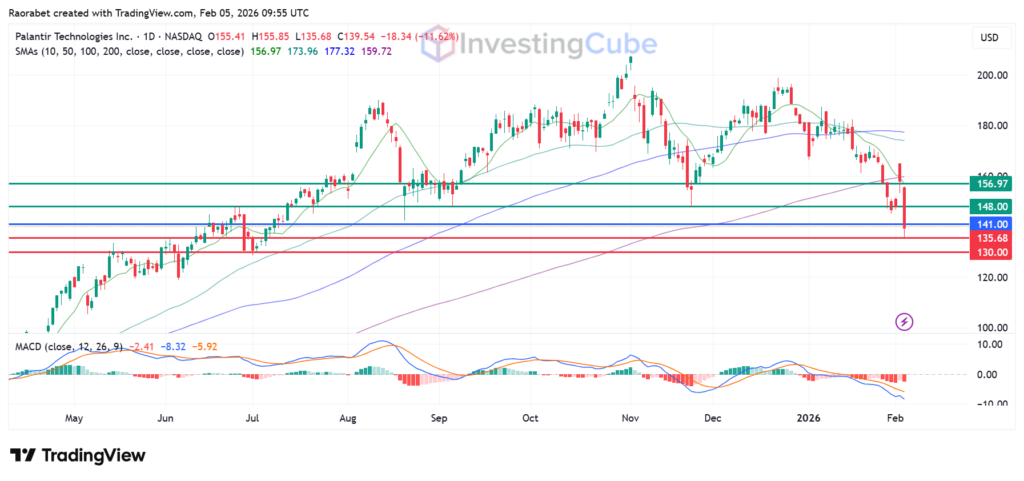
Palantir stock on the daily time frame with key support and resistance levels for February 5, 2026. Created on TradingView
Not necessarily. After the big gains of 2025, a correction is normal. The business is doing better, with Q4 revenue growth at 70%. This suggests the drop is a price adjustment, not a sign of business problems.
They prove that enterprise demand for AI is robust and that companies are willing to spend. As Big Tech builds the cloud infrastructure, Palantir provides the software layer that allows businesses to actually generate ROI from that spend.
Cautiously yes for rebound potential, but limit position to 2-3% and set stop-loss at $120 to guard against extended correction.