- BP reported a drop in its earnings, with profit dropping from $9 billion to $7.5 billion, primarily due to a decline in oil prices
- The decision to halt its share buyback program could put BP stock under pressure for a long period
- The year 2026 is a transition time, with the pullback from $4.8 billion renewables projects likely to pay off in the long-term
BP stock has been quite the topic this week. It started with a solid 10% gain for the year, then took a sharp 6% dive on Tuesday, February 10. Luckily, it seems to be recovering a bit today. Shares are up slightly, around 2.3% as of this writing, as investors seem to be digesting the recent earnings report. This makes you think about how company news can cause these ups and downs, with people reacting first and then rethinking things later.
What Triggered BP Stock’s Tuesday Turbulence?
The recent headwinds seem to come from BP’s earnings report for 2025, released on February 10. It showed profits of $7.5 billion, which is less than the $9 billion they made in 2024. This is mostly because global oil prices have been dropping.
But it wasn’t just the lower earnings that caused the sell-off. BP also changed its plans for how it will treat shareholders. The company has stopped its share buyback program. The market has become used to these buybacks as a way to keep share prices up, so this news was disappointing. CFO Kate Thomson explained that this is part of a plan to reduce debt. Right now, BP is the only major oil company among the Big Five to completely stop buybacks.
The company also took a $4.8 billion charge related to pulling back from some renewable energy projects that weren’t performing well, like offshore wind and biogas. This decision, while cautious, was not what investors wanted to hear, especially with net debt around $26 billion. The small rebound today seems to match a broader recovery in the energy sector as oil prices rise.
Is the Outlook for BP and Oil Prices Different in 2026?
For BP, 2026 could be a year of transition with a chance for a comeback if these strategic changes work out. Oil prices are expected to level out around $60-70 per barrel because of oversupply. While many analysts are concerned about the buyback halt, it could be seen as a way for BP to reset. BP’s stock is trading at a lower value compared to its competitors.
If oil prices hold steady, BP’s focus on more efficient operations could lead to better results. But a global slowdown could limit gains, unlike the commodity rebound in 2025. The EIA’s February 2026 Short-Term Energy Outlook suggests a more complex situation. They predict Brent crude will average around $58 per barrel this year, which is lower than the $60s in 2025.

However, they have increased their short-term forecasts because of unexpected supply problems in Kazakhstan and the US. OPEC+ is also being more cautious. Recent statements from the OPEC Secretariat confirm that eight key members have stopped production increases through March 2026 to address seasonal weakness.
BP Stock Price Forecast
BP is currently pivoting at the 20-day EMA at 447.90p level and will likely head up going by the RSI reading near 53. The next barrier will likely be at 464.20p, beyond which it could test psychological 470.00p. Immediate support is at 441.05p, the lowest point from Tuesday. below that level, the upside narrative will be invalid and BP stock could go lower to attempt breaking below 434.50p.
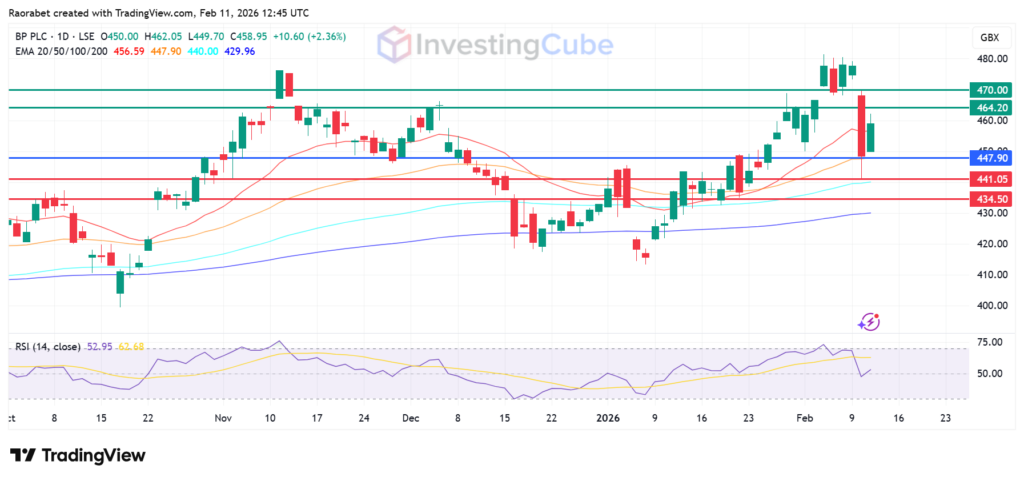
BP stock on the daily time frame on February 11, 2026 with key levels of support and resistance. Created on TradingView
The pressure on BP stock price is from earnings revealing $7.5B profits down from $9B, buyback halt for balance sheet repair, oil price weakness; challenges consensus temporary dip, noting structural margin issues extending volatility.
BP is prioritizing debt reduction and a strategic pivot back to oil and gas. By stopping buybacks, they hope to reach their net debt target of $14-$18 billion faster given the lower oil price environment.
The main risks are a worse-than-expected global economic slowdown and potential political issues related to returning to oil. Also, if debt levels don’t decrease as expected, the company’s credit rating could be affected.