

- The US will start imposing 10% trade tariffs on top European economies, potentially rising to 25%
- European nations targeted by the tariff threats are weighing counter-tariffs, and that could implode into a broader trans-Atlantic trade war
- Most analysts view the threats as more of a negotiation strategy, implying that markets could soon rebound strongly
The S&P 500 took a hit on January 20, 2026, dropping over 2% to close at 6,796.86. The slide is tied to President Trump’s tariff talk regarding Greenland, which has spooked the markets. We discuss what this move means and whether this dip is a short-term blip or the start of something bigger.
How Is This Likely to Play Out?
Trump announced 10% tariffs starting February 1 on imports from Denmark, Norway, Sweden, France, Germany, the UK, and the Netherlands. If no deal is made for the U.S. to buy Greenland, these tariffs could jump to 25% by June.
This has triggered worries of a trade war with Europe, with the EU prepping about €93 billion in counter-tariffs. Analysts say that talks are likely to will be long, like past trade tariff disagreements that were later fixed through negotiations.
In the near term, escalation appears plausible if no concessions are made, potentially disrupting supply chains and inflating costs. However, Bloomberg notes that such threats may serve as negotiating tactics, with historical precedents indicating de-escalation once talks commence.
Is a Reversal on the Horizon?
The big question is whether this is a dip to buy or the start of a deeper correction. Analysts like Dan Ives of Wedbush remain optimistic, suggesting the “bark will be worse than the bite” as diplomacy takes over. Historically, as noted by Wells Fargo’s Paul Christopher, these tariff threats often serve as opening bids in larger negotiations.
Tech stocks, which led the market early in 2026, and form a substantial portion of the S&P 500, were hit the hardest on Tuesday. Nvidia (-4.38%), Apple (-3.46%) and Google (-2.42%), all dropped as investors got nervous about supply chain disruptions. Treasury Secretary Scott Bessent told CNBC the market was overreacting, but the IMF warned a back-and-forth tariff war could hurt global growth, potentially dropping it from 3.3% for 2026. Still, risks are there.
The Wall Street Journal mentions bond market issues from Japanese yields making the selloff worse. If tariffs aren’t stopped, bigger drops could happen. On the bright side, Saxo Bank’s analysis shows investors are moving to safe assets like gold, which suggest any risk aversion will be temporary. The market could get back on track when the news fades.
S&P 500 Forecast Today
The S&P 500 pivots at the 100-day EMA at 6,838 and just tested a major support zone at 6,789, which aligns with recent year-to-date lows. A breach below this level could expose the 6,760 mark. On the upside, resistance is now firmly capped at the 6,858–6,872 range, with the psychological 7,000 level acting as a heavy ceiling.
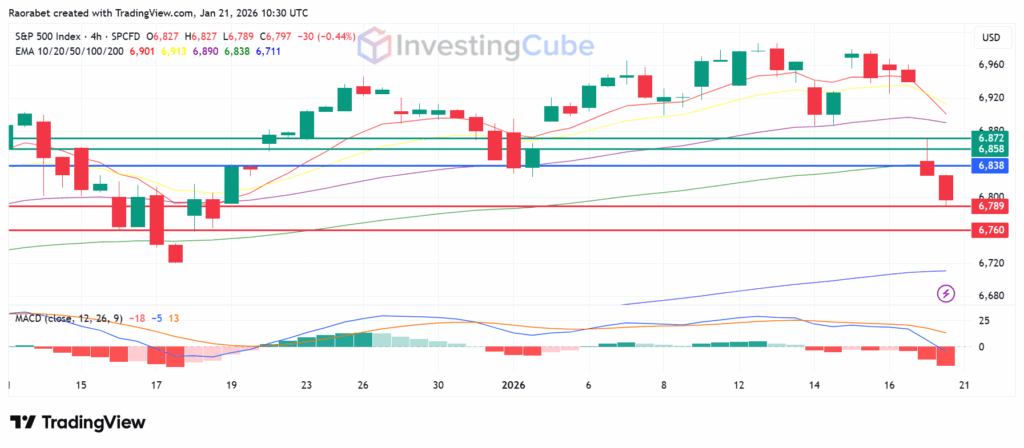
S&P 500 Index 4-hour chart with key support and resistance levels for January 21,2026. Created on TradingView
The S&P 500 index dropped after President Trump’s tariff threats on European countries regarding Greenland triggered trade war fears and a widespread selloff.
Many analysts believe this is a short-term blip because of all the political noise. They think strong earnings and the AI boom could help the market recover once tensions ease in 2026.
Extended trade disputes could limit gains amid high valuation, but lower interest rates could help. Geopolitical uncertainty remains important.