



- The EU and India signed a mega trade deal that drastically cuts tariffs on 99.5% of goods imported from India
- The Sensex Index has been under pressure, with Foreign Institutional Investors selling $874 million worth of shares in the first three weeks of January
- US-India trade negotiations are still ongoing and the outcome will have a strong bearing on the Sensex Index
The BSE Sensex has been under pressure since the start of 2026, falling to lows not seen since October 2025. This performance contrasts with the resilience seen in previous years, prompting one to assess the underlying factors contributing to this weakness.
What is Weighting Down the Sensex Index?
The primary thing dragging on the Sensex is a relentless wave of selling by Foreign Institutional Investors (FIIs). Data shows they’ve sold billions of rupees worth of Indian stocks this month alone. By the third week of January 2026, they had net-sold over ₹8,000 crore (about $874 million). This seems to be driven by worries about aggressive trade moves from the US.
Back home in India, things aren’t much better. Many companies had weak earnings for the December quarter, especially in the IT and banking areas, which only grew by single digits. Panic selling on January 21 also wiped out gains without any big news causing it. So, the market is dealing with both problems from outside and ups and downs inside India.
Is a Near-Term Rebound Possible?
Despite the gloom, signs of recovery have emerged, suggesting a potential short-term rebound. The Sensex Index jumped by 0.39% yesterday and is up by 0.55% on the daily chart as of this writing, on the back of a mega EU-India trade deal. The deal has resulted in a drastic removal of trade barriers between the two blocks, which currently trade about €180 billion worth of goods and services annually. For instance, the EU will cut tariffs on 99.5% of all goods imported from India over a seven-year period.
Some experts also think the upcoming Union Budget could help. In the past, the Indian market has often dropped before the budget, but then risen if the government focuses on spending on projects and being careful with money.
Key Risks to Watch
The road back to the top isn’t without its potholes. US trade policies remains the biggest wild card. Deloitte’s January economic outlook identifies US tariff policies and the India-US trade deal conclusion as major threats, potentially disrupting growth. Any escalation in trade friction between India and the U.S. could hit export-oriented sectors like IT and Pharma.

Geopolitical escalations and domestic economic slowdowns further compound vulnerabilities, underscoring the need for caution in a volatile environment.
Sensex Index Forecast
The Sensex Index pivots at 81,887 points and the upside will prevail if the action stays above that level. Immediate support zone for the Index lies at 81,530. If this fails to hold, a deeper correction toward the 81,088 year-to-date lows is possible. On the flip side, the index faces stiff resistance at 85,800, followed by a major hurdle at 82,800.
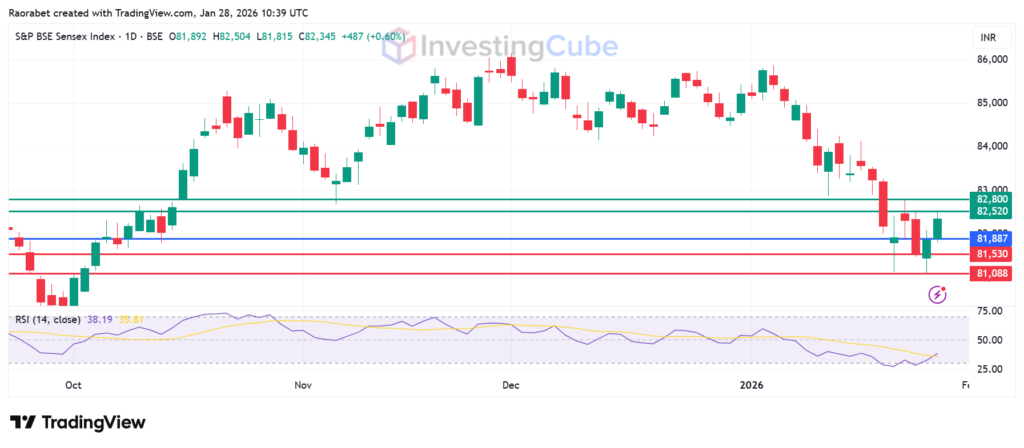
Sensex Index on the daily chart on January 28, 2026 with key resistance and support levels. Created on TradingView
The decline is mainly because foreign investors are selling stocks and there are worries about U.S. tariffs on Indian exports along with bad earnings.
By the third week of January 2026, Foreign Institutional Investors (FIIs) had net-sold shares worth over ₹8,000 crore, equivalent to approximately $874 million. This persistent selling has neutralized much of the buying support provided by domestic mutual funds and retail investors.
US tariff escalations, India-US trade deal uncertainties, ongoing FPI sell-offs, geopolitical tensions, and potential market crashes pose significant threats.