

- The FTSE 250 and FTSE All-Share have dipped into negative territory. Read our analysis to understand the implications and what to watch!
UK and European stock markets are declining due to Trump’s tariff threats. The FTSE 250 is trading in the red, down 253.52 points or 1.13%. The FTSE All-Share is also declining, along with the FTSE 100, which is down by 133.30 points or 1.30%.
The European stock market dipped as investors bet that European companies could suffer if exports to the US were curbed as a result. The French CAC 40 DIPS BY 105.66 or 1.30%, Germany’s DAX declines by 362.19 points or 1.45%, and Spain’s IBEX ends yesterday’s trading session down by 0.26%. This decline is driven by Trump’s latest tariff threats. Trump’s tariff targets eight European countries that are not supporting his plan to take over Greenland.
FTSE 250 | How Does It Perform against Its Peers?
The UK benchmark FTSE 250 is on track for the worst day since 18 of january. It’s losing more than 1% to a session low. This performance put it as the worst-performing country index in Europe this morning.
Looking at the FTSE 100, which is largerly international index because the majority of its constituents source their revenue from abroad. You may notice that a weaker US Dollar means the profits of FTSE 100 constituents are reduced when converted into their home currency.
This is why, in the past, when the local currency was weaker, like after the Brexit vote, the FTSE 100 still went up. This may help explain why the UK benchmark is underperforming today. Mutinational giants such as health care company AstraZeneca, banking group HSBC, and defence contractor BAE Systems are among the biggest contributors to the index’s decline.
Within the FTSE 250, one notable constituent, Foresight Group, has continued to buy back its shares. Foresight Group has continued its share buyback program, repurchasing over 19,000 shares. Such purchases bring the total to nearly 3 million. The move highlights the company’s ongoing efforts to manage capital and support shareholder value.
UK Stock Market Under Pressure from Geopolitical Tensions:
Bank of England Governor comments on the impact of Trump’s Greenland tensions.
The central bank has to be very alert
- He also highlighted that the bank sees that the financial markets as being “more muted” in response to Trump’s plans to impose tariffs on certain countries.
- Earlier this week the US president Donald Trump said: the UK and other countries would face 10% tariffs on all products. He highlighted that it will be srating from February, until a deal reached for Washington to purchase Greenland.
Financial markets have been weaker so far this week. This is because investors and traders are digesting Trump’s tariff threats. These threats could cause further trade disruption.
Technical Outlook for the FTSE 250 Index:
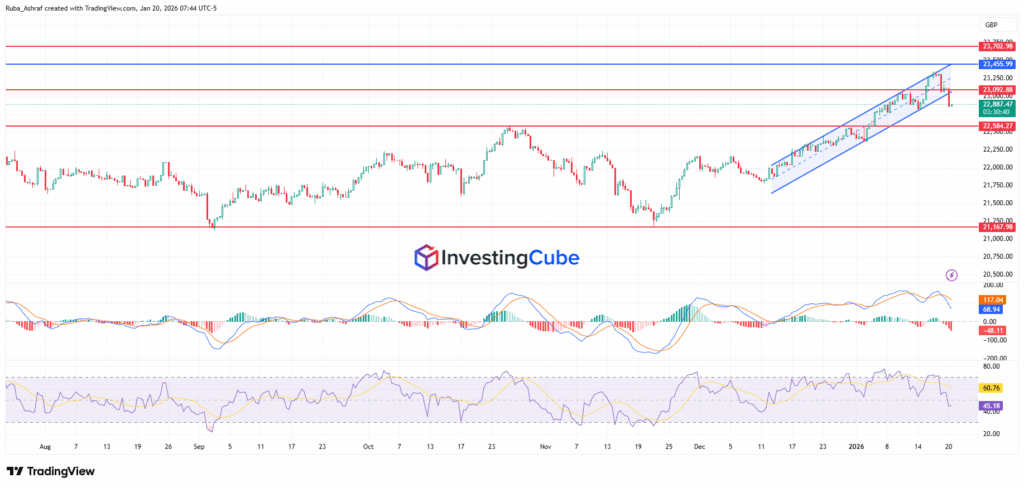
The price action shows that the index was trading in clearly defined upward channel. After a steady rally from mid-December 2025 through early January 2026, the index break below the lower boundary of the channel. This signals a potential short-term weakness.
Key support level highlighted around 22,584 and 21,168, while the resistance levels sit near 23093, 23456, and the all-time high at 23703. The recent pullback from the channel suggests traders may be taking profits after the extended upward move.
The MACD indicated that momentum had shifted in favor of sellers and that the recent upward trend may be slowing. The RSI is currently around 45, suggesting that the market has moved from bullish toward neutral or slightly oversold condition. This indicates potential for furthur consolidation or a bullback to the next support level.
The FTSE 250 tracks 250 mid-sized UK companies, while the FTSE 100 tracks the 100 largest.
Global tensions and tariffs can create market volatility, impacting FTSE 250 stocks, especially exporters and mid-cap companies.