

- Many analysts still view the London market as undervalued relative to Wall Street
- That the FTSE 100 Index rose to 10,000 points despite marginal UK economic growth points to its underlying significant upside potential
- AI market crash, geopolitical risks, and BoE interest rate surprises pose the greatest threat to the FTSE 100's upside
It is a historic start to 2026 for the London Stock Exchange. After a banner year in 2025 that saw the FTSE 100 surge by more than 21%, the index has officially conquered a historic milestone: the 10,000-point mark. As we observe the FTSE 100 Index achieving a five-session winning streak and surpassing the 10,000-point milestone for the first time, it prompts us to consider the underlying dynamics.
Why Is the FTSE 100 Rallying?
LSEG data suggests the rise has less to do with the UK economy suddenly booming, and more to do with the index’s mix of sectors. Because of international tensions and lasting inflation, the FTSE’s big players, including miners, defense firms, and banks, have become popular safe investments worldwide.
Rolls-Royce and Fresnillo, a precious metals miner, have been key. Fresnillo’s value shot up in 2025 as silver and gold hit record prices, and that’s kept going into January. Plus, strong holiday sales helped, with companies like Next reporting strong Christmas numbers. This boosted the index, even with weaker PMI data.
Will the 10,000 Floor Hold?
Keeping the index above this level will be a challenge in 2026. There’s a lot of optimism, but expect some ups and downs. Hargreaves Lansdown analysts say that to keep the 10,000 level as a support, company earnings need to keep growing at the projected 5% rate this year.
A weaker British Pound helps since it increases the reported profits of many global firms in the index that earn in Dollars. Projections look positive, with AJ Bell expecting a rise to 10,750 by the end of the year.
JPMorgan predicts up to 10% growth, backed by strong earnings. Meanwhile, even with the fast rise, the valuation gap between London and Wall Street is still attracting investors. UBS says the FTSE 100 is cheaper than the S&P 500, so 10,000 seems like a fair value.
Potential Risks
However, risks cannot be overlooked. High prices could lead to corrections if AI trading causes a market crash. Fidelity International warns that a tech-led correction in the US could cause a global selloff, impacting London. Tensions around the world or unexpected interest rate changes from the Bank of England also create uncertainty.
The recent US military intervention in Venezuela has not impacted the energy sector adversely for now. However, the situation remains delicate and any sudden spike in oil prices could reignite the inflation that central banks have worked so hard to tame. Overall, while the rally feels solid, vigilance toward these factors is advisable.
FTSE 100 Forecast
The FTSE 100’s Relative Strength Index (RSI) is at 75, signaling strong bullish hold amid overbought conditions. If the rise continues, the next upside targets are around 10,150 and 10,200. Immediate the pivot is at the psychological 10,000 points mark, with the 9,900 points serving as primary support. Below that level, the upside outlook will be invalid and the momentum could clear the path to test 9,936.
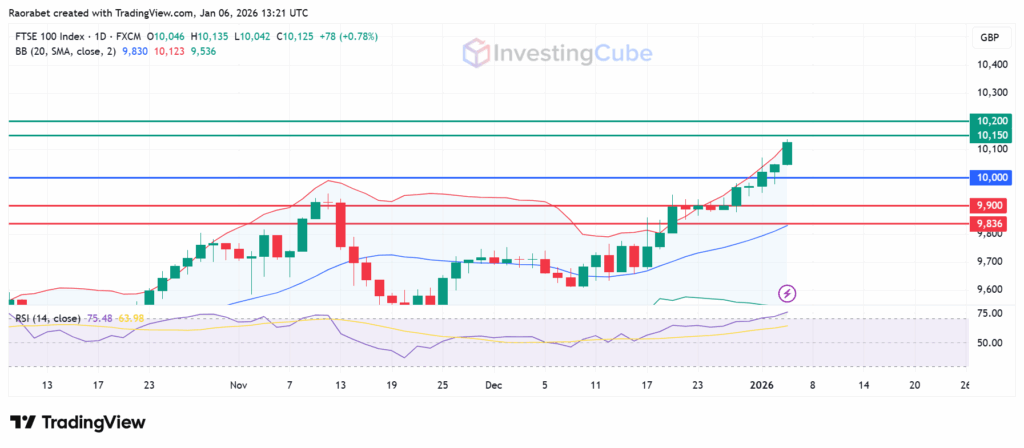
FTSE 100 Index daily chart with key support and resistance levels on January 6, 2026. Created on TradingView
The surge is fueled by global equities rally, strong retail figures and gains in miners and energy stocks, amid resilient earnings
Surprisingly, most analysts say no. Despite the milestone, the index trades at a Price-to-Earnings (P/E) ratio of around 14x, which remains a significant discount compared to the S&P 500’s much higher valuation multiples.
Risks include AI speculation crashes, economic slowdowns impacting sectors, and geopolitical tensions, potentially leading to corrections.