


- The Dow Jones Index has risen by nearly 1% in the last two sessions on improved outlook of shipping at the Strait of Hormuz
- Federal Reserve monetary policy officials are meeting this week and their speeches will influence market sentiment heading into Q2
- Rising oil prices continue to blur market outlook, with some forecasts signaling that it could rise as high as $200
The Dow Jones Industrial Average has been on a downward trajectory for much of the past month, shedding around 2.6% amid global uncertainties tied to the Middle East conflict. Yet in the last two trading sessions, the index has posted notable gains, climbing from recent lows near 46,500 to around 46,946 as of March 17, 2026.
What’s Behind the Rebound?
One key driver seems to be President Donald Trump’s recent remarks indicating that the conflict is largely “very complete” and close to resolution. This helped alleviate immediate concerns about prolonged disruptions to oil supply. As a result, oil prices dropped sharply from peaks above $120 per barrel, easing inflation worries and prompting investors to shift focus toward undervalued technology and AI stocks.
On the same day, the Dow advanced 0.83%, marking its strongest single-session gain in weeks, while the S&P 500 climbed 1.01%. This relief rally fits with what has happened in the past when oil prices stabilize and markets quickly recover from Middle East flare-ups. The index was helped by a wider shift back into growth sectors, which made up for earlier weakness caused by rising energy costs.
On the corporate side, strong revenue guidance from Delta and American Airlines. Airlines being one of the sectors most sensitive to oil prices and consumer confidence, added to the bullish tone on Tuesday.
Is This the Beginning of a Reversal?
The near-term outlook remains uncertain. While the two-day gain arrested the downward trend, technically this appears more as a corrective bounce than a definitive shift. If Trump’s timeline holds and oil prices stay below $90, the Dow could build on this momentum. But challenging the idea that de-escalation will lead to a quick recovery, any rise in prices or new supply shocks could put pressure on the index again, since it is still sensitive to changes in energy prices.
Consider what has not changed. Brent crude has resumed its climb, moving back above $103 on Tuesday. Iran has not moderated its position on the Strait. Iran’s new Supreme Leader Mojtaba Khamenei has explicitly stated it should remain closed as a pressure tool. Energy analysts cited by have flagged that oil could reach $200 per barrel in a worst-case scenario. These are not conditions that historically produce sustained stock market recoveries.
The smarter framing is this. The Dow bounced because it had fallen far enough, fast enough, to trigger bargain-hunting and short-covering. That is a technical bounce, not a trend reversal.

Outlook for Q2 Cautious, Not Catastrophic
Heading into Q2, the Dow faces a layered set of challenges. Premarket futures on Wednesday, March 18 were modestly positive. Dow futures were up about 0.52%, but market sentiment, as measured by the CNN Fear & Greed Index, remains in ‘Extreme Fear’ territory.
The bear case is arguably more compelling. If the Fed’s SEP is hawkish and takes away hopes for a rate cut in the near future, risk assets will lose value. If oil prices stay above $100 for a long time, inflation will rise, consumer spending will fall, and corporate margins will be squeezed at the same time. Add to that the political uncertainty surrounding Fed Chair Powell’s leadership, whose term expires in May, and the fog over Q2 thickens considerably. According to CME FedWatch, there is a 99% probability that rates stay in the 3.50%–3.75% range.
Dow Jones Index Forecast
Dow Jones Index MACD shows narrowing negative divergence, hinting at fading downside. The pivot is at the round figure 47,000 points. Immediate support sits at 46,710, with a critical long-term floor at 46,271. The bulls face a stiff ceiling at 47,428. A breakout above 47,800 is required to confirm a structural trend reversal.
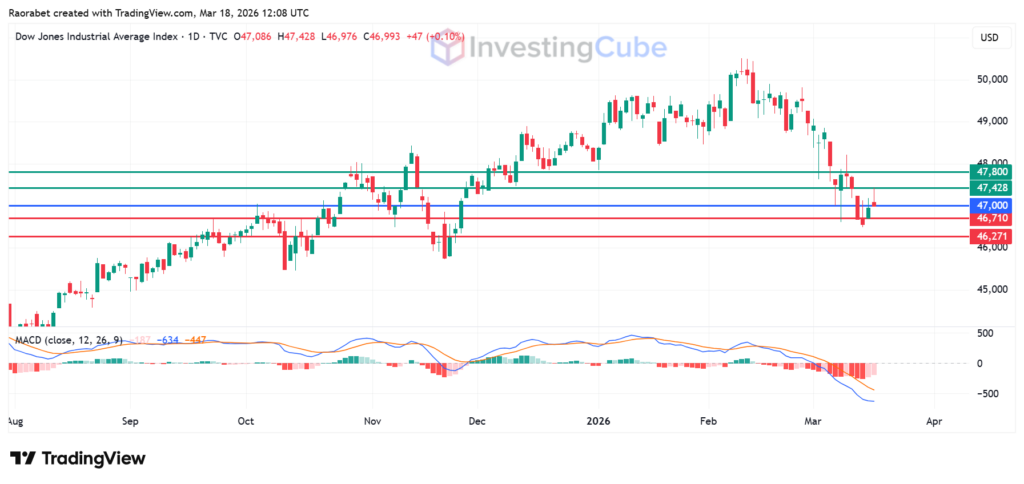
Dow Jones Index daily chart showing key levels of support and resistance on March 18,2026. Created on TradingView
Initial declines driven by spikes in energy prices gave way to relief on hopes for de-escalation. U.S. status as a net oil exporter may provide additional resilience, potentially supporting gains for a longer period than expected.
Markets reacted to news that some shipping traffic resumed in the Strait of Hormuz. Additionally, investors are buying the rumor that the Federal Reserve will maintain interest rate stability during its March meeting, providing a temporary sense of calm.
The Fed is expected to hold rates at 3.50%–3.75%. However, the market is hyper-focused on the Dot Plot and Powell’s press conference for clues on whether the Middle East war will delay planned rate cuts later this year.