



- This week had AUD/JPY experience a shift in momentum as Sanae Takaichi secured an election win, and RBA stayed hawkish
- Strong commodity prices continue to cushion the Australian dollar
- Risk of AI bubble burst still lingers and that could bring pressure to AUD if it happens and triggers a risk-off sentiment
Throughout early 2026, the AUD/JPY pair was popular for carry trades, gaining over 4% as the Australian dollar benefited from mining optimism, while the Japanese yen dealt with political uncertainty. This week, things changed fast. On Tuesday, the pair had its biggest daily drop since October 2025, and it’s still falling today, down another 0.3%. We discuss the reasons for this, as the market generally expects the uptrend to continue after this period of instability.
What Caused the Shift in AUD/JPY Momentum?
The recent drop reflects a JPY recovery driven by fears of intervention and a more aggressive Bank of Japan (BoJ). USD weakness faced NFP data delays, with USD/JPY’s fall increasing the downside in AUD/JPY crosses. Also, speculation of coordinated US-Japan intervention triggered JPY buying after USD/JPY neared 160, indirectly pressuring AUD/JPY lower.
The Reserve Bank of Australia (RBA) recently raised rates to 3.85% to fight ongoing inflation. In Japan, things are shifting. The BoJ’s January 2026 report suggests that while inflation might dip briefly, the era of near-zero rates is ending, with short-term rates expected to hit 1.75% by 2027.
This week’s quick drop likely shows traders selling the news on the RBA’s actions and preparing for a possible surprise from the BoJ, as Japan’s domestic demand is surprisingly strong.
Risks and Opportunities for 2026
The main risk this year is the unwinding of carry trades. If the BoJ speeds up its tightening cycle while the RBA pauses, the big interest rate difference that drove the uptrend will shrink, potentially causing a sharp deleveraging event. Fiscal issues in Japan, especially Prime Minister Takaichi’s spending plans, initially weakened the yen but are now being addressed.
Opportunities exist in carry trades if JPY fiscal concerns continue, with IG International’s 2026 outlook projecting AUD/USD to 0.6950, implying AUD/JPY upside. For long positions, size 1% with a stop-loss at 105.50, targeting 110; for short positions below 106.50, stop at 108 aiming for 104 amid volatility.
Despite many seeing opportunities, risks from AI bubble bursts could cause global risk-off, pressuring the AUD more. However, if lithium and copper prices keep rising due to the AI boom, AUD/JPY might ignore interest rate shifts. Traders should look out for shifts in commodity prices and watch the CRB Commodity Index as an early sign of AUD strength.

AUD/JPY Forecast
AUD/JPY is currently pivoting at the 109.00 psychological level. A sustained action above this could set the stage to go higher and encounter the first barrier at 109.80. A stronger hold by the buyers could result in further gains to target the record highs at 110.85. Conversely, a break below the pivot will have AUD/JPY’s first support at 108.03. The upside narrative will be invalid below that level. An extended control by the sellers will invalidate the upside narrative and target the second support at 107.27.
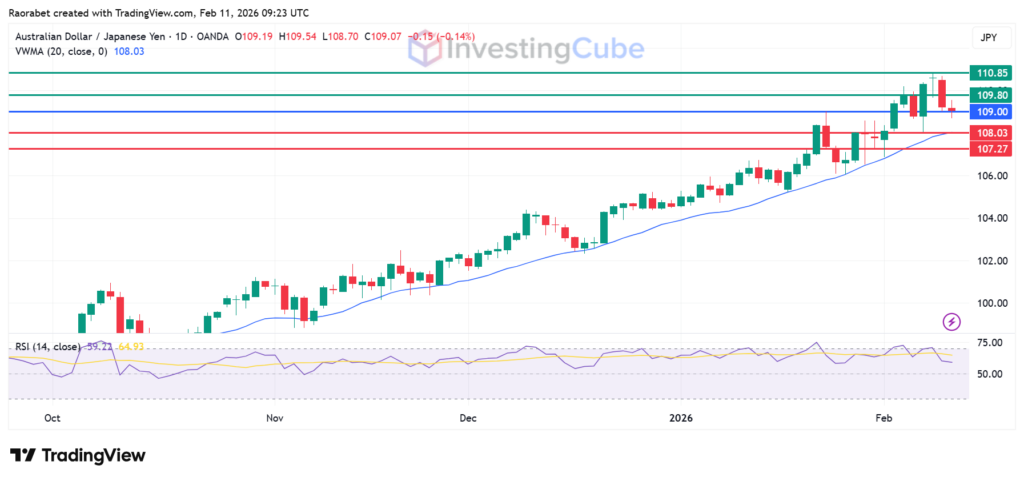
AUD/JPY daily chart on February 11,2026 with key support and resistance levels. Created on TradingView
Trader’s Tip:
Most analysts expect a slow rise. I disagree. The volatility this week suggests a topping pattern. If you’re still long, a hard stop at 108.20 is crucial to avoid a total trend collapse. Keep exposure to 1-2% of your account equity, as the JPY can experience intervention-style spikes that bypass wider stops.
The drop was because of a buy the rumor, sell the fact reaction to the RBA’s rate hike. Traders realized the RBA might be nearing its peak, while worries about BoJ tightening resurfaced.
Use trailing stops and reduce position sizes during Japanese political events. The narrowing rate differential makes the carry less profitable and more sensitive to sudden price swings.
The yen weakness could continue if BoJ hikes accelerate. But, shrinking interest rate differences could last longer if fiscal expansion delays normalization.