


USDZAR Live Chart and Current Setup
USD/ZAR is an emerging market currency that is currently trading as a high-beta risk and oil-sensitive FX pair. Currently, the pair is facing hard shifts from the geopolitical front. Geopolitics in the Middle East is impacting risk sentiment, energy prices and inflation expectations. The pair is not trading on the individual fundamentals of the constituent currencies alone.
So, what is the current price picture for USD/ZAR this week? It has been a three-day rollercoaster, which started on Tuesday, 7 April, with investor risk aversion and a selloff, followed by a recovery in the Rand due to the ceasefire and Hormuz reopening. Indeed, the USD/ZAR fell 2.56% to roughly 16.37–16.41, as the Rand rebounded sharply and the greenback declined amid falling bond yields and risk-on sentiment. But with the latest headlines indicating that Iran has closed the Strait of Hormuz once more due to the Israeli strikes in Lebanon late 8 April, the Rand is at risk of losing all of Wednesday’s gains.
A look at the price action on 8 April, when the rand gained on the U.S.-Iran ceasefire, and the initial 1% drop in the rand’s value on 2 April, when new strikes dented risk sentiment, gives an insight into how the pair is responding to the current geopolitical situation.
USD/ZAR: Macro Drivers
1) Oil shock/war headlines
Being a net energy importer, South Africa is highly sensitive to rising energy prices, inflationary pressures and US interest rate expectations. The current oil shock and global risk aversion are directly responsible for the Rand’s current weakness against the US Dollar. Any changes in the war headlines, as showcased in this week’s price action, will cause corresponding shifts in the direction of the USD/ZAR.
2) SARB Policy
In its 26 March meeting, the South African Reserve Bank (SARB) left its policy rate unchanged at 6.75%, with a strong emphasis on exercising caution due to the war-driven rise in energy prices and the attendant inflationary pressures that would follow. The SARB warned about upside risks to inflation, which had already fallen to its 3% target previously. Rising fuel-driven inflation and a weaker local currency are now viewed as renewed risks, hence the bank’s shift from a dovish stance to one of caution.
3) USD/ZAR: a global risk sentiment barometer
The rand is a classical emerging market FX proxy which retains sensitivity to global risk sentiment. The Rand weakens when investors de-risk, rebounding sharply when risky sentiment strengthens. This has been a growing pattern since the US-Iran war broke out, with continuous shifts in sentiment brought about by contrasting headlines from day to day. This is why the USD/ZAR is regarded as a barometer of global risk sentiment.
What matters this week (3 catalysts)
Oil path and Middle East risk premium

This remains the biggest external driver. If the ceasefire holds and oil stays contained, the rand can remain supported. If tensions flare again and crude jumps, USD/ZAR can reverse higher quickly through the inflation and risk-aversion channel.
Dollar direction and U.S. rate pricing
USD/ZAR remains highly sensitive to the broader dollar and Treasury-yield setup. Reuters’ March coverage showed the rand strengthening when the dollar softened and weakening when the dollar firmed, even when local data was decent.
Whether the market keeps postponing SARB cuts
The March 26 SARB decision matters beyond that meeting because it signaled that policymakers are now more concerned about imported inflation and currency weakness. If markets keep pushing out cuts, that can cushion rand weakness, but it does not fully remove USD/ZAR upside risk if global sentiment worsens.
USD/ZAR Forecast Scenarios (USD/ZAR)
Base case: Like many assets linked to the oil shock situation, the USD/ZAR is expected to trade in a two-way street, range-bound with heavy volatility. The sudden changes in the war headlines (ceasefire and Hormuz reopening one day, and Israeli airstrikes and Hormuz re-closure next day) makes for a bumpy ride.
Bear case: the trigger for a bull case scenario remains the renewed closure of Hormuz, higher oil prices, a rise in US bond yields -> a stronger dollar, and a renewed bout of risk aversion. For a currency already prone to changes in US interest rate expectations, the factors mentioned above could all combine to give an outsized push to the USD/ZAR.
Bull case: for the bear case on the USD/ZAR to be actualized, the ceasefire must remain n place despite any provocations. Oil prices must also stay below $100, and US bond yields need to fall further with lower inflation expectations that ultimately lead to upward repricing of Fed cut expectations.
USD/ZAR Technical Outlook
The rejection from the 17.15 resistance has put the pair on the path of a potential retest of the 15.51 support. A breakdown of this pivot unlocks access to the 14.43 support and prior low of 18 March 2022.
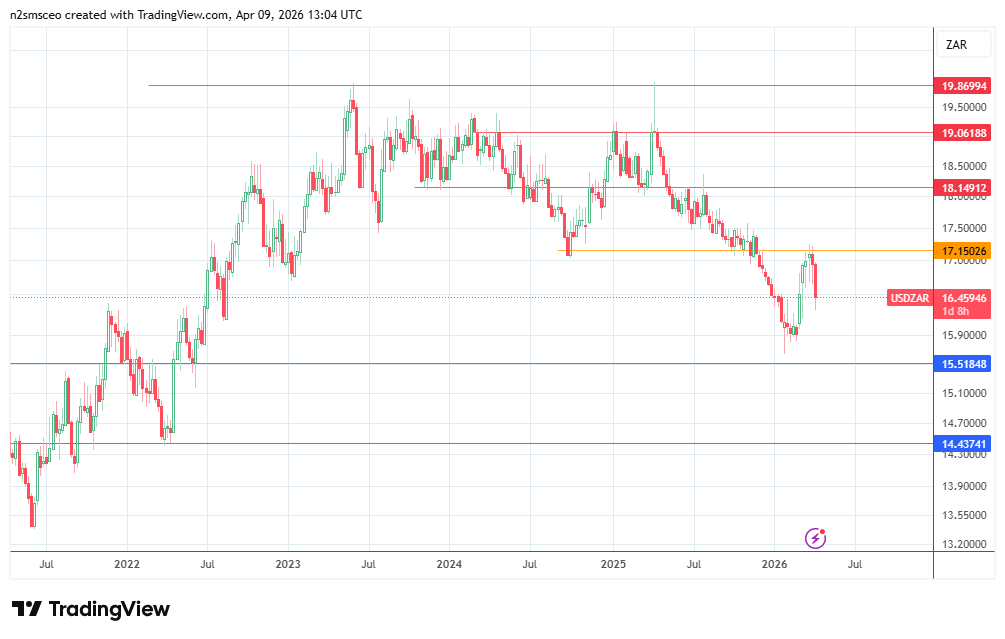
Conversely, further recovery will follow a break of the 17.15 resistance mark, targeting the June/July 2025 top at 18.14 as the initial target. Further extension will unlock access to the multi-year high at 19.86, with an intermediate target at 19.06.