


- The Russian ruble has been under sustained pressure from geopolitics yet it has risen by more than 3% against the dollar since the start of 2026
- High interest rates have cushioned the ruble against inflation-driven weakness
- Russian oil is sold at a fraction of standard global prices due to sanctions, but low demand for foreign currency eases the pressure on the ruble
In 2026, the Russian ruble has played a surprising role in currency markets. It has held up against the US dollar, despite international sanctions and an unstable energy market. So far in February, the USD/RUB is down about 1.3% this year, with the ruble up 3.7% in the last month. In this article, we delve into how the ruble has defied expectations and what lies ahead.
How the Ruble Defied the Odds
The ruble’s strength comes from a few things. The Central Bank of Russia’s strict monetary policy, keeping interest rates at 20%, has kept inflation in check and lowered the need for foreign money, as CNBC noted.
Also, as a result of trade sanctions, Moscow gets fewer rubles for each dollar of oil it sells, which increases the budget deficit. Yet, the ruble stays up because there’s little demand for foreign currencies, since imports are limited by logistics and sanctions.
Is this A Reversal or Pullback?
The dollar has gone up for three successive sessions, pushing USD/RUB to 77 on February 3, a 0.38% increase. This rise from February 2 levels around 75.58 shows the dollar is recovering a bit. But it looks like a temporary dip, not a full reversal. The ruble might weaken a bit in 2026 because of expected rate cuts, but it will likely stay stable early in the year since there’s not much need for foreign money.
USD/RUB Key Influences in 2026
Several fundamentals will influence the pair’s trajectory. Monetary easing by the Central Bank, aiming to lower rates from 19% to 13% may pressure the ruble. Economic slowdown, with the Russian GDP growth projected at 0.8-1.5% by the IMF, alongside labour shortages and declining oil revenues, adds downside risks. Geopolitics remain pivotal, as progress in Ukraine talks could support the ruble, while escalated sanctions might weaken the ruble.
The ruble might face challenges later in 2026 as the government needs a weaker currency to balance the budget. Some analysts say that a stronger ruble is something the Russian budget, now focused on military spending, can’t afford for long.

The USD/RUB narrative could shift as investors look toward the Central Bank of Russia’s (CBR) upcoming meeting on February 13. If the CBR signals that the peak of the hiking cycle has passed, the ruble’s yield advantage could begin to erode.
USD/RUB
The USD/RUB pair shows signs of a short-term increase within a larger downward trend. The RSI is rising out of oversold territory toward 48, suggesting the recent dollar strength is a bounce. The pair pivots at the 10-day EMA level at 76.77.
The first resistance is at 77.35, a level that has served as a barrier in ten sessions. A break past that mark could set the stage to test 78.00. Action below the pivot could see the first support come at 76.50, below which the upside narrative will be invalid and USD/RUB could slide to 76.00.
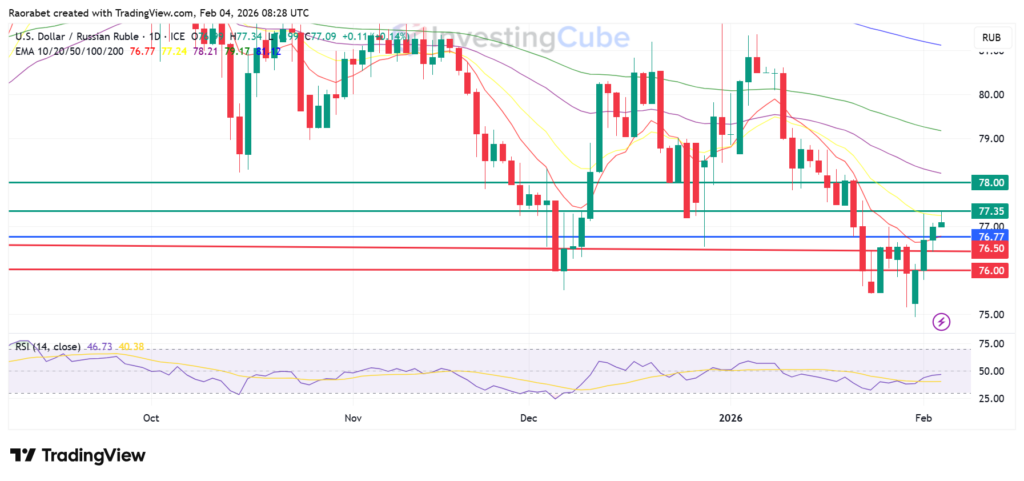
USD/RUB daily chart on February 4 with key levels of support and resistance. Created on TradingView
The ruble benefited from high domestic interest rates and a significant reduction in imports. This created a situation where the demand for foreign currency was low, while the incentive to hold rubles for savings remained high.
Most analysts see the current rally as a temporary pullback. Technical indicators suggest the ruble is steady after a period of strength, but a full reversal would likely require a change in Central Bank policy.
Moderate weakening is expected due to banking risks and easing, potentially by September, though geopolitics could stabilize and help strengthen the ruble.