



- Rising oil prices initially helped the Canadian dollar, but interest rate differentials have weighed down on it in recent days
- By retesting the 1.3700 level, the USD/CAD pair is signaling a likely upward trajectory in the coming days with US economy remaining robust
- The Bank of Canada's decision to hold interest rates at 2.25% predisposes CAD to weakness in the coming weeks
The USD/CAD currency pair presented a dynamic trading environment throughout much of April 2026. Following a notable decline during the initial three weeks of the month, the Canadian Dollar (Loonie) appears to be easing its strength, with the US Dollar showing efforts to regain the 1.3700 level.
While recent signs of recovery on the charts might suggest a straightforward relief rally, the underlying market dynamics reveal a more complex interplay between North American central bank policies.
The Oil Wildcard
A significant factor bolstering the Loonie has been the robust recovery in crude oil prices. West Texas Intermediate (WTI) has seen its value rise above $100 per barrel, primarily influenced by the continuing US-Iran tensions and supply interruptions in the Strait of Hormuz.
As a substantial net energy exporter, Canada typically benefits from elevated oil prices, leading to increased foreign exchange inflows and a more favorable environment for the Canadian dollar. Despite this, the pair’s downward movement seems to have moderated.
Recent trading sessions have observed the pair repeatedly testing the 1.3700 mark, with late April closures generally settling around 1.3680–1.3690. While higher oil prices undeniably benefit Canada’s trade balance, ongoing geopolitical instability and potential supply interruptions introduce complexities into the Bank of Canada’s (BoC) policy decisions.
Central Bank Policy Weighs In
Higher oil does support Canada’s trade balance, but persistent geopolitical uncertainty and potential supply disruptions can also complicate the Bank of Canada’s policy calculus. The BoC held its policy rate steady at 2.25% on April 29, 2026, signaling it would look through the immediate inflationary effects of energy prices while remaining vigilant against second-round impacts.
This measured stance contrasts with expectations around the Federal Reserve. With both central banks widely anticipated to hold rates in their recent decisions, attention shifted to forward guidance and upcoming U.S. core PCE data.

Historically, a narrowing of interest rate differentials has tended to support the Loonie. However, the near-term trajectory largely hinges on how market participants assess growth and inflation indicators emanating from both Canada and the United States.
Concurrently, the US economy continues to demonstrate robustness, and as long as the yield differential remains advantageous for the US, the 1.3700 level is likely to continue attracting significant price activity.
USD/CAD Forecast
The pair has its pivot at the 10-day EMA at 1.3689 and the RSI at 43 signals control by the sellers. Primary support will likely be at 1.3667, and the second one at 1.3650. The upward trajectory will likely encounter initial resistance at 1.3700, with action above that level invalidating the downward thesis. A conclusive daily close surpassing this point would potentially clear the way towards retesting the 20-day EMA of 1.3789.
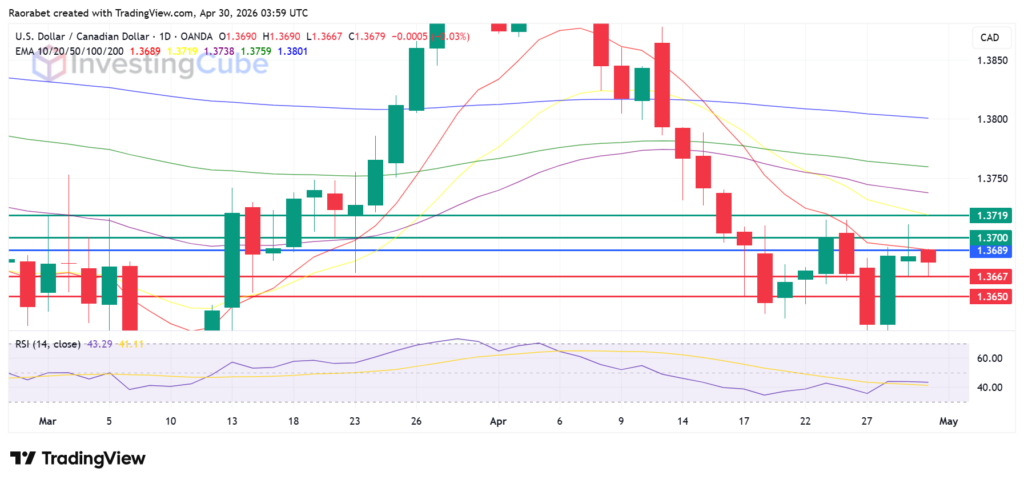
USD/CAD forex pair on the daily time frame on April 30, 2026 with the key levels of support and resistance. Created on TradingView
Even with Brent crude trading near $114, the historical correlation between oil prices and the Canadian Dollar appears to be diminishing. Currently, the differing policies of central banks and the robust resilience of the US economy seem to be exerting a greater influence than the favorable impact of elevated energy prices.
The level is a genuine battleground. USD safe-haven demand and oil-driven CAD support are roughly equal forces. A clear catalyst from crude prices, US-Canada trade headlines, or central bank signals is needed to resolve the standoff.
Unlikely. The BoC is more focused on domestic inflation and housing stability. Therefore, unless the Canadian Dollar experiences extreme volatility that could jeopardize the inflation target, the central bank is expected to allow market forces to determine the exchange rate.