



- High Foreign Institutional Investor outflows are straining the rupee
- India's oil and other import bills have raised the demand for the dollar amid increased hedging activity
- Reserve Bank of India has a history of intervention and could soon enter the market to prevent a steeper decline
The Indian Rupee (INR) is currently experiencing significant pressure, having succumbed to a three-day losing streak against the US Dollar (USD) and pushing the USD/INR forex pair up by more than 2% in the last month to touch new all-time highs of 91.08.
Why the Rupee is Under Strain
A big reason for the Rupee’s weakness is Foreign Institutional Investor (FII) outflows. Due to uncertainty, global fund managers are selling Indian stocks, which increases the demand for US Dollars as they move their funds.
Also, India’s ongoing trade and current account deficits keep pressure on the currency. India imports a lot of crude oil and electronics, and since these are bought in USD, rising global prices mean India needs more Rupees to buy the Dollars needed.
Finally, there’s the issue of hedging activity. As the Rupee hits new record lows, many importers and corporates with foreign currency debt rush to hedge their exposure by buying Dollars in the forward market, further increasing short-term USD demand and exacerbating the spot market weakness.
The Outlook for the Rupee
It looks like the Rupee will stay under pressure for now. The market situation favors buying USD when the price dips. But things could change. A good trade deal between India and the US could turn things around and stop the Rupee from falling.
Will the RBI Intervene?
The immediate question for market participants is whether the Indian authorities, specifically the Reserve Bank of India (RBI), will intervene to stem the slide. The RBI is known to be an active participant in the forex market, typically aiming to curb excessive volatility rather than targeting a specific exchange rate level.

Past actions indicate that the RBI often steps in, as state-run banks have been observed selling dollars to ease pressure, according to reports. The central bank uses its considerable foreign exchange reserves to sell Dollars, thereby increasing the supply of USD and putting a brake on the USDINR pair’s upward momentum.
If the drop becomes too erratic or threatens the financial state, intervention is likely. The RBI also tends to let the Rupee fall gradually, which can help Indian exports compete.
USDINR Forecast
The USD/INR Relative Strength Index (RSI) is currently at 73, indicating overbought conditions that could usher a consolidation zone. The immediate resistance level is clustered around the historical high of 91.08-91.20. Conversely, the first support level to watch is the 90.20 mark, with the second one likely to come lower at the psychological 90.00.
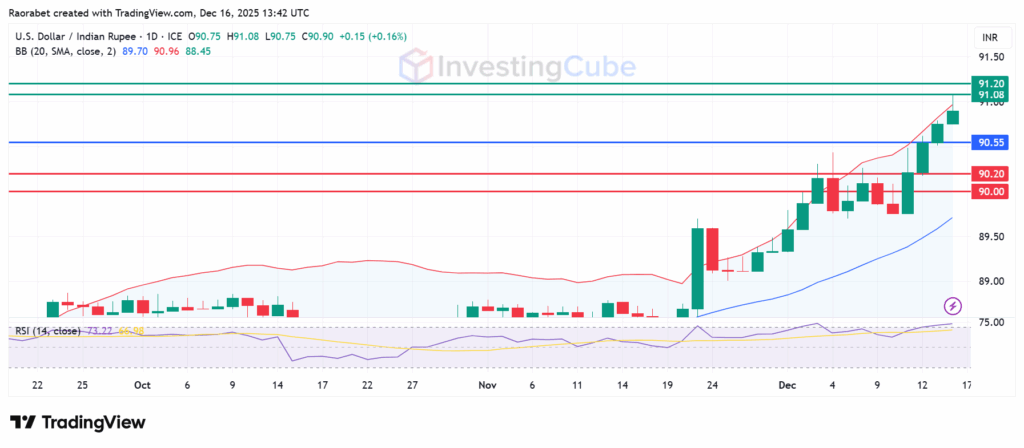
USDINR daily chart with key support and resistance levels on December 16,2025. Created on TradingView
The value of the rupee depends on the flow of money in and out of India, as well as trade. Continual foreign outflows and trade uncertainty have put pressure on the currency, even though the basics of the Indian economy are good.
The main reason is that foreign investors keep selling off their Indian investments and changing their Rupees into Dollars, causing money to flow out of India.
India relies on imports, especially crude oil which is priced in dollars. This creates a constant need for more dollars to pay for these imports, causing an imbalance in supply and demand.