
- AUD/JPY is at a crossroads with Japan's looming snap elections and RBA interest rate decision at the core of the next move
- Australia's commodity-dependent economy means the AUD's performance depends much on how China's stimulus spending unfolds
- The Bank of Japan is increasingly becoming hawkish and that could limit AUD/JPY's upside as the carry trade favourite
The AUD/JPY pair has been dropping lately, pulling back from highs around 109.00. It’s currently trading near 107.69, down 0.1% for the day, as the Aussie dollar faces pressure against the yen. That said, the the pair is still up by 2.87% year-to-date. We discuss how AUD/JPY might react to different central bank policies and global events, with recent happenings giving the yen an edge
What’s Behind the Decline?
The recent decline comes from a mix of things that are helping the yen and hurting the AUD. The Bank of Japan’s (BOJ) January meeting minutes hinted at a more aggressive approach, making the JPY stronger as board members pushed for quick rate increases to keep up with inflation. The yen isn’t just sitting back anymore.
The BoJ’s January Summary of Opinions showed a growing sense of urgency, with board members asking for timely and appropriate rate hikes to fight inflation caused by a weak yen. Japan’s snap election on February 8 adds a safe-haven demand for the yen, pushing the AUD/JPY pair down. In Australia, the focus is on stubborn inflation.
In Australia, the focus is on ongoing inflation. Recent data from the Australian Bureau of Statistics (ABS) showed underlying inflation rose 0.9% in the December quarter. Because of this, major banks like Commonwealth Bank (CBA) and Westpac expect a 25-basis point rate increase to 3.85% at the RBA’s February 3 meeting. Higher rates usually help a currency, but this expectation seems to be already factored into the price.
Are the Fundamentals Shifting?
Looking ahead, the pair’s outlook is indecisive, with a chance of further drops in the near-term. China’s stimulus and Japan’s elections create uncertainty, which could help the yen if tightening happens. We’re also seeing a shift from a situation where Japan had the lowest rates to one where the BOJ is trying to normalize.
On the other hand, if the RBA takes a tough stance and raises rates to 3.85% amid 3.8% CPI, it could boost the pair. At the same time, global risk sentiment has worsened due to rising tensions between the US and Iran, as well as higher oil prices.

AUD/JPY Prediction
After failing to stay above the 108.50 resistance area, the AUD/JPY pair is showing uncertainty. The RSI has fallen from overbought levels (near 70) and is now around 62. This suggests that while the medium-term uptrend isn’t over, the short-term momentum has shifted toward sellers.
The immediate resistance is at 108.20, with a stronger barrier at 109.05. Traders are keeping an eye on the 20-day EMA at the 106.64 level, as a break below this could lead to the 106.15 support level, which previously served as an accumulation zone.
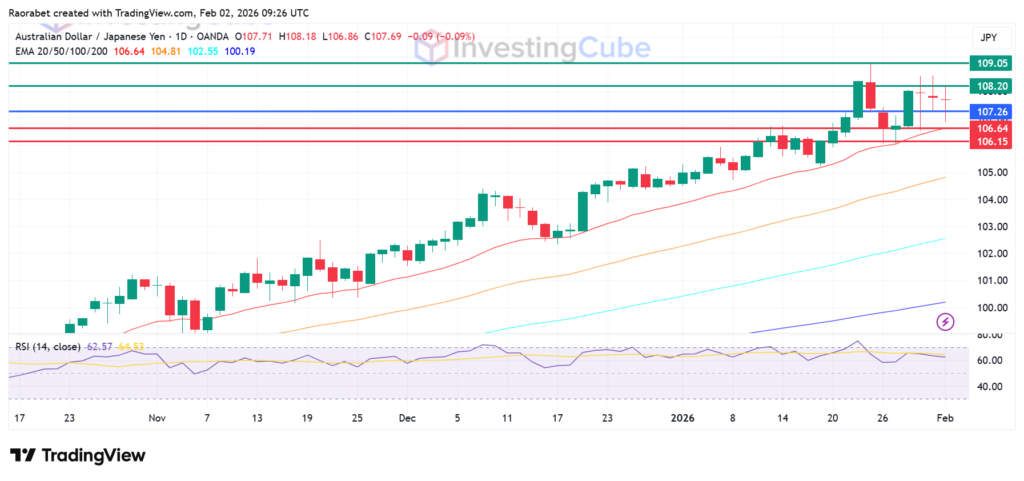
AUD/JPY FX pair on February 2, 2026 with key support and resistance levels. Created on TradingView
The BOJ’s tough stance on rate hikes, intervention threats, and fiscal worries are boosting the JPY, while crowded AUD positions are causing pullbacks.
Yes, market conditions are shifting toward smaller policy gaps as the BOJ tightens and the RBA remains hawkish, potentially helping the yen recover amid trade tensions.
Higher-than-expected Australian inflation keeps the RBA hawkish, but Japanese inflation is pushing the BOJ to consider faster rate hikes. This narrows the interest rate differential that previously supported AUD/JPY.