


- GBP/TRY remains in strong long-term uptrend driven mainly by persistent Turkish lira weakness.
- The pair is consolidating near 52-week highs around 60.25, suggesting a potential breakout setup.
- Unless Turkey's inflation and credibility outlook improves, pullback may stay temporary.
Overview
And there are a few hotter spots in FX market than GBP/TRY, one of the most structurally bullish currency pairs on the monthly chart in large part due to lira weakness. The spread is currently around 59.4 – 59.7 — near its best 52-week high of about 60.25. It looks per trading today. During the past year GBPTRY has surged over 30%, illustrating profound macroeconomic distortions in Turkey and relatively stable UK monetary conditions.
Having seen the pair consolidated at this heights traders will be trying to ascertain whether this is just another pause before resuming upwards — or a nascent counterm move lower.
Macroeconomic Backdrop
Turkish Lira: Structural Fragility Persists
The main driving factor for GBP/TRY remains the structural weakness of the Turkish lira. While the Central Bank of the Republic of Turkey has kept policy rates high to stabilize inflation, price pressures are well above those in developed economies. Inflation has been in high double digits, a real dent to domestic buying power and investor morale.
Although an increase in interest rates has temporarily slowed the depreciation, structural factors such as current account pressure, FX reserve limits and credibility issues mean that Turkish lira weakness persist. As inflation remains high and capital inflows sporadic, the lira is likely to remain under a medium-term pressure.
In other words, a neutral or mildly softer GBP can still rise against the TRY.
British Pound: Relative Stability
The British pound itself has not been in an extended bullish cycle. However, it benefit benefits from institutional credibility, relatively transparent monetary policy, and lower inflation volatility compared with emerging-markets currencies.
The Bank of England has adopted a cautious stance as inflation pressures have eased in the United Kingdom. Although growth has moderated, recession risks has not meaningfully increased. This relative macro stability supports GBP on a cross-currency basis, particularly against structurally weaker peers like TRY.
In other words, GBP’s relative strength — rather than outright dominance — has been sufficient to keep the door open for further upside in the pair.
Technical Structure
High-Level Consolidation
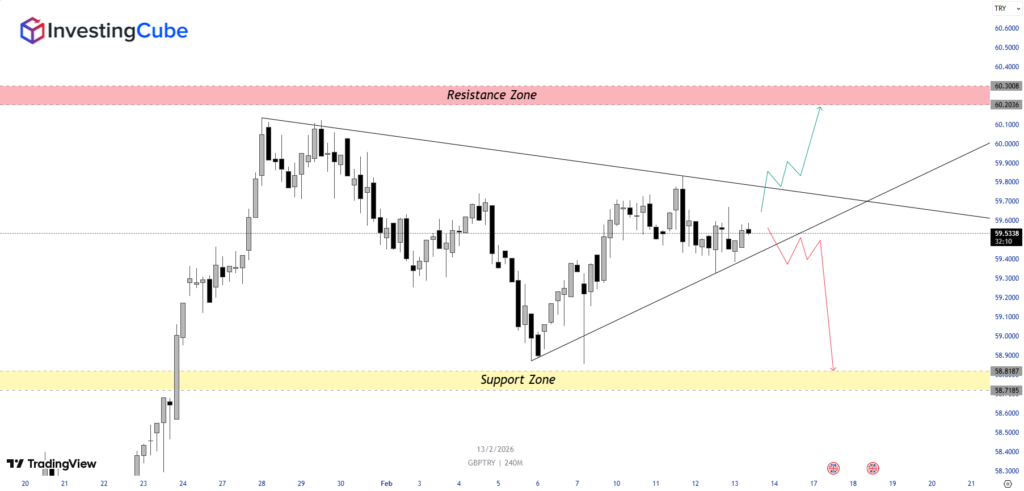
GBP/TRY daily chart is consolidating below recent high near 60.25 while above the main SMAs . The larger trend is still comfortably upward, with the highs and lows of the last year both higher.
Key technical observations:
- Price is still trading above key moving averages.
- Momentum is showing slight cooling without significant bear divergence.
- Volatility has narrowed, suggesting compression before expansion.
The actual formation looks more like a consolidation instead of reversal.
Key Technical Levels
Resistance:
- 60.25 — Recent yearly highs
- 61.00 — Psychological level
- 62.50 — Projected breakout extension.
Support:
- 58.80 – Near term consolidation floor.
- 58.00 – Stronger technical base.
- 56.50 – Major structural support (trend invalidation zone)
Price Scenarios
Bullish Continuation Scenario (Primary Bias)
In the event that the lira remains under pressure for the inflation and capital outflow concerns, or if global risk appetite were to turn soft, GBP/TRY may penetrate above 60.25 to extend momentum driven buying.

A confirmed breakout above 60.30 on strong volume could open the path toward:
- 61.00 (psychological target)
- 62.00 – 62.50 (measured move extension)
Considering the structure, declines could find some buyers at 58.5 to 59.0 levels, more so if Turkish macro scenario does not improve significantly.
Consolidation/Corrective Pullback Scenario
In the event of Turkish authorities adopting a more aggressive stance on currency stabilization or if risk sentiment improves materially, we could see a technical pullback in GBP/TRY.
In this case:
- A break below 58.80 may expose 58.00.
- Sustained selling below 58.00 could extend towards 56.50.
Yet without major improvements in inflation, dynamics and policy credibility in Turkey, the deeper corrections may still be temporary within the broader uptrend.
Volatility and Risk Factors
GBP/TRY is naturally a little wild with the emerging market exposure. Key risks include:
- Sudden Turkish central bank interventions.
- Unexpected changes in the UK monetary policy outlook.
- Geopolitical development impacting risk sentiment.
- Changes in capital control policies.
Traders must adjust to greater spread and infrequent liquidity voids, especially outside regular trading hours.
Outlook Summary
The general structure in GBP/TRY is still very much skewed to the upside, driven more by continued lira weakness rather than pound strength. Now, although the pair is trading around multi-month high, the technical formation favors further upward unless key support becomes vulnerable.
The short-term volatility here may have pullback into 58.0 to 58.8, but in the absence of sustained macro dynamic stabilization for turkey dips should be viewed as corrective only.
Advancing above 60.25 would add to the bullish tone and accelerate towards 61 or 62 zones. Whereas in the medium term, structural favors still suggest bulls retain control over GBP/TRY.
Frequently Asked Questions
This is because the main driving force has been Turkish lira weakness rather than pound strength. TRY remains under constant depreciation pressure owing to structural inflation, credibility concerns about policy and capital flow volatility in Turkey.
A sustainable reversal would probably need Turkish inflation management to improve significantly, stronger FX reserves, rising investor confidence, and lasting incredibly in monetary policy. Reversals — without structural reform — could be only transient.
Yes, but with caution, the pair has strong volatility and trend persistence, both appealing for traders, but spreads can widen and price gyrations can be severe, so traders will need to manage risk carefully.