



- All eyes turn to Australia’s inflation data due on March 25; while a hot print could reinforce the RBA’s 4.10% hawkish stance, market sentiment remains tethered to geopolitical "risk-off" flows and DXY dominance.
The Australian Dollar faced a sharp reversal this week, with the AUD/USD pair dropping to the 0.6950 region. While institutional players like Barclays have recently upgraded their long-term forecasts to 0.74 citing the AI-driven commodity boom, the immediate reality for the “Aussie” is a “perfect storm” of domestic economic contraction and a massive flight to safe-haven assets.
As geopolitical risks in the Middle East escalate, the commodity-linked currency is struggling to maintain its footing against a resurgent U.S. Dollar.
AUD/USD weekly recap: Risk-off sentiment shakes the Aussie
The AUD/USD exchange rate came under heavy fire on Tuesday as a renewed wave of risk aversion swept through global markets. Despite the Reserve Bank of Australia’s (RBA) hawkish stance and a policy rate of 4.10%, the currency could not withstand the pressure from a weakening domestic fundamental backdrop.
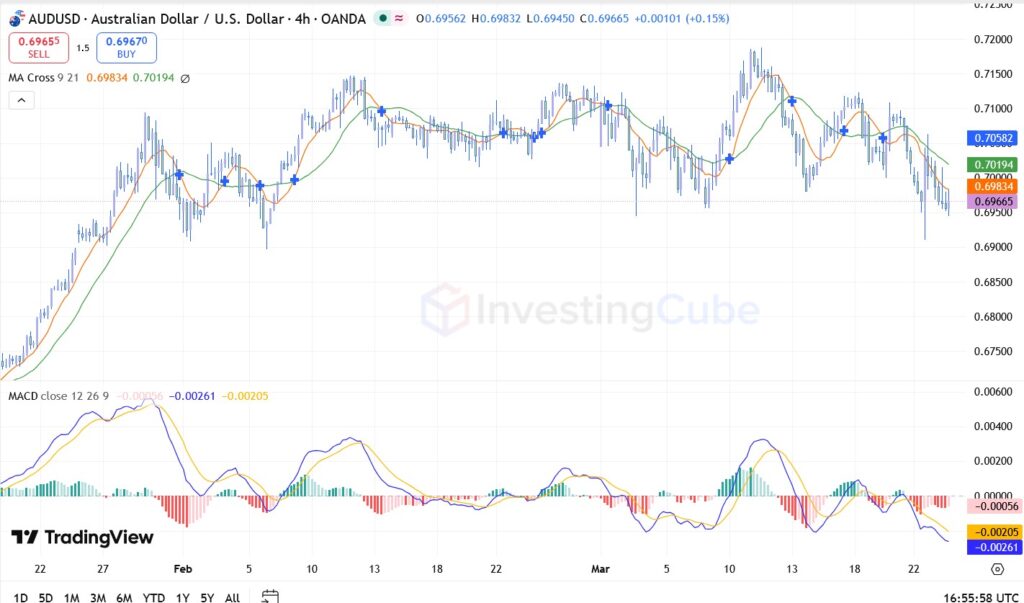
Regarding price action, the AUD/USD decisively broke below the 0.7050 support level and is currently testing the 0.6950 zone, marking a significant shift in near-term momentum.
AUD/USD key technical levels to watch:
- Support: 0.6945 This is the critical area where the price is currently finding buyers. It aligns with the recent lows seen in late February.
- Invalidation: 0.7019 As long as the price stays below this level by the end of the week, the current bearish structure remains intact. A move back above this suggests a false breakdown.
- Resistance: 0.7058 The Aussie needs to reclaim this previous support floor and close a full day above it to prove the recovery has officially started.
AUD/USD outlook: Weak Australia PMI and Middle East tensions boost US Dollar demand
The Aussie’s decline was accelerated by disappointing S&P Global PMI data. The Composite PMI dropped to 47.0 in March, signaling a return to contraction territory after 18 months of expansion. This sharp decline in the services sector suggests that domestic demand in Australia is buckling under the weight of higher interest rates.

Meanwhile, in the U.S., a mixed economic picture (Manufacturing PMI at 52.4 vs. Services at 51.1) has done little to deter the Greenback. Instead, investors are focusing on the escalating conflict in the Middle East.
While President Trump signaled a delay in deadlines linked to the Strait of Hormuz, the denial of negotiations by Iranian officials and fresh strikes on Tehran have pushed investors firmly into the “safety” of the U.S. Dollar.
AUD/USD outlook: Inflation data and geopolitical volatility
As we look toward the March 25 session in a few hours, the focus shifts to Australia’s inflation data. While a high print could theoretically support the RBA’s hawkish narrative, the “Risk-Off” environment remains the primary driver. If geopolitical tensions do not de-escalate, technical support levels may remain secondary to the broader flow of capital into safe havens.
Traders should stay nimble and prioritize capital protection as we await the Wednesday CPI release. The path of least resistance currently tilts lower, targeting a test of the 0.6900 handle unless a significant “de-risking” of the Middle East conflict occurs.
The AUD/USD is under pressure primarily due to escalating Middle East tensions, which have triggered a flight to the safe-haven US Dollar. Additionally, weak domestic PMI data showing a contraction in the Australian services sector has dampened investor confidence in the Aussie’s short-term outlook.
Barclays recently upgraded its year-end forecast for AUD/USD to 0.7400. The bank cites Australia’s smaller exposure to Middle East oil shocks and a “secular tailwind” from the AI-linked commodity boom as key reasons for the Aussie’s potential long-term outperformance.
Higher-than-expected Australian CPI (inflation) data often strengthens the Aussie by supporting the Reserve Bank of Australia’s (RBA) hawkish interest rate stance. However, during periods of extreme geopolitical risk, global sentiment and DXY strength can often overshadow domestic data points.