- Oil has dropped to the $93–$96 range following the surprise two-week ceasefire, but it remains "coiled" between 64 and 79 as traders wait to see if the Strait of Hormuz truly reopens.
Crude oil price plunges and opens on a gap lower in response to the 2-week cease-fire agreement between the US and Iran. The oil price dropped below $100 a barrel despite holding steady for a week. Once US President Donald Trump said that he had agreed to a two-week ceasefire with Iran, the shift in stance started.
The WTI oil futures slip 15%, dropping from $100 to $93 per barrel. The Brent crude oil (UKOIL) declined by approximately 9.39%, with the previous close at $103.43 and an open at $95.00. Although this drop moves, oil prices remain well above the levels where they were before the war. Brent crude oil was trading below $73 a barrel before the US-Iran tensions began. With that, we have to highlight important things:
- How Do Oil Prices and Global Markets React to the US–Iran Ceasefire?
- Iran’s 10-Point Plan, Why It Matters for Oil Prices
- Will the US agree to this 10-point plan?
- On top of that, what is the technical outlook for crude oil prices?
Let’s address these key questions to understand what’s happening in the market following the ceasefire agreement between the US and Iran.
How Do Oil Prices and Global Markets React to the US–Iran Ceasefire?
European markets opened strongly on Wednesday in response to the agreement. Stocks moved higher across the board. The Stoxx 600 rose by 4% as investors reacted positively to the ceasefire news. Lower geopolitical risk boosted overall market sentiment.
Travel and leisure stocks surged, such as Air France, which rose by 14.5%, Lufthansa, +11%, IAG, +9.5%, and TUI, +12%. These stocks benefit from stability, as less conflict means more travel demand and fewer disruptions. The FTSE 100 gained nearly 3%. The index hit its highest level since the start of the Iran conflict. Strong global demand supported UK equities.
The opposite happened with the oil industry; oil stocks fell sharply after the ceasefire. Because lower oil prices reduce profits for energy companies. On the other hand, Asian markets rallied earlier: Nikkei 225 +5%, ASX 200 +2.55%, Kospi +7.5%, Hang Seng +3.1%
and CSI 300 +3.2%. The rally started in Asia and carried over to Europe. Markets reacted quickly to easing tensions and an improved outlook.
The key question now is how long can this positive sentiment last?. The answer is uncertain. It largely depends on Iran’s demands and whether the US is willing to accept them.
Iran’s 10-Point Plan | Why It Matters for Oil Prices
Iran has made it clear that the war will only end once both sides agree on the final details of its proposed 10-point plan, which was reportedly delivered to the US through mediators. The proposed plan requires the main key points:
- Sanctions to remove: Iran wants all economic restrictions lifted, aiming to trade freely again and boost its economy.
- Control over the Strait of Hormuz stays with Iran: Iran aims to keep authority over this key oil route. This gives it a strong influence over the global oil supply.
- US forces to leave the region: Iran is pushing for a full US military withdrawal from the Middle East. Such a move would reduce the US presence and influence in this area, which would not be in the US’s favor.
- No more attacks on Iran and its allies: The plan calls for a complete stop to military actions.
- Frozen assets to be released: Iran wants access to its funds held abroad, which would improve its financial position quickly.
- Deal to be legally binding under the UN: Iran is seeking a UN-backed agreement. This would ensure all sides are committed and cannot easily back out.

Will the US agree to this 10-point plan?
The US hasn’t signed off on the whole thing yet; they only said that using the 10-point plan is a starting point. President Trump recently called the plan a “workable basis on which to negotiate.” He has temporarily halted military strikes for two weeks to assess the possibility of reaching a genuine agreement. However, the 10-point plan has some major “deal-breakers” that the US will keep fighting.
What the U.S. has already accepted: the reopening of the Strait of Hormuz, with passing ships starting again by this week. The US demanded this as a condition for even talking. Moreover, the biggest win for the US is Iran’s acceptance of a two-week ceasefire.
What the U.S. will likely consider a “Hard No”: The US will likely reject the idea of withdrawing its military forces from the Middle East, particularly in the presence of allies such as Saudi Arabia and Israel. As well as leaving the permanent control of the strait to Iran, the US would reject it. Because the US has always insisted that these are international waters that must be free and open to everyone without Iranian interference.
All of these probabilities will be affirmed or denied within “Pakistan Talks.” Delegations from both countries are scheduled to meet in Islamabad on Friday, April 10, 2026. This is where we will see if the U.S. is willing to compromise on things like “partial withdrawal” or “monitored enrichment.”
What we are highly expecting is a “Grand Bargain.” Since the U.S. is under massive pressure to get oil prices down, they probably partially agree on points and fight for others.
Crude Oil Price Technical Outlook | Oil Price in a Pause:
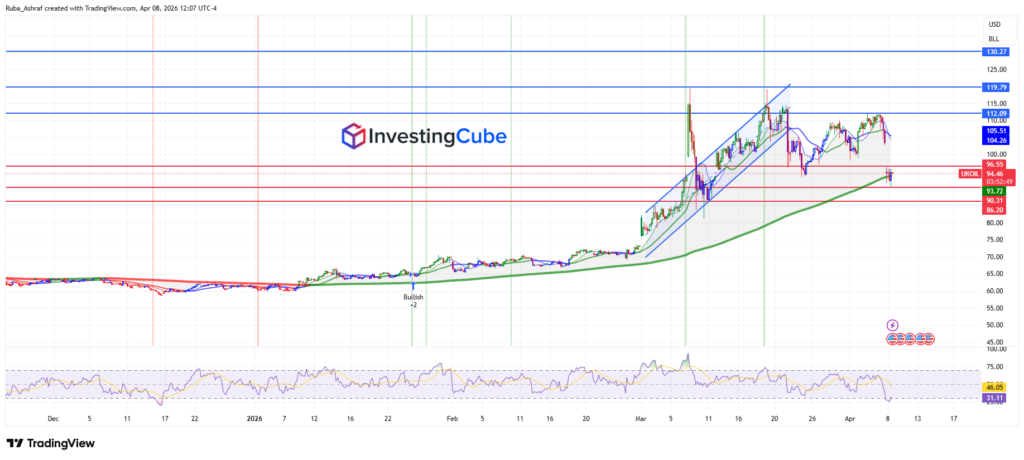
The chart shows a strong bullish trend that developed over time, especially since the US-Iran tensions began. Today’s shift into a corrective phase, gapping lower, followed the 2-week ceasefire agreement.
Currently, the price has dropped sharply and is testing a key support zone around the 93–95 level, which aligns closely with the long-term moving average. This area is critical; holding above it could lead to a short-term rebound, while a clear break below may open the door toward deeper support levels near 90 and 86. The recent reaction here shows some attempt to stabilize, but the structure remains fragile.
At this moment, we can say that the market is “in a pause” waiting for further development in the US-Iran tensions. Traders are waiting for the outcomes of the upcoming US-Iran meeting in Islamabad this Friday.
Looking at momentum, the RSI has moved lower and is approaching oversold territory. This reflects the strength of the recent sell-off. However, it also suggests that a short-term bounce is possible if buyers step in around current levels.
Overall, the trend has shifted from strongly bullish to corrective. The market is now at an indecision point, waiting for a new catalyst. The price may either rebound from support to regain upward momentum or continue lower if support fails.