


- Fed interest rate decision on December 10 will have a significant impact on the appetite for high-risk assets like BTC
- Some institutions like Strategy have been buying BTC but ETF data signals reducing confidence
- On-chain metrics signal potential undervaluation, which could help trigger a rebound
As of this writing, Bitcoin price is floating around $90,500, a bit lower than the $93,500 peak we saw last week. Will it cap off 2025 with a triumphant breach above $100,000, rewarding the faithful, or succumb to pressures and close below $90,000, echoing past winters?
The Bullish Case
If Bitcoin does go above $100,000 by December 31, it will likely be because the Federal Reserve might decide to lower interest rates at its December 10-11 meeting. This could send more money into high-risk investments like Bitcoin. ETF inflows could reignite, as BlackRock’s IBIT alone netted $28.76 million on December 8 despite broader outflows of $60 million, per SoSoValue data.
Meanwhile, major institutional investors like MicroStrategy, who added 10,624 BTC last week at an average price of $90,615, are also helping. Data shows that long-term holders have increased their supply by 2% since November, meaning they’re buying more, not selling. Gate.io’s 2025 MVRV study shows that Bitcoin might be undervalued and could go up by 15-20%.
The Bearish Case
The strongest case for a sub-$90,000 close is the current bearish tilt in on-chain indicators. The MVRV (market value over realized value) Z-score, a key valuation metric, has recently flipped into “overheated territory,” while network activity has weakened, and stablecoin buying power has declined. These patterns, according to analyses, resemble the early stages of a downturn rather than a continuation of a rally.
Current observations show older supply returning to the market with soft demand, which has historically pressured the price downwards. Furthermore, if the Fed delivers a less dovish message than expected, this macro shock could trigger rapid deleveraging in the thinly traded December market, pushing the price towards key support levels below $90,000.
If spot ETFs continue to lose money, like the $60 million lost yesterday, and if regular investors start to lose confidence, Bitcoin could drop further. Reuters warns of a possible Bitcoin winter if this year sees its first annual decline. Glassnode reports that things look tense, similar to early 2022, with active addresses dropping 25% in November and profit/loss ratios going negative, which could mean people are giving up.
Bitcoin Price Prediction
Bitcoin’s technical structure is at an inflection point. Following the rejection from the $120,000+ zone, the price has been trading in a corrective phase. The coin could build some near-term upside momentum if it avoids breaking below the 10-day SMA at $90,390. The next significant barrier will be at $94,230, and a strong support at that level could see BTC retest $100,000.
The main support level is at the psychological $90,000 mark and a break below that level could send Bitcoin price lower to the $84,656-$80,537 support band.
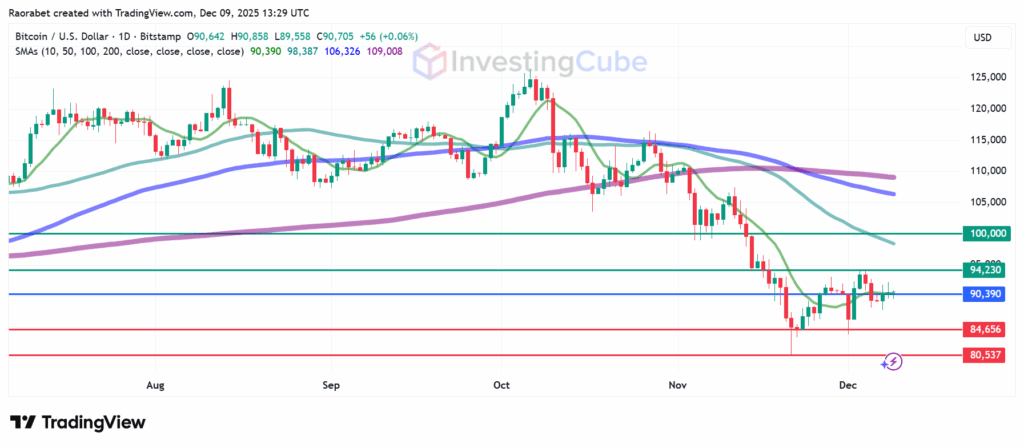
BTCUSD daily chart on December 9, 2025 with key support and resistance levels. Created on TradingView
The clearest sign would be if the price consistently stays above $97,000. This is where the price has struggled before, and it also breaks a downward trend. If this happens, it would cancel out the negative outlook and open the door for a move toward the $100,000 mark.
The MVRV Z-score compares Bitcoin’s current market value to the actual value of all Bitcoins. A high score means things might be getting too hot. Current numbers show the score is high, suggesting the price is higher than what the average coin holder paid.
If the Fed decides to hold steady on interest rate cuts, it could make Bitcoin act more like stocks, which could lead to sell-offs. Reuters notes that ETFs are seeing money leave (a loss of $60 million yesterday), which makes the problem worse. Also, fewer active Bitcoin addresses (down 25%) points to weak demand.