


- Silver price declined by over 35% in just three sessions as hawkish US government statements favoured the dollar, triggering mass liquidations
- The metal's structural story is unchanged as massive demand from AI data centers and green energy cushion outlook for 2026
- Some analysts warn that silver price has been subjected to excessive speculation, predisposing it to sudden sharp drops
Silver has had a wild ride since mid- last week. In just three trading sessions in early February 2026, it crashed by over 35% (including a 26% drop on a single day), falling from record highs above $110 per ounce. But just when people thought the silver bull run was over, it jumped more than 9% in a single day. So what’s happening?
Why Silver Price Plummeted
The drop started in late January when silver hit a record $121.64 per ounce. Within hours, it had fallen to around $85, wiping out billions in market value. Market watchers say this happened because President Trump nominated Kevin Warsh as head of the Federal Reserve, which was seen as a sign of tighter monetary policy. Warsh’s tough stance made the U.S. dollar stronger and made assets like silver, which don’t pay interest, less appealing.
Speculation also played a big part. In late January, news came out that the Chinese government had stepped in to limit leveraged trading on its exchanges to prevent capital chaos. This news shook the global market, especially the Shanghai Gold Exchange, where silver had been selling at a much higher price.
To make things worse, the CME Group increased margin requirements on silver futures from 11% to 15%, according to CNBC. This forced traders using borrowed money to sell off their positions quickly. Overbought conditions, after a 250% increase in price, were pointed out by Bank of America.
Is the Rally Over?
Today’s 9% recovery suggests that while the weakness has been shaken out, the fundamental floor remains incredibly high. It appears the rally is not concluded, though it may face interruptions. The plunge was a positioning shock rather than a fundamental shift.
Silver’s role as both an industrial metal and a safe investment supports its strength. Broadly speaking, the metal’s structural story hasn’t changed. Silver is currently experiencing its fifth year in a row of supply shortages. With the big growth of AI data centers and solar energy, industrial demand isn’t affected by price, meaning companies need the metal whether it costs $70 or $100.

Analysts are divided on this. JPMorgan’s Marko Kolanovic warns of a possible fall to $50, citing too much speculation, while others, like GoldSilver’s Alan Hibbard, predict prices above $100, maybe even $175 if deficits get worse. Past patterns suggest recoveries after price drops like this are possible, but there are still risks from a stronger dollar.
Silver Price Prediction
After rebounding from a monthly low near $71.34, silver has its pivot at the psychological $80 mark and action above that level favours the buyers to stay in control. The Average Directional Index (ADX) indicator reading has dropped from above 70 during the recent downturn and is at 58, affirming the weakening of the downtrend and the onset of bullish control.
Immediate resistance is at $87.96, the previous session’s barrier. Action past that level could take XAG/USD higher to the middle Bollinger Band level at $93.18. If the metal flips that into a support, it could build the momentum to reclaim $100.00. The downside has primary support at $75.64 and secondary one at $69.87, corresponding to the lower Bollinger Band on the daily chart.
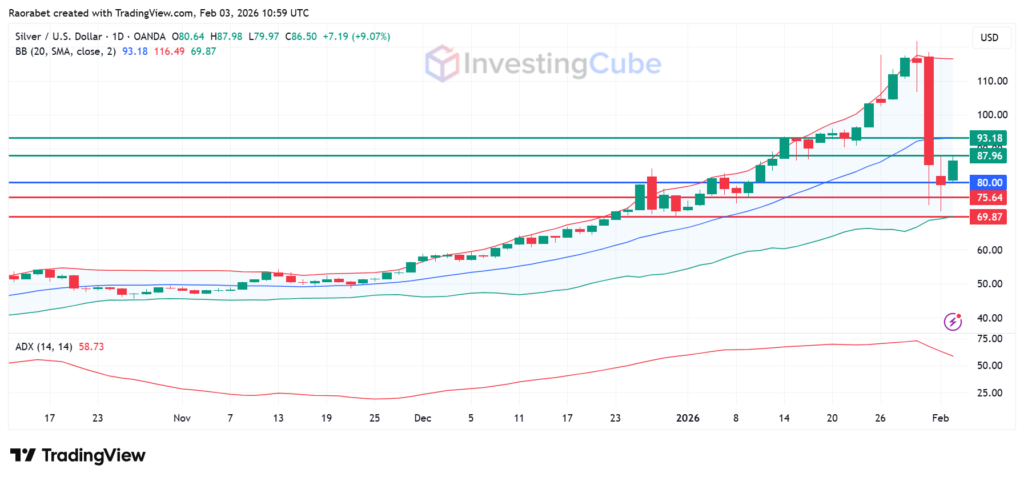
Silver price on the daily time frame with the main levels of resistance and support on February 3, 2026. Created on TradingView
The drop was caused by Trump’s nomination of Kevin Warsh, which strengthened the dollar, plus CME margin increases that forced liquidations.
The rebound was from bargain hunting after the sharp drop, with investors seeing the metal as oversold.
Yes. While investment hype caused the recent spike, the bedrock of the 2026 market is silver’s essential role in green energy infrastructure and AI data centres.