



- An upbeat start to the year with Brent above $70 transitioned to weaker demand quarter after quarter, ultimately sending oil to $50s
- High output from non-OPEC members neutralised te impact of supply cuts by OPEC cartel
- Reduced uptake by China amid economic struggles negatively affected demand outlook
Oil prices were weak for most of 2025, making industry leaders and investors wonder if the commodity’s isn’t so valuable anymore. There was record-breaking production from countries outside OPEC, and major economies didn’t recover very fast. Now, as we go into 2026, there’s way too much oil stored up. So, what’s going on with the world’s most traded product, and what does the future look like?
A Year of Sliding Through the Four Quarters
At the start of the year, Brent crude was about $72. Prices went up initially, reaching almost $83 per barrel because of initial hope around a global recovery and the belief there might be supply issues. But, prices mostly stayed around $78 because the United States and Brazil produced more oil, which added pressure even though demand was steady. Data from the International Energy Agency (IEA) showed that winter demand helped a little, but people were already worried about rising supplies.
In the second quarter, prices dropped into the $60s. The US administration’s Liberation Day tariffs and changes in trade policy caused problems in global trade. J.P. Morgan Research said that this time, people were more afraid of a global manufacturing slowdown than of supply disruptions.
In June and July, prices went up temporarily because of increased tensions between Iran and Israel. That pushed prices back up to around $80. But, this geopolitical risk disappeared quickly when it became clear that the actual supply wasn’t interrupted.
By the end of the year, Brent had fallen to about $62, which is the lowest it’s been in four years. OPEC+ recently changed its strategy from focusing on price to focusing on volume, showing they’re willing to let prices drop to get back market share from producers with high costs.
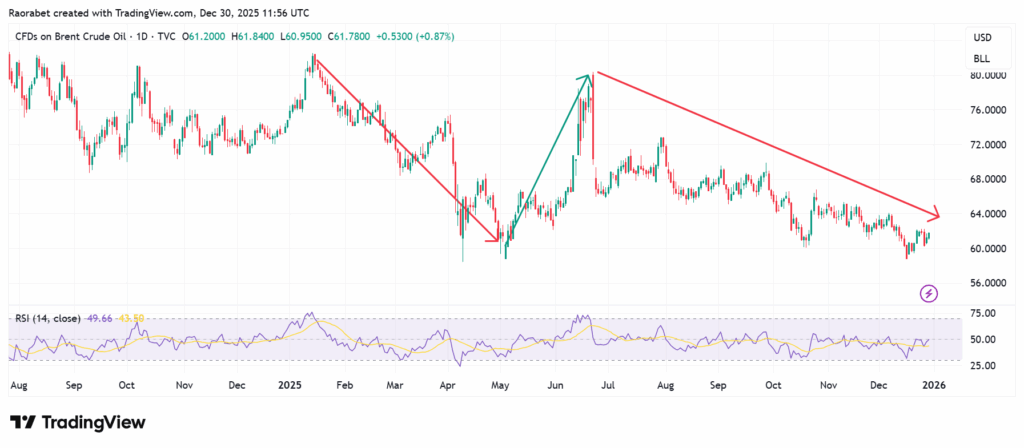
Brent oil price trend in 2025. The commodity spent most of the year on a downward trajectory. Source: TradingView
Why Oil Underperformed in 2025
The primary culprit for the 2025 slump was a “lopsided” balance sheet. While the world was expected to be oversupplied, the sheer scale of the surplus caught many off guard. Non-OPEC+ production, led by a record-breaking 13.6 million barrels per day from the US, effectively neutralized every attempt by Saudi Arabia to prop up prices.
Furthermore, the “China factor” underwent a structural change. For decades, China drove oil demand. But in 2025, its electric vehicles became more popular, and the property market struggled. This dragged China’s demand growth to less than half of what it used to be, according to World Bank data.

Oil Price 2026 Outlook
Looking to 2026, fortunes could change if demand rebounds or supply is curtailed, but forecasts suggest continued pressure. The EIA Short-Term Energy Outlook projects Brent will average $55 per barrel, with similar prices throughout the year, because of rising inventories.
Reuters has recently predicted that the risk of a supply glut in 2026 is still there, with prices in the mid-$50s to low-$60s, as non-OPEC output increases. There could be opportunities if OPEC+ cuts production or if there are geopolitical problems in the Middle East, which could tighten markets and raise prices, according to analyses from Oilprice.com. A rise in demand from emerging economies or policy changes could also improve things.
But, there are risks. J.P. Morgan warns that too much supply could push Brent below $50, possibly returning to prices as low as during COVID. Economic slowdowns, especially in China, and unchecked production from the Americas could also lower prices.
Goldman Sachs says that Russia is a key factor, with potential to lower forecasts. Also, potential peace agreements in Ukraine or changes in Russian sanctions could flood the market with more sanctioned oil that is currently stored on tankers. Basically, while there may be some chances for improvement, the industry needs to be careful this year.
China’s role as the world’s biggest source of demand changed significantly in 2025. A struggling housing market and more people using electric and hybrid cars caused much less oil consumption growth than before.
It’s the added cost in oil prices due to worries about supply issues from conflicts. In 2025, this extra cost went away because oil shipments stayed steady, even with issues in the Middle East and Ukraine.
Oversupply and rising inventories could push prices below $50, exacerbated by economic slowdowns in China and unchecked production, as warned by J.P. Morgan and Goldman Sachs analyses.