



- The US labor market data delay heightens economic uncertainty, boosting gold’s appeal as a safe-haven.
- US dollar movements amid the delay can further affect gold, with a weaker dollar typically supporting higher prices.
- Easing US‑India tensions may limit gold gains.
- Markets are watching US‑Iran nuclear talks on Friday, which could influence gold sentiment.
Gold prices rallied to $4,932.78, rising by 266.25 points, or 5.73%. During the first half of the European session, gold briefly touched the $4,950 level.
Several factors are driving this recovery. Expectations of Federal Reserve interest rate cuts have increased following the nomination of Kevin Warsh as the next Federal Reserve chair. As a result, US dollar gains remain capped amid the prospect of lower interest rates. This environment can drive flows toward safe-haven assets like gold and silver.
On the geopolitical side, the signals of de-escalation of US-Iran tensions over the latter’s nuclear program can limit Gold gains slightly. Along with the US-India trade deal, which seems to be going in a positive direction.
On the other hand, the CME’s decision to increase the margin requirements on precious metals futures could be a bearish catalyst for the gold price. With that, we expect the gold price to struggle before rallying back to $5000.
What Do Fed Policy Signals and Macro Data Mean for the USD and Gold Prices?
- On Friday, the US President Donald Trump nominated Kevin Warsh to be the next Fed Chair after Jerome Powell leaves in May.
- Warsh is known for his hawkish stance, which means he would stay alert if inflation starts rising.
- The CME Group announced over the weekend that it would increase margin requirements on precious metals futures starting from market closing on Monday. This decision tightens the liquidity in the market, dragging gold to a four-week low on Monday.
- US-India tension eases with Trump’s announcement on Monday that they have reached a trade deal and will lower tariffs on each other’s goods.
- Investor confidence strengthened on the ongoing talks between the US and Iran. It’s expected to resume its nuclear talks on Friday.
Macro Data to Watch:
- The US Institute for Supply Management reported on Monday that the PMI for factory activity rose to 52.6 in January, recovering from 47.9 in December. This means that US factory activity expanded for the first time in a year, moving back into expansion territory (above 50).
- Due to the partial US government shutdown, some key macro data will be delayed:
- The Job Openings and Labor Turnover Survey (JOLTS) for December 2025.
- The Nonfarm Payrolls (NFP)
In turn, US dollar price dynamics will influence gold prices. On the other hand, a lack of liquidity may cause XAU/USD to struggle and trade sideways until a clear catalyst emerges.

US–India de-escalation and ongoing nuclear talks between the US and Iran could cap gold buyers’ momentum, while sellers continue to digest broader market developments.
The Technical Outlook for Gold Price (XAU/USD):
The chart shows gold’s recent price action in a clear ascending channel. The upper boundary of the channel, around the $5,145 level, currently acts as a key resistance, while the lower boundary, near $4,393, acts as a key support.
Gold’s recent pullback from all-time highs indicates that if it fails to consolidate near its current level around $4,920, it could potentially test the lower support zone.
The MACD suggests that bullish momentum is attempting to return, indicating moderate upward pressure rather than a strong trend. The RSI is currently around 48, signaling that selling pressure has eased and there is room for further upside. But gold is not yet in strong overbought territory.
Overall, the chart shows cautious optimism that gold could recover toward the resistance, but failure to consolidate above current levels may trigger a deeper pullback toward the key support level.
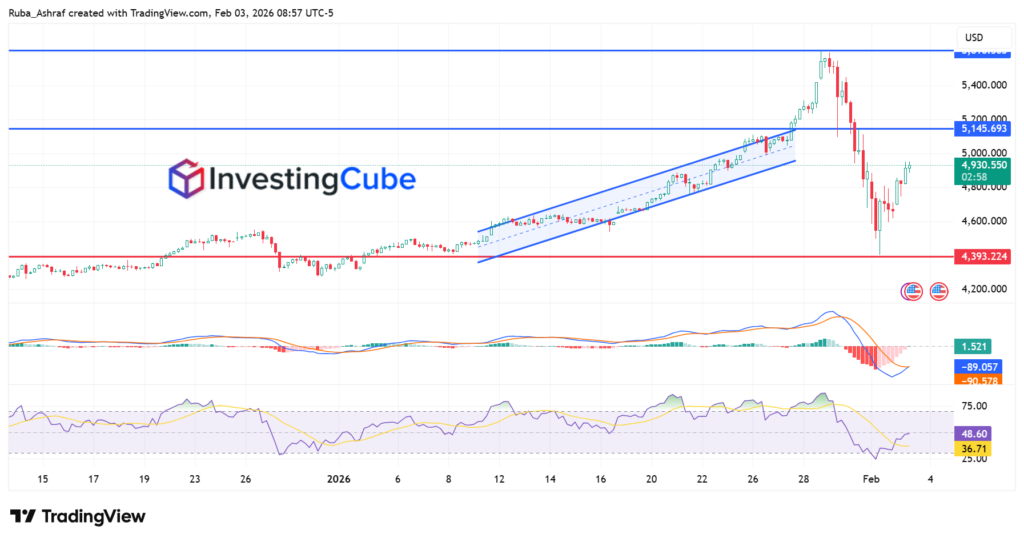
Gold faces strong resistance around $5,145 and critical support near $4,393; failure to hold current levels around $4,920 could trigger a pullback
Delayed labor data adds uncertainty about the US economy, boosting gold’s safe-haven appeal. US dollar fluctuations can also influence gold, with a weaker dollar often supporting higher prices.