



- Gold is consolidating above $5,000 after failing multiple breakout attempts amid profit-taking and rising volatility,
- Short-term price action is range-bound, while the broader long-term bullish structure remains intact.
- Dollar strength, shifting risk sentiment, and macro uncertainty are capping near-term upside momentum.
Volatility Rises as Markets Reassess Direction
Gold in early February 2026 has become complex and volatile as traders rethink the dynamic between strong long-term bullish fundamentals and higher short-term headwinds. Having rallied to all-time peaks earlier this year, XAU/USD has since struggled to preserve its upside bias and maintain a firm psychological hold above $5000 as markets pause to reassess positioning and tactical strategies.
Latest Price Action and Market Commentary
As of February 6, 2026, spot gold is trading within a wide range fluctuating around the mid-$4,700, and just below $5,000 per ounce. Multiple attempts to sustain prices above the $5,000-$5,100 zone have been met with rejection selling, as traders have been quick to take profits at elevated levels. This does not signal that bears are in control, but rather reflects strong supply emerging near recent highs.
The sharp rally that propelled gold to these levels was driven by a combination of geopolitical risk, persistent global uncertainty, and robust safe haven demand. However, once prices reached historical extremes, profit-taking accelerated, particularly as broader financial markets experienced the bouts of volatility. This has resulted in wider intraday swings and more two-sided market structure.
Key Fundamental Drivers
The U.S.dollar remains one of the most important near term drivers for gold. Recent sessions have seen intermittent strength, which typically weighs on gold by making it more expensive for non-U.S. buyers. Even modest rebounds in the dollar index havw been enough to cap gold’s upside momentum in the short term.
US macroeconomic data also continues to dominate the narrative. Investors are closely monitoring labor market and inflation indicators as this will shape expectations for future Federal Reserve policy. While longer-term assumptions remain skewed toward looser monetary conditions later in the cycle. Near-term uncertainty has helped keep yields and the dollar supported, reducing golds’s appeal as a non-yielding asset.
Market sentiment and risk dynamics also play a role. Recent declines in equity markets —particularly among high-valuation technologies stocks — have times forced investors to liquidate gold positions to meet margin requirements elsewhere. Such cross-market pressures can temporarily disrupt gold’s traditional safe-haven behavior, even amid elevated macro risks.
Technical Structure and Key Levels
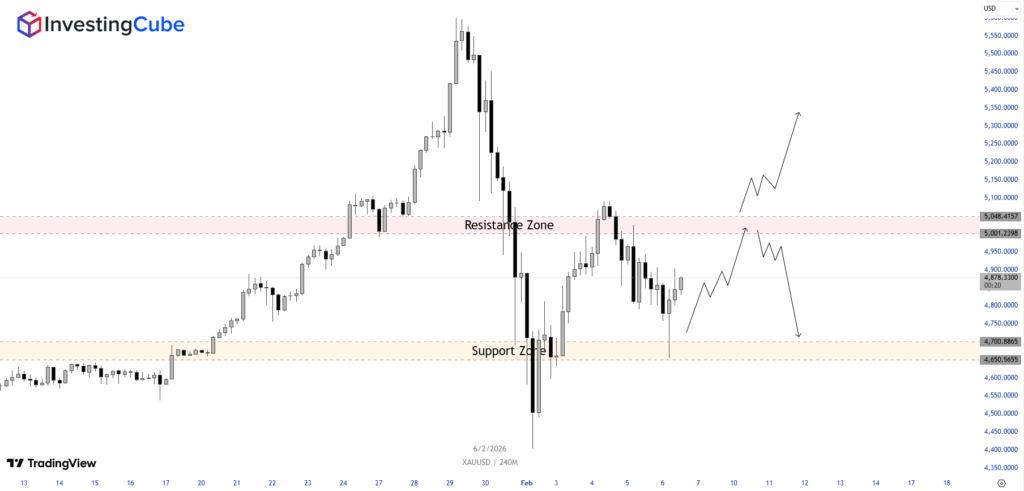
From a technical perspective, gold remains in the broader uptrend on higher time frames, but short-term signals point to consolidation rather than trend continuation. The $5,000 level represents a major psychological and technical barrier, reinforced by previous highs and heavy trading volume. A daily close above this area would be required to confirm a fresh impulsive move higher.

On the downside, a key support confluence lies in the $4,650-$4,700 zone. This area has repeatedly attracted buying interest and aligned with prior breakout levels and moving average convergences. A decisive break below this support could trigger a deeper corrective move, potentially towards the low $4,500s, though such a scenario would likely require a material shift in the macro backdrop.
Short-Term vs. Medium Term Outlook
In the near term, gold is likely to remain range$bound with traders responding to the U.S. data releases, dollar movements, and shifts in risk sentiment. Volatility may stay elevated, but conviction in either direction appears limited without a clear catalyst.
That said, the medium to long-term fundamental case for gold remains constructive. Ongoing geopolitical risks, steady central#bank gold purchases and lingering concerns about global economics stability continue to underpin the broader bullish narrative. As long as key support level holds, pullbacks are likely to be viewed as corrective rather than trend-reversing.
Conclusion
Gold is transitioning from a sharp rally into a grinding consolidation phase, marked by increased volatility and more tactical trading behavior. While near-term risk suggest further pullbacks remain possible, the broader macro and structural drivers continued to support gold over the longer term. The coming sessions will be crucial in determining whether XAU/USD can break decisively into new highs or whether a deeper correction phase is needed before the next leg higher.
Frequently Asked Questions
Heavy profit-taking, intermittent strength and strong technical resistance around the $5,000 level have limited follow-through buying.
Not necessarily. So far, the move appears to be a consolidation or a correction within the broader bullish trend.
Major resistance lies around $5,000 to $5,100 while key short-term support is located near $4,650-$4,700.