




- Explore the latest crude oil outlook and updates on the reopening of the Strait of Hormuz, easing geopolitical risks and market uncertainty.
The United States and Iran have signed a memorandum of understanding (MoU), activating a 60-day agreement to reduce tensions and ensure maritime stability. Iran has confirmed that the Strait of Hormuz remains open to shipping, although vessel traffic continues to face some operational limitations. The United States announced the end of its naval blockade, implementing the measure ahead of the 30-day timeline previously agreed upon by both parties.
The agreement significantly lowers immediate risks to global trade, energy markets, and supply chains by safeguarding navigation through one of the world’s most critical oil transit routes. Despite the breakthrough, future negotiations may face challenges as Iran reportedly plans to introduce maritime transit fees for vessels using the strait after the 60-day negotiation period.
The current MoU guarantees safe and free passage only during the 60-day window, leaving the waterway’s long-term governance unresolved. Overall, the deal has eased near-term geopolitical risks, reducing concerns over potential disruptions to global energy supplies and international shipping.
Crude Oil Price Technical Outlook:
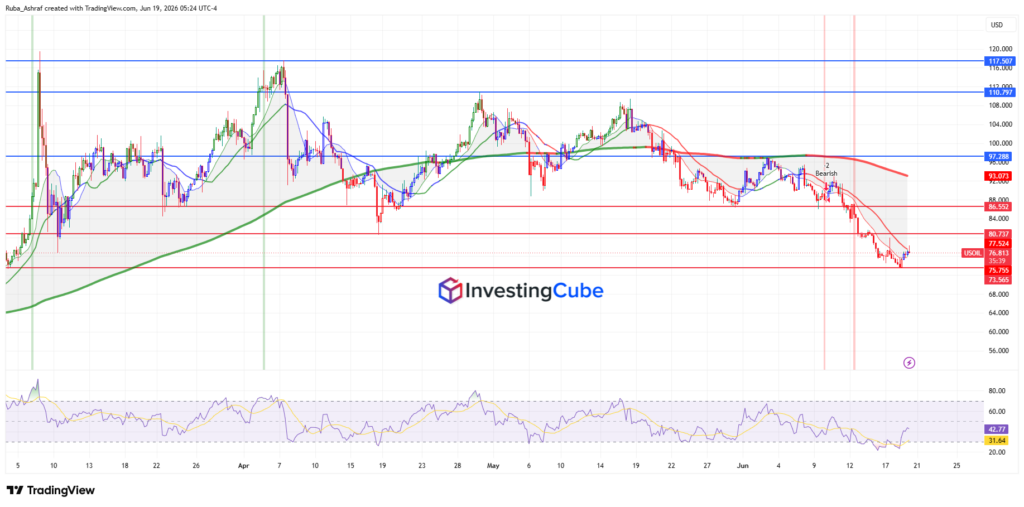
The crude oil remains under significant bearish pressure following the sharp decline triggered by easing geopolitical concerns. Moreover, there are expectations that the Strait of Hormuz will remain open. The broader structure has shifted decisively lower, with price breaking below several key support levels.
The market is now trading well below the major moving averages, highlighting a deterioration in medium-term momentum. The moving average reinforces the bearish outlook. The short-term moving averages have crossed below the longer-term averages. Meanwhile, the 200-period moving average continues to trend downward. This creates a bearish alignment across all major trend indicators, suggesting that sellers remain in control.

The highlighted “bearish” pattern on the chart accurately reflects the recent breakdown from a lower-high formation near the $90-$92 region. After failing to reclaim the key resistance zone around $86.55, sellers accelerated the decline, driving prices through support at $80.74 and eventually toward the major floor around $73.56. The inability to hold above previous support levels confirms that market sentiment has shifted from correction to a broader downtrend.
The RSI has rebounded from oversold territory and is currently recovering toward the neutral 50 level. This suggests that selling pressure has eased in the near term and that the market may attempt a corrective bounce.
Looking ahead, the first resistance zone lies around $77.38, followed by the stronger resistance area at $80.74. A sustained move above these levels would signal that buyers are regaining some control and could open the door for a deeper recovery toward $86.55.
On the downside, the key support remains at $73.56. A break below this level would confirm the continuation of the bearish trend and could expose additional downside targets as the market searches for a new equilibrium after the recent collapse.