- The commodity weekly roundup indicates that energy prices remain the primary driver of the commodity markets.
Here’s the commodity weekly roundup for the week ended 26 March 2026.
The dominant theme for commodity markets remains the ongoing Iran war and the inflationary shock that has so far affected the energy markets (crude oil and derivatives), fertilizer, and shipping. As such, crude oil continued to set the tone for the broader commodity market. In contrast, metal assets continued their violent whipsaws as the geopolitical situation shifted interest rate expectations back and forth. The agricultural markets, hitherto mostly weather-driven, are now facing higher input costs.
Crude
Crude continued to dictate cross-asset pricing. On 26 March, Brent and WTI rose again to around $105 and $93, respectively. This occurred as hopes for de-escalation faded quickly, with the Houthi rebels in Yemen joining the fray and the Strait of Hormuz still closed to shipping. The resumed geopolitical premium has broader market commentary calling for Brent crude to push above $110 as the supply disruption and the conflict continue. The weekend deployment of 3,500 US troops to the region reinforces the risk premium, keeping oil as the market’s primary macro driver.
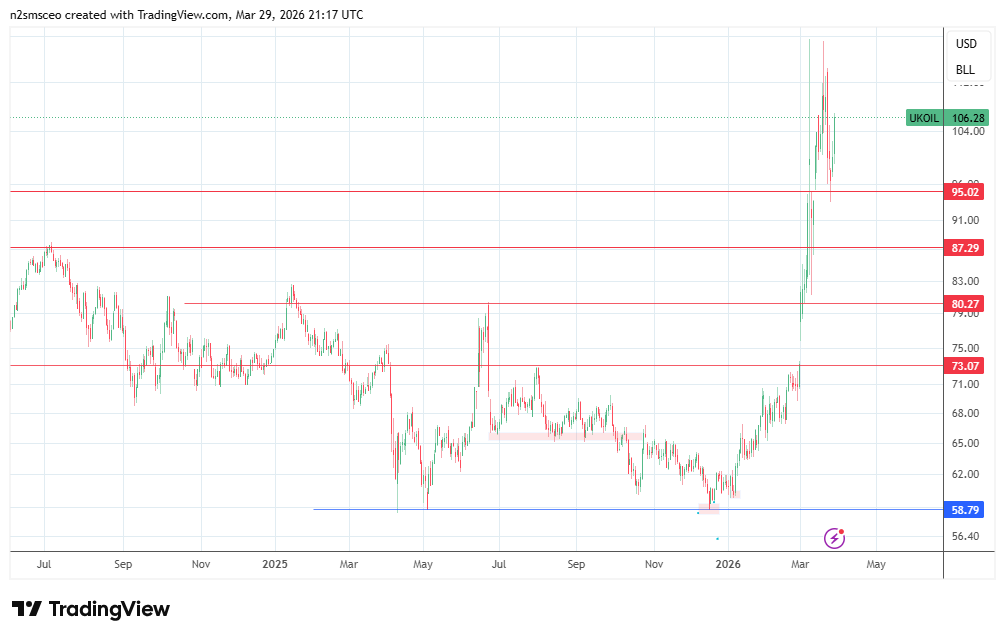
The conflict, which by all accounts is the largest global energy disruption in history, has shuttered 20% of world oil and LNG flows. In addition to rising energy costs, several countries are now facing rationing of energy products.
The price information for the week is clear: crude oil prices are now feeding directly into inflation expectations and, as a consequence, interest rate pricing.
LNG Pricing Remains Supported
Natural gas prices remain supported by the same Hormuz disruption factor, even though price action appears less pronounced than that of Brent crude. According to Reuters reports, LNG shipping rates have spiked by more than 40% since the first bombs fell.
The broader market narrative continues to price in additional logistics constraints, damage to key LNG infrastructure (such as Iran’s missile strike on UAE’s LNG trains), and Gulf-export uncertainty to LNG price action. So far, the price appears to have found a double bottom support at $2.85, which keeps the October 2025 and early March 2026 $3.48 price target within reach.
The LNG pricing situation matters because natural gas is an industrial energy input, and rising costs send producer prices higher. The war is now a broader energy-complex story.

Gold remains volatile
Gold reversed sharply in the week under review, jumping more than 3% on Friday, 26 March, to around $4,536. This was aided by dip-buying after gold had struggled under the weight of a firmer dollar and higher oil-driven inflation expectations.
Earlier in the week, Reuters also reported that gold was climbing toward $4,553 as oil softened, halting the higher repricing of rate expectations. The current gold market remains in a tug of war between the pull of safe-haven demand on one side and higher-for-longer rate expectations on the other.
Industrial Metals Followed Gold’s Upside Push
Industrial metals also mirrored gold’s performance. Silver, platinum and palladium rose 4%, 3% and 3.7%, respectively in a move that was more of a relief rally rather than a full-fledged reversal of sentiment. The message here is that dip buyers are still in business even as the geopolitical backdrop remains unresolved. Any renewed rise in yields or changes to inflation expectations remain macro drivers at the moment.
Copper remains constructive in the long-term
Copper prices remain constructive in the long term despite their relatively nondescript price action compared to other metals. In January, several institutional analysts were polled and they provided a 2026 LME cash copper consensus price of $11,975 per metric ton in 2026. This number represents the highest annual consensus on record, driven by mine disruptions and supply concerns amid cautious demand.
Copper sits between two competing narratives. tighter supply on one side and global growth concerns on the other, following ongoing energy price hikes. I had mentioned earlier that rising energy prices would raise production costs and producer prices. If the ongoing energy shock spreads into the broader industrial inflation complex, copper would be an asset to watch.
Outlook for the week ahead
The main question for the week ahead is whether commodity markets will continue to trade as dictated by a sustained supply-shock regime or shift back to a regime driven purely by risk-premia.
Continued closure of the Strait of Hormuz and persistence of the risks to energy infrastructure will keep oil, LNG, aluminium, and fertilizer-sensitive agricultural markets supported.
On the flip side, a material cooling of oil due to advances in diplomatic efforts may give gold a cleaner footing to chase northbound targets, even as the inflationary risks across industrial and agricultural markets ease.
Presently, the commodity markets remain in an energy-led inflationary complex rather than a regular macro-driven environment. That was last week’s message, and could continue this week.