- Rolls-Royce stock is perceived to carry a significant weight related to the defense industry but it has been declining amid the Middle East war
- While the company generates a substantial amount from military equipment, civil aviation remains its biggest income generator
- Modular nuclear reactors and UltraFan Engine launch could provide strong propulsion in the coming months
Rolls-Royce (LSE: RR) has been a standout in the FTSE 100, particularly following a strong 2025 when profits reached a record £3.46 billion. However, since late February 2026, Rolls-Royce stock has experienced some volatility, declining about 12% from its 52-week peak of 1,420p.
While a 1.2% drop over the past month might seem minor in the context of a five-year rally, the timing raises questions. Given the heightened geopolitical tensions in the Middle East, why is a company with a solid defense portfolio facing challenges?
A Civil Aerospace Company First
The short answer to the above question is that, contrary to popular belief, Rolls-Royce is not primarily a defense stock. Knowing this difference is essential to comprehending the decline as well as what must change for the share price to rise again.
Investors typically associate Rolls-Royce with nuclear submarines and fighter jet engines. Although those are real businesses segments of the company, most of its earnings money does not come from them. According to Rolls-Royce’s own earnings transcript, civil aerospace makes up about half of total net sales, with the remaining portion coming from defense and power systems.
More critically, the single largest profit driver within civil aerospace is not engine sales. Rolls-Royce generates most of its revenue based on actual engine flight hours, which means that the impact of decreased flights due to the conflict in the Middle East directly affects earnings. As a result of the war, civil aerospace has suffered from flight cancellations and reduced operations in the Middle East.
Supply chain issues and production constraints have compounded the pressure, with the conflict indirectly affecting component availability. This contradicts the popular belief that defense pure-plays are inevitably enhanced by war. For Rolls-Royce, the civil aerospace segment’s current struggles appear to weigh more heavily on its near-term performance, while defense contracts, which comprise about 25% of the business, often take time to translate into revenue.
Is this An Opportunity to Buy?
Some analysts view the recent Rolls-Royce stock decline as an attractive entry point, highlighting record earnings and optimistic guidance. However, it’s important to remember that Rolls-Royce’s valuation already reflected strong expectations before recent geopolitical developments.
The consensus view tends to anchor on the operational excellence. Four consecutive years of earnings beats, margin targets hit three years ahead of schedule and a £7-£9 billion buyback programme, make a strong case for one to conclude the stock remains a buy.

Over the next few weeks, changes in European defense architecture and civil aviation will have a significant impact on how quickly Rolls-Royce shares pick up steam. A formal reiteration of guidance in a trading update, or just by the lack of a profit warning would also restore confidence.
Looking further ahead, the company’s long-term prospects remain promising. Progress in its small modular reactor programme, pending regulatory approvals in the UK, Sweden, and possibly the US, could substantially increase the company’s valuation.
Meanwhile, the anticipated UltraFan engine, dependent on government support, may mark a transformative product cycle for the civil aerospace division. These longer-term projects underpin the premium multiples currently assigned to Rolls-Royce by investors, even if they do not materialize as near-term catalysts.
Rolls-Royce Stock Price Forecast
The RSI for Rolls-Royce stock is currently close to 42, indicating that it is getting close to but has not yet reached oversold territory. The pivot is at 1,250p and immediate support will likely be at 1,200p, which has historically attracted buyer interest. The stock may test the 1,154p pivot if it breaks below this. On the upside, the first resistance is at 1,272p, and going above that level will invalidate the downside narrative and potentially clear the path to test 1,303p.
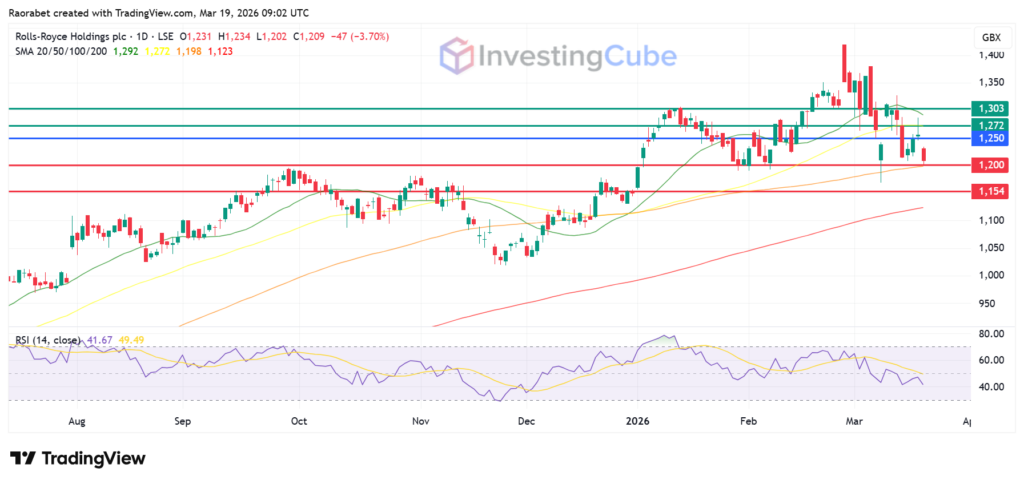
Rolls-Royce stock on the daily chart with key levels of resistance and support on March 19, 2026. Created on TradingView
Because Rolls-Royce’s largest profit driver is civil aerospace servicing, not weapons production. Flight groundings directly cut flying-hour revenue.
Only selectively. The medium-term goals are realistic, and the operational fundamentals are still outstanding. But at current multiples, the margin of safety is still thin.
The impact on civil aviation is significant, as aftermarket revenues tied to miles flown suffer from route cuts. In the midst of protracted tensions, this exposure delays upside more than is generally anticipated.