


- Rolls-Royce stock declined in March, pressured by Middle East war which affected civil aviation negatively
- A ceasefire agreement between the United States and Iran has driven oil prices down, which translates to increased air travel and service hours for Rolls-Royce
- The war in the Middle East will likely lead to increased defense spending, which could increase demand for Rolls-Royce jet engines
After losing over 15% in value in March, Rolls-Royce stock left many questioning whether the long climb tied to CEO Erginbilgiç era could last. This downturn was largely driven by external factors, including a rise in jet fuel prices and geopolitical tensions in the Middle East, both of which threatened the ongoing recovery in civil aviation. However, the situation shifted in April. Within the first ten days, the stock regained more than 11%, demonstrating resilience that surprised many skeptics. So what flipped the script?
What Is Fueling the Gains?
Rolls-Royce’s performance is closely tied to crude oil prices, though this relationship is often misunderstood. While the company does not refine fuel itself, its business depends heavily on engine flying hours.
The civil aerospace sector, Rolls-Royce’s largest source of revenue, produces jet engines for wide-body commercial aircraft and generates significant profits from long-term service agreements linked to those flight hours. When jet fuel prices increase, airlines tend to reduce flying, which in turn lowers the service fees Rolls-Royce collects. Therefore, the ceasefire is more than just a political development; it directly influences the company’s financial outlook.
The ceasefire led to a notable drop in crude oil prices, with Brent and WTI benchmarks falling by over 10%. This decline is expected to ease jet fuel costs for airlines and reduce tensions in the Middle East, where air traffic had been restricted in recent weeks.
Additionally, there are expectations for higher defense spending due to the ongoing Middle East conflict. Military operations have increased demand for Rolls-Royce’s Trent engines, used in fighter jets and transport aircraft, along with related aftermarket services. Analysts from Barclays and JPMorgan recently revised their defense revenue forecasts upward, which has supported the more positive market sentiment.
The stock’s recent strength is also due to short covering after a long period of selling pressure, which caused trading volumes to rise sharply. Even though the mood in the broader market stayed cautious, these geopolitical and technical factors have pushed the share price up.
The Structural Story That Markets Keep Overlooking
Most commentary frames this rebound as a ceasefire trade, implying it could unwind just as quickly as it arrived. That framing, while not wrong, underweights the corporate fundamentals that were already building beneath the surface noise of geopolitics.

The £2.5 billion 2026 buyback, which officially commenced on April 1, is creating a persistent bid in the stock that analysts describe as a price floor. Instead of cashing out completely, CEO Tufan Erginbilgic held on to 4,144 shares from his latest bonus package, offloading just a portion to settle what he owed in taxes. CFO Helen McCabe did the same thing and kept 1,601 shares. When executives sell only to pay taxes and keep the rest, that’s a sign that you should pay attention to. It shows that the company believes in the stock’s intrinsic value.
The underlying financials support that conviction. Rolls-Royce’s guidance for 2026 projects underlying operating profit between £4.0 billion and £4.2 billion, up from £3.46 billion in 2025, alongside free cash flow expectations of £3.6 billion to £3.8 billion. The company’s updated mid-term targets aim for underlying operating profit of £4.9 billion to £5.2 billion and free cash flow of £5.0 billion to £5.3 billion by 2028.
Rolls-Royce Share Price Forecast
Rolls-Royce share price has its immediate resistance at 1,286p. A break above that will bring 1,300 within reach, with action above that likely to confirm a sustained reversal. Primary support sits at 1,230p, with the second one at 1,200p, near the Volume Weighted Moving Average (VWMA) level.
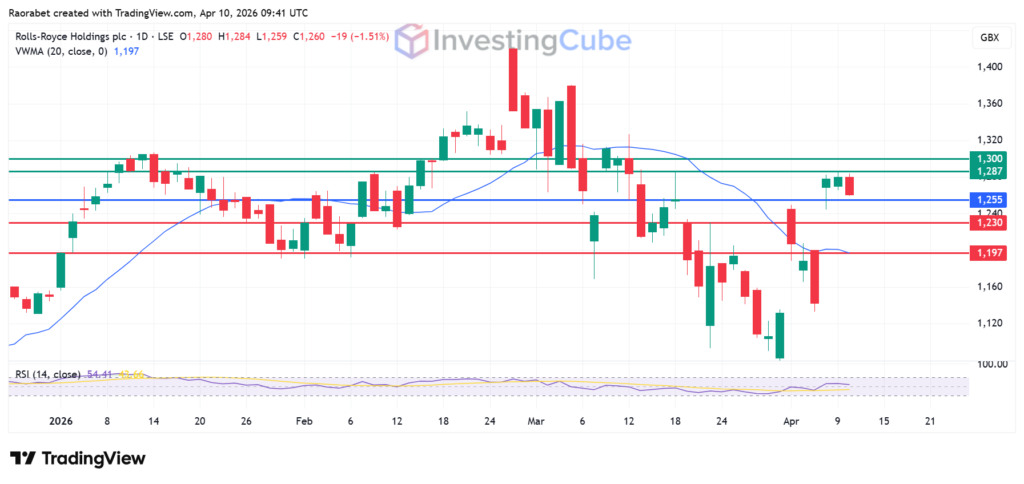
Rolls-Royce share price on the daily time frame with the key support and resistance levels for April 10, 2026. Created on TradingView
The sharp decline was mainly triggered by the escalation of the US-Iran conflict, which pushed Brent crude prices above $100 per barrel. This raised concerns about reduced airline flight activity and led investors to move away from premium-valued industrial stocks in a broad risk-off shift.
The US-Iran ceasefire announcement on April 8 caused a rapid decline in oil prices and reopened the Strait of Hormuz. This development directly benefited airlines and, by extension, Rolls-Royce’s service fee revenue model.
The defence division provides a counter-cyclical hedge. As global geopolitical tensions remain high, the demand for military engine maintenance and new defense contracts provides a stable revenue stream that offsets aviation risks.