



- The HDFC share price forecasts are being repriced lower due to the current unresolved governance issues and the oil risk premia.
HDFC Share Price Forecasts are Being Repriced Lower: Why?
HDFC fell 3.2% on the day, and is also down 28% below its 52-week high as the market starts to reprice confidence in the stock. Most of the selloff has been induced by governance issues, and compounded by the current oil shock that has stemmed from the Middle East geopolitical situation.
HDFC share price forecasts remain dominated by governance headlines amid a high-volatility environment. The sharp selloff in the stock has dragged Indian indices lower, turning it into a systemic index driver.
The stock is trading within the 730-760 price range after a further leg to the south, with heavy-volume selling driving the 6-day selloff that has sent the stock down from 2026 highs at just about 1000 rupees to its current levels, a 25% decline.
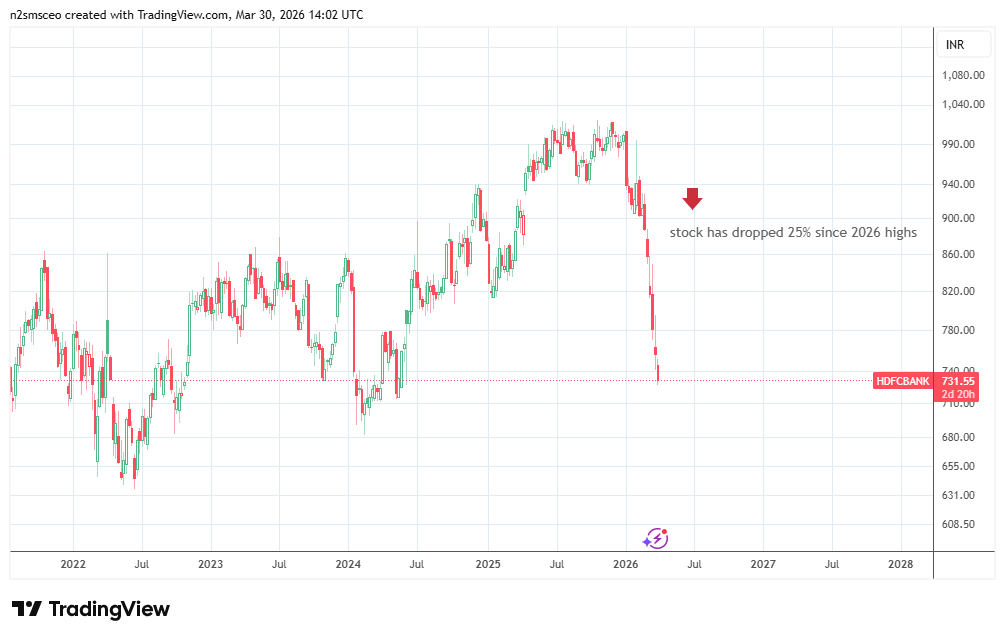
A large market-cap hit was triggered by the sudden resignation of the HDFC Bank chairman, refocusing investor attention on the stability of the bank’s leadership even as the tenure of the current CEO, Sashidhar Jagdishan, lapses at the end of the year.
What is Driving HDFC Share Price Forecasts Right Now?
1. Governance Risk
Governance/leadership risk is now the primary catalyst for the current price action. Following Chairman Atany Chakraborty’s resignation, citing differences in values and ethics, investor attention has shifted to the bank’s internal workings. With internal tensions now exposed, investors are sharply repricing HDFC share price forecasts lower, along with its broader financials. Further reporting by Reuters reveals an allegation by Chakraborty against the bank, stating that disciplinary action was delayed in a case linked to the alleged mis-selling of AT-1 bonds to NRI investors. The allegations have created doubt about the company’s reputation and have reinforced regulatory overhang risk.
2. Oil Shock
India is the third-largest crude oil importer, and the current situation in the Middle East (the Iran war and disruptions to global oil and LNG shipping through the Strait of Hormuz) has put significant pressure on Indian stocks. The Indian stock markets have endured their worst month since the onset of the 2020 COVID pandemic, as crude oil prices inch towards $115 per barrel. The financial stocks, including HDFC, are the hardest hit.
Despite bearish drivers, HDFC Bank still has stable fundamentals, as evidenced by its FY2026 3rd-quarter results. The bank’s gross non-performing assets ratio fell from 1.42% before to 1.24%, pointing to stable asset quality. However, the stock is being priced not on its fundamentals, but on governance and the existing oil risk premium.
Catalysts for HDFC Bank Share Price
The HDFC share price is expected to be catalyzed by the following factors:

1. Clarity on Board/Governance: Investors will seek clarity on the current situation with the board, with emphasis on the succession of the position of Chairman, tone of the management’s communications, and any escalations of the current allegations regarding the AT-1 bonds.
2.Oil/INR Direction: The Rupee has taken a hammering as a result of the current oil shock. The risk premia facing banks tend to widen if crude oil prices remain high and the Rupee stays under pressure. Goldman Sachs has already warned of the potential for additional strains on the INR if the oil disruption persists.
3: Foreign Portfolio Flows: Outflows from foreign portfolio investors hit a new record this month due to the market selloff. The key to stabilizing the market and HDFC lies in resolving the geopolitical situation.
Traders need to understand that what has hit HDFC is more of a systemic shock. The core fundamentals are still in good shape. JP Morgan has raised its HDFC share price rating to Overweight, setting a target of 1,010. The investment bank cites a 16-year low forward price-to-book ratio, improved credit outlook, and easing funding costs, in addition to solid asset quality. Jefferies is also seeing a valuation upside.
Weekly HDFC Share Price Forecast Scenarios
Base case: The base case now calls for the stock to range-trade, with downside skew as governance issues seek more clarity and resolution from investors. If markets continue to trade in a risk-off manner, this scenario is likely to play out.
Bull case: a relief rebound could be triggered if there is credible clarity on the governance issues and stabilization of the geopolitical standoff in the Middle East. A rally can be expected on de-escalation headlines, which could suddenly make the current stock price look like a bargain.
Bear case: a further downside extension could occur if there is an escalation in either the governance issues or the Middle geopolitical tensions. Regulatory involvement or any potential investigation of the NRI investor bond mis-sell allegations are also headlines that can trigger the bear case scenario.
HDFC Share Price Forecast: Technical Outlook
HDFC’s rejection of the 1021.75 region suggests that the stock may have topped out in the medium term. The rejection and hard sell-off have taken out major support levels and the rising trendline that supported the broader uptrend from 2023 till early 2026 with aggressive force.
Price has taken out the 760-780 demand zone, unlocking a move to the 695.60 support. This focus remains valid as long as the price remains below the trendline and the 760-780 zone. If the 695.60 support also fails, focus will shift to 635.40.
However, if price reclaims the trendline and the 760-780 price zone, the focus for the bulls would be an approach towards 863.90, the former top for October 2021-June 2024. A further climb brings in 940.10 into the mix, being the high of December 2024.