
- Both AMD and Intel stocks surged over 7% on Wednesday following reports that both chipmakers are set to raise CPU prices by 10% to 15% starting in March and April.
- Supply chain constraints have extended delivery lead times from 1–2 weeks to as long as 6 months, granting chipmakers significant pricing power in a tightening market.
The semiconductor sector caught a powerful bid this week as Advanced Micro Devices (AMD) and Intel (INTC) reportedly informed clients of imminent price increases across their entire CPU product lines.
According to reports from Yahoo Finance, the price hikes, averaging between 10% and 15%, reflect a worsening supply-demand imbalance as resources shift toward high-end AI and server chips. Investors reacted positively to this display of “pricing power,” sending AMD shares up 7.26% to $220.27 and Intel up 7.08% in Wednesday’s session.
AI demand drives supply crunch and chip price increases
The reported price increases are a strategic response to a tightening global supply chain:
- Extended lead times: Delivery windows for central processing units have stretched from a historical average of one week to between 8 and 12 weeks, with enterprise-grade silicon facing even longer delays.
- Focus on high-end silicon: Both Intel and AMD are prioritizing the production of high-margin server CPUs and AI accelerators, resulting in a widening supply gap for mid-range consumer processors.
- Data center dominance: AMD’s Data Center segment now accounts for over 52% of its total revenue, reinforcing the company’s shift toward high-value infrastructure over consumer PCs.
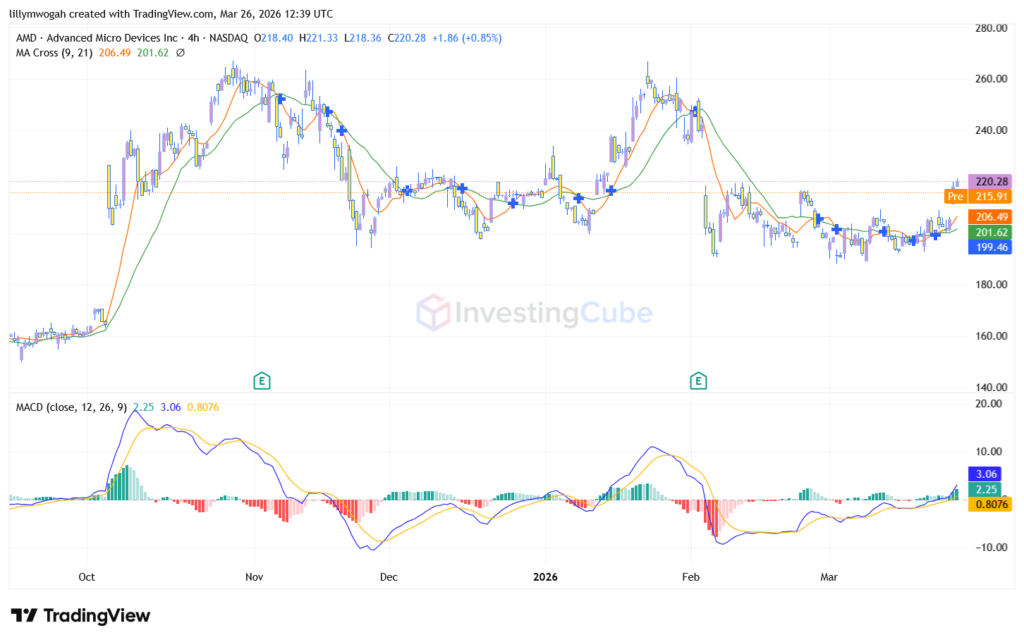
AMD technical outlook: Can AMD hold the $220 handle?
With the reported 15% price hikes now acting as a primary fundamental tailwind, the technical levels for AMD are in sharp focus as it breaks out of its recent consolidation:
- Support: The stock surged to open at $220.27. If the market fails to sustain this level following any broader semiconductor cooling, the focus shifts back to the $214.60 zone (50-day moving average) and the critical Barclays bear-case floor at $186.
- Resistance: Reclaiming the $240 psychological hurdle now depends heavily on whether AMD’s data center momentum can decouple from the wider “AI exhaustion” narrative and potential U.S. tariff noise.

Why investors are buying the hikes
Unlike traditional inflationary price increases, these hikes are viewed by Wall Street as a margin-expansion play. With Meta Platforms recently inking a massive 6-gigawatt GPU deal with AMD and AWS expanding its EPYC cloud instances by over 50%, demand appears resilient enough to absorb the higher costs.
Furthermore, Intel’s launch of its Core Ultra Series 3 enterprise chips on the advanced 18A process technology signals that the industry’s leaders are successfully moving toward more expensive, high-performance manufacturing.
Conclusion: fundamentals vs. supply constraints
The reported 15% price hike from AMD and Intel marks a significant shift in the semiconductor landscape, moving the narrative from volume-driven growth to pure pricing power. As AMD successfully transitions into a data-center-first powerhouse, its ability to dictate terms in a supply-constrained environment represents a major fundamental win for shareholders.
While the path ahead remains “bumpy” due to macroeconomic headlines and potential trade hurdles, the technical breakout above $220 suggests that “chip shortage 2.0” may be the definitive catalyst needed to drive the stock toward its next major price targets. For investors, the focus now remains on whether enterprise demand can remain resilient in the face of these rising costs.
Intel’s price adjustments are taking effect immediately, having started at the end of March 2026 for major PC manufacturers and OEMs. AMD is scheduled to follow with its widespread price hikes beginning in April 2026.
While these wholesale increases are already being implemented, retail consumers may see the full impact on store shelves over the next 4 to 6 weeks as current inventory is depleted.
While the stock is currently trading at a premium with a price-to-sales ratio of 6.78x, many analysts maintain a “Strong Buy” rating, citing projected revenue growth of 32% in Q1 2026 and accelerating AI GPU shipments.
Yes. Since CPUs are a core component, an average increase of 10% to 15% in processor quotes will likely trickle down to higher MSRPs for finished consumer electronics by the second half of 2026.