



- Alphabet (GOOGL) trades lower at $285.29 despite unveiling TurboQuant, a breakthrough that reduces AI memory requirements by 6x without losing accuracy.
- The "TurboQuant Shockwave" rattles the chip sector, with hardware leaders like AMD falling 5.62% as investors fear software efficiency could soften physical hardware demand.
- Immediate headwinds persist as Alphabet battles a "risk-off" macro environment, massive $185B CapEx concerns, and a recent legal negligence verdict regarding social media addiction.
Alphabet Inc. Class A (GOOGL) shares are currently trading at $285.29, down $5.64 (-1.94%) during Thursday’s intraday session. This downward movement comes despite a massive technological breakthrough from Google Research known as “TurboQuant,” which has significantly disrupted the semiconductor and cloud landscape.
While Google’s own stock is feeling the broader market pressure, the “TurboQuant” news has sent even sharper ripples through the hardware sector. AMD (Advanced Micro Devices) is currently falling as well, trading down roughly 5.62% as investors recalibrate the demand for physical chips in light of Google’s new efficiency software. This synchronized dip across tech giants and chipmakers suggests a market-wide digest of how software optimization might shift future hardware capital expenditures.
Google TurboQuant AI: How 6x memory compression is rattling chip stocks
Yesterday, March 25, 2026, Google unveiled TurboQuant, a suite of “extreme compression” algorithms capable of reducing the memory requirements for Large Language Models (LLMs) by 6x without sacrificing accuracy. For Google Cloud and Gemini, this is a massive operational win, as it allows AI models to run faster and on significantly less hardware.
However, as reported by Bloomberg, the news sparked a “shockwave” sell-off in memory and processor stocks, as traders fear that if AI workloads become six times more efficient, the urgent need for massive hardware buildouts might soften in the near term.
Why GOOGL is falling despite AI breakthroughs
Despite the long-term margin benefits of TurboQuant, Alphabet is facing immediate headwinds that have dampened investor enthusiasm:
- Legal and regulatory risks: A California jury recently found Google and Meta negligent in a high-profile youth social-media addiction trial. This verdict introduces significant new legal risks and the potential for substantial punitive damages, creating a cloud of uncertainty over future liabilities.
- CapEx concerns: Alphabet’s aggressive 2026 capital expenditure plan, estimated between $175 billion and $185 billion, continues to weigh on sentiment. Investors are increasingly worried about the impact of this massive AI infrastructure spend on short-term profit margins.
- Macro headwinds: The stock is battling a “risk-off” macro environment. Rising oil prices and heightened geopolitical tensions in the Middle East have revived inflation fears, pushing the broader market toward safer havens and away from high-growth tech names.

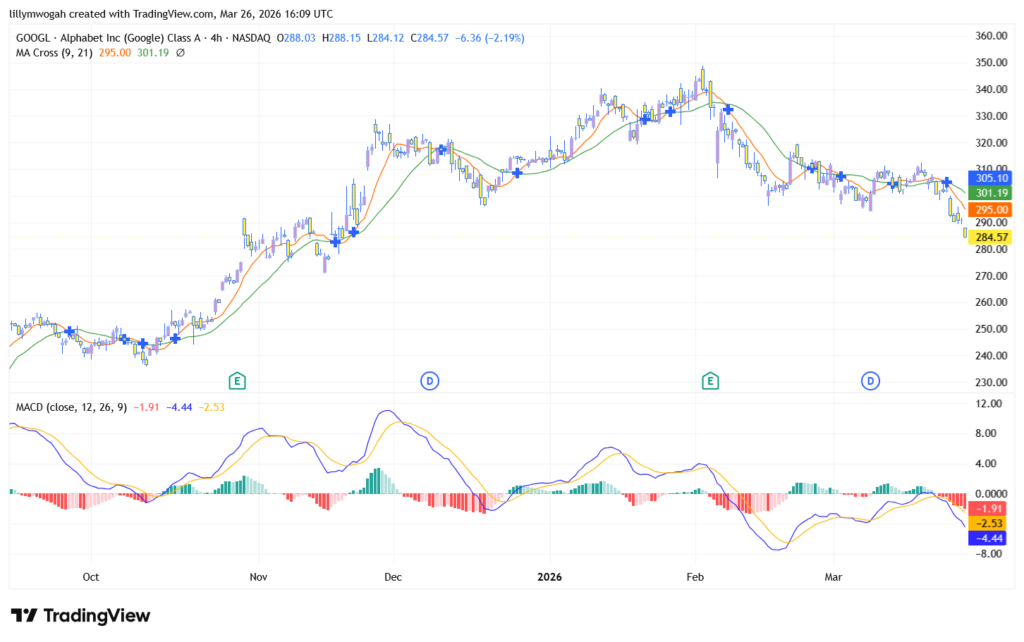
GOOGL technical outlook: Can Google hold the $288 support level?
Alphabet is currently in a correction phase, having dropped approximately 16% from its February peaks.
- Support: Initial technical support rests at the $288.84 level. With the stock currently trading below this handle at $285.29, the focus shifts to whether it can reclaim this floor before the closing bell.
- Resistance: To invalidate the current bearish trend, GOOGL needs a sustained move back toward the $300 psychological barrier, which would require a cooling of the recent legal and regulatory headlines.
- Sentiment: Despite the dip, institutional consensus remains bullish, with a 12-month price target of $345.71, suggesting over 11% upside from these levels.
Conclusion: Efficiency vs. market uncertainty
The unveiling of TurboQuant is a double-edged sword for Alphabet; it proves Google’s dominance in AI software efficiency but simultaneously unnerves a market heavily invested in hardware growth. While the stock is currently facing pressure from legal verdicts and broader sector volatility, the underlying shift toward more cost-effective AI operations is a long-term fundamental win.
For investors, the current dip below the $288 support represents a critical testing ground, the key will be whether Google can prove that software efficiency will lead to higher adoption rates rather than just lower hardware spending.
While TurboQuant is a long-term win for Google’s margins, the stock is facing immediate pressure from a $1.94% intraday dip due to broader macro factors. These include a recent legal negligence verdict regarding social media addiction, concerns over Alphabet’s $185 billion CapEx plan, and rising energy costs for data centers driven by Middle East tensions
TurboQuant is a new AI compression algorithm from Google Research that reduces the memory required to run LLMs by 6x.
It works by optimizing the “key-value cache”, allowing AI to run faster and on significantly cheaper hardware without losing accuracy.