


- Hang Seng Index has experienced increased downward pressure due to Hong Kong's dependence on Gulf oil and investor jitters
- The past five sessions have registered higher volatility, as there seems to be no clarity on the much-reported US-Iran ceasefire talks
- HSI outlook is delicate, but a notable shift in household investments from real estate to stocks is providing some relief
The Hang Seng Index (HSI) experienced significant volatility during the week of March 23, 2026, driven by geopolitical instability and shifting macroeconomic expectations. After recording a 3.5% decline on March 23, the index recovered 2.8% during the following session, reflecting high sensitivity to developments in the Middle East and energy price fluctuations.
A Week of Extremes and Uncertainty
The past five trading sessions have been nothing short of volatile. The week opened with its worst session. On Monday, March 23, the Hang Seng tumbled 3.5% to close at 24,382, its worst single-day loss of the entire Iran conflict.
The primary driver of last week’s volatility was the escalation of tensions between the United States and Iran, which caused Brent crude oil prices to approach $120 per barrel. As Hong Kong is a major net oil importer, the potential for stagflation prompted a broad sell-off across equity markets, particularly in high-growth technology sectors. The index tested critical support levels near 24,765, demonstrating its vulnerability to geopolitical risk premiums.
The primary influence was the evolving narrative around US-Iran ceasefire talks. Early in the week, diplomatic signals. These included the US presenting a 15-point proposal and remarks by President Trump regarding Iran’s good faith gestures on the Strait of Hormuz, prompted relief rallies. This optimism helped the index gain up to 2.8% on March 24 and an additional 1.1% on March 25, as investors anticipated easing oil prices and reduced risk aversion.
Yet mixed signals quickly reversed sentiment. Iran confirmed it was reviewing the US proposal but ruled out direct talks and insisted on meeting its conditions first. This uncertainty, combined with a rebound in oil prices, triggered a pullback, with technology stocks leading the decline.
How Soon Can Hang Seng Index Recover?
Even though things have been rocky lately, the HSI’s outlook is still supported by underlying structural factors. More money is flowing south, thanks to Chinese households moving money from real estate to stocks. This creates a fundamental liquidity floor.
Thierry Wizman, Global FX and Rates Strategist at Macquarie Group, expressed caution, suggesting the conflict may intensify over the next two weeks as the US seeks concessions, resulting in a talk and fight scenario rather than a swift resolution. For his part, Matthias Scheiber at Allspring Global Investments voiced concern too, pointing out that aligning what America, Israel, and Iran want simultaneously will not be easy.

Analysts at IG International, who set a year-end target of 28,300 for the HSI before the conflict erupted, believe the base case is still intact if policy execution and corporate earnings continue to deliver. A de-escalation of the Iran conflict would logically push the index back toward the 27,000–28,000 range as oil retreats and risk appetite returns.
Short-selling activity has picked up on the Hang Seng’s recent rebounds. On March 25, short-selling trades made up more than 15% of total volume, showing institutional investors aren’t fully convinced the rise will last. Behind the uptick, skepticism lingers in how far prices can hold. In such market conditions, what looks like momentum might just be temporary relief.
Hang Seng Index Forecast
The MACD on Hang Seng Index is in a bearish configuration, with the signal line yet to turn positive. Resistance is positioned at 25,800, with a decisive move above 26,350 needed to confirm a sustained bullish trend. Immediate support rests at 25,000, while a critical support floor stands near 24,765.
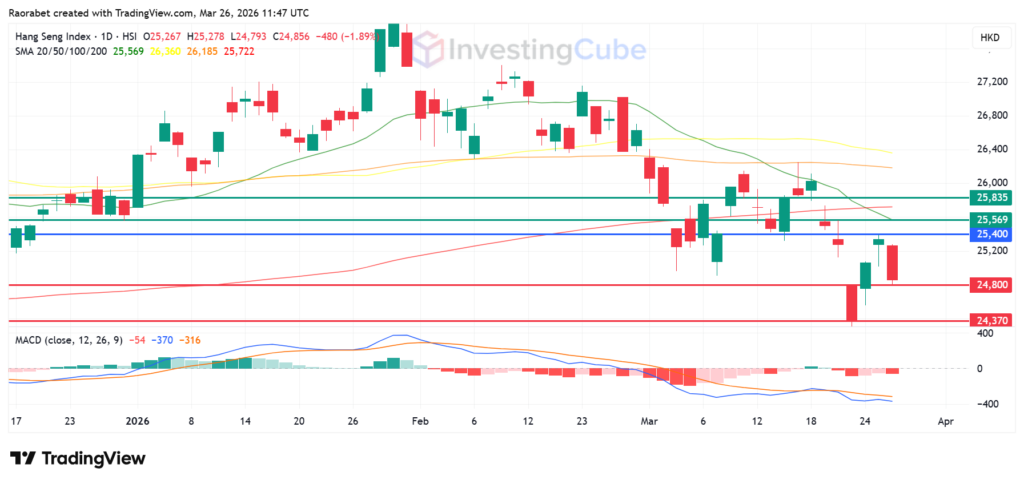
Hang Seng Index performance on the daily chart showing key levels on March 26, 2026. Created on TradingView
The impact is primarily indirect via oil prices, global risk appetite, and rising bond yields that compress valuations of Hang Seng’s technology-heavy components. Hong Kong itself has no direct military exposure but is highly sensitive to global energy and liquidity conditions.
The news of a possible peace framework was a good thing that lowered geopolitical risk premiums. This caused oil prices to stabilize and the HSI to rise nearly 2.8% on March 24.
The outlook hinges on negotiation progress. If the situation calms down, it could lead to a relief rally by lowering oil prices and making people less afraid of risk. If talks don’t move forward, pressure is likely to stay high because energy costs will go up and Asian stocks will stay low.