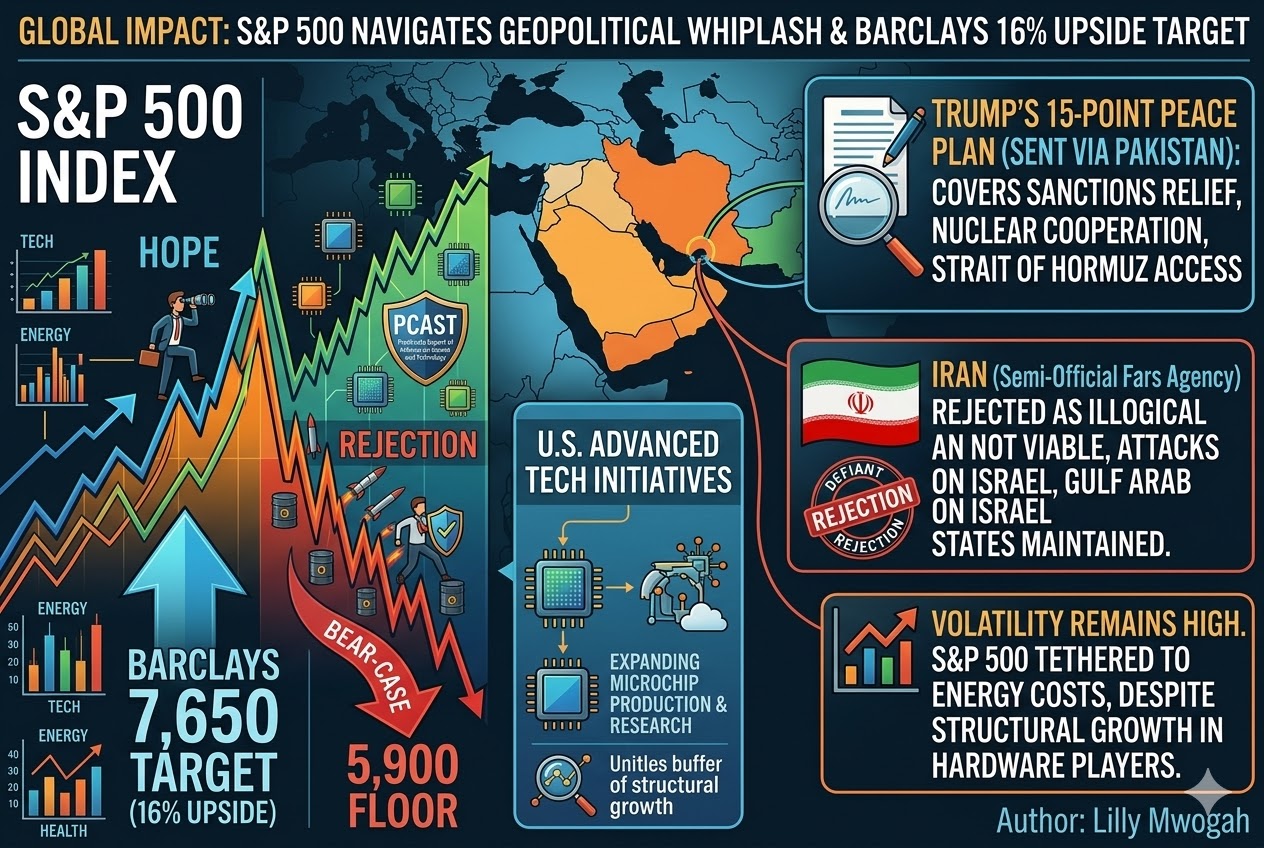
- Wall Street’s early gains under threat as Iran officially rejects the U.S. ceasefire proposal, labeling the move "illogical and not viable".
- Brent crude faces renewed volatility following the 5% intraday slump; prices may bounce back if the 15-point peace plan fails to gain diplomatic traction.
- Barclays’ 7,650 target remains the focal point for long-term investors, though "bumpy" near-term geopolitical rejection could test the 5,900 bear-case floor.
The early-morning optimism that sent the S&P 500 jumping 1% has been met with a harsh diplomatic reality. While markets initially surged on reports that Washington had funneled a 15-point peace plan to Iran via Pakistan, Tehran has formally delivered a blow to those efforts.
According to latest reports by Bloomberg, Iran has rejected the ceasefire proposal and maintained its attacks on Israel and Gulf Arab states, describing the Trump administration’s attempt at indirect talks as “illogical” at this stage of the conflict.
Barclays S&P 500 forecast: Price target raised to 7,650 with 16% upside
Amidst this geopolitical whiplash, Barclays has significantly adjusted its outlook for the S&P 500, providing a high-conviction anchor for institutional investors. The bank raised its year-end 2026 target to 7,650 from 7,400, citing a resilient “profit base” in technology and industrials that could offset Middle East tensions as reported by Reuters.
This new target implies a 16% upside from recent lows, backed by an increased earnings-per-share estimate of $321. However, the bank warned of a “bumpy path” ahead, noting that sustained oil strength could leave the Federal Reserve with fewer options to cut rates.
Wall street volatility: S&P 500, oil prices and geopolitical tensions drive market moves
The contradiction between the S&P 500’s opening rally and the evening’s diplomatic rejection highlights the extreme “headline risk” currently defining Wall Street:
- The failed breakthrough: The 15-point plan, which covered sanctions relief, civilian nuclear cooperation, and monitoring by the IAEA, was intended to stabilize the USDINR and global energy routes. Tehran’s rejection suggests the “crude oil shock” may not be over.
- Oil price sensitivity: Brent crude, which had slumped to $95.25 on the initial news, now faces a potential reversal as the threat to the Strait of Hormuz remains active despite the U.S. proposal.
- Defense stock resilience: The sustained strength in Lockheed Martin and Palantir earlier today appears prescient in hindsight, as Iran’s commitment to maintaining its military posture justifies the continued “war premium” in the defense sector.
Technical outlook: Can the S&P 500 hold the 6,600 handle?
With the ceasefire “reported breakthrough” now officially contested by Tehran, the technical levels for the S&P 500 and VOO/SPY ETFs are in sharp focus:

- Support: The index opened at 6,618.70. If the market loses this level following the Bloomberg report on Iran’s rejection, the focus shifts back to Barclays’ 5,900 bear-case support.
- Resistance: Reclaiming the 7,650 year-end target now depends heavily on whether the U.S. can salvage negotiations or if corporate earnings can decouple from the geopolitical noise.
- Sentiment: The India VIX and global volatility gauges, which cooled earlier today, are likely to see a late-session spike as investors digest the “illogical” label placed on the peace plan by Tehran.
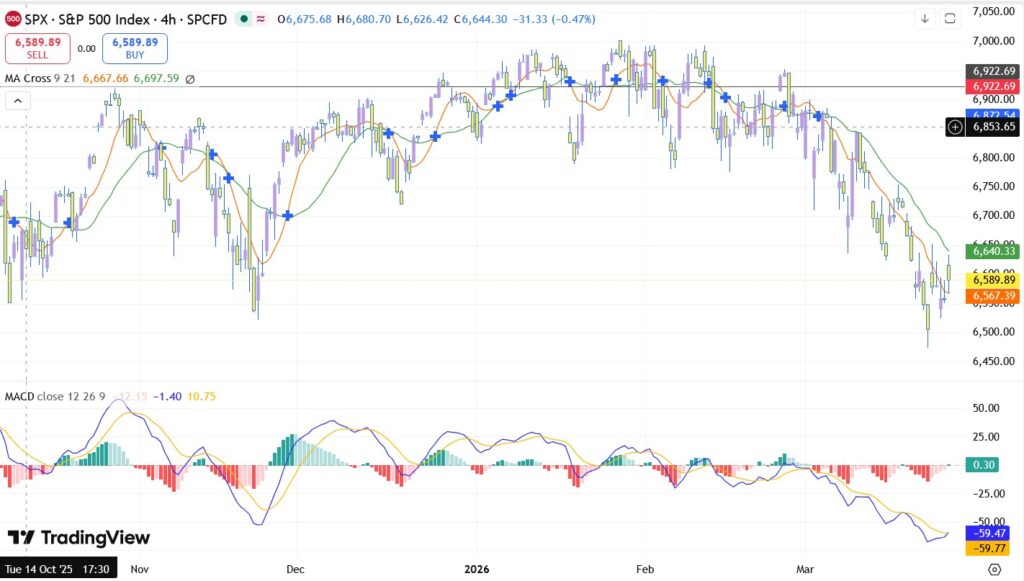
S&P 500 Outlook: Tehran rejection clouds market rally into next session
The late-session headlines from Tehran have materially shifted the near-term outlook for the S&P 500, injecting fresh uncertainty into what had been a relief-driven rally. While earlier gains were fueled by optimism around a potential diplomatic breakthrough, the outright rejection of the proposal has reintroduced geopolitical risk as a dominant market driver heading into the next trading session.
This development threatens to sustain the elevated risk premium across energy markets, with crude oil volatility likely to dictate sentiment on Wall Street. Although structural support from mega-cap tech continues to provide a cushion, the index now faces a more fragile setup, where overnight developments could decisively influence direction.
For investors, the focus shifts from momentum chasing to risk management, as the market recalibrates to a fluid and headline-driven environment.
Iran’s semi-official Fars news agency reported that the proposal was deemed “illogical and not viable” at this stage of the conflict. Tehran has maintained its military operations against Israel and Gulf Arab states, viewing the Trump administration’s indirect negotiation attempts as a blow to regional stability rather than a solution.
The early 1% rally in the S&P 500 is facing significant pressure as the “peace rally” fades. While the index opened higher on initial ceasefire hopes, the official rejection reintroduces “headline risk,” potentially pushing the market back toward the 5,900 bear-case level identified by Barclays if energy prices spike again.
Brent crude, which had slumped 5% to $95.25 on peace rumors, is seeing renewed volatility. With Iran maintaining attacks and rejecting the 15-point plan, the threat to the Strait of Hormuz remains high, increasing the likelihood of oil prices reclaiming the $100 mark and pressuring global inflation data.
Defense stocks like Lockheed Martin and Palantir have remained resilient, as Tehran’s rejection suggests a prolonged conflict. Investors are holding these names as a hedge against the continued “war premium,” even as the broader market struggles with the collapse of diplomatic negotiations.