


Live Chart and Current setup
The S&P 500 is currently trading amid macro headlines tied directly to the geopolitical situation in the Middle East. It has been a 3-day rollercoaster. The index sold off on Tuesday amid risk-off sentiment. This was followed by a macro-driven relief rally after the US and Iran agreed to a 2-week ceasefire with the reopening of the Strait of Hormuz. Hormuz remained open for less than 24 hours, as Iran shuttered the critical shipping waterway once more after Israel struck sites in Lebanon.
This is why I have harped on the fact that traders need to watch war-related headlines very carefully, as most exposed assets trade on a two-way, volatile street where prices rally and fall sharply in response to headlines.
Following the 8 April sharp rebound in the index, S&P 500 futures are once more trading lower, pointing to a lower open for the index in a few hours. The 2.51% rise in the S&P 500 index, which moved it above the 200-day moving average for the first time since March, has now been followed by a 0.28% decline in early London trading.
The entire situation is complex, as inflation expectations will keep shifting, leaving the Fed with no option but to stand pat and watch it unfold.
S&P 500 Macro Drivers
1) Oil shock and war headlines
The biggest near-term driver is the current war headlines. Specifically, those that detail whether the ceasefire will hold or if the Strait of Hormuz will remain open or closed. The reopening of that shipping pathway on 8 April was quickly followed by another closure soon after Israeli airstrikes hit targets in Lebanon. Equity multiples are sensitive to inflationary pressures and expectations of Fed interest rate changes. Therefore, the S&P 500 is directly impacted by the current war headlines.
2) US bond yields and Fed policy pricing
The S&P 500 rallied after the 8 April ceasefire and bond yield drop that followed the reopening of the Strait of Hormuz and oil price decline to $90.40. This is because it brought Fed rate-cut expectations back to the front burner. However, the Fed’s March minutes showed that policymakers are starting to consider rate hikes after raising their 2026 inflation outlook due to the war-related oil shock. So the S&P 500 will continue to respond to Fed policy repricing and the Treasury yields situation.
S&P 500 Macro Drivers
1) Oil shock and war headlines
The biggest near-term driver is the current war headlines. Specifically, those that detail whether the ceasefire will hold or if the Strait of Hormuz will remain open or closed. The reopening of that shipping pathway on 8 April was quickly followed by another closure soon after Israeli airstrikes hit targets in Lebanon. Equity multiples are sensitive to inflationary pressures and expectations of Fed interest rate changes. Therefore, the S&P 500 is directly impacted by the current war headlines.
2) US bond yields and Fed policy pricing

The S&P 500 rallied after the 8 April ceasefire and bond yield drop that followed the reopening of the Strait of Hormuz and oil price decline to $90.40. This is because it brought Fed rate-cut expectations back to the front burner. However, the Fed’s March minutes showed that policymakers are starting to consider rate hikes after raising their 2026 inflation outlook due to the war-related oil shock. So the S&P 500 will continue to respond to Fed policy repricing and the Treasury yields situation.
S&P 500 Catalysts for the Rest of the Week
The catalysts for trading the S&P 500 this Thursday and on Friday are as follows:
a) Oil Pathway/Ceasefire: The main macro driver now centers on the durability of the ceasefire and what Iran’s stance towards the continued opening/closure of the Strait of Hormuz would be in the face of any renewed aggression by Israel. Headline risk will continue to determine sentiment, and any changes will immediately impact oil first, then the S&P 500 and other assets linked to the oil shock.
b)U.S. CPI (10 April): The next US Consumer Price Index report is due on Friday, 10 April. A red-hot inflation print will be bearish for the S&P 500 index, as it will be a departure from the current sentiment that the cooling of geopolitical tensions will calm inflationary pressures and keep the Fed dovish.
c) US bond yield direction: Elevated inflationary risks, especially if the US CPI report comes in hotter than expected, will keep US bond yields on the upward trajectory. But if the CPI shows a slower-than-expected reading, this would support the S&P 500 as it would keep bond yields lower and dampen any Fed rate hike narrative.
S&P 500 Weekly Forecast Scenarios (S&P 500)
Base case: the bear case scenario is for the index to remain cautiously bullish, albeit with war-headline sensitivity. US bond yields have retreated, providing some support for the S&P 500. But such support depends on the ceasefire staying in place and the CPI not stoking “higher-for-longer” fears.
Bull case: lower oil prices will lead to a containment of US yields, a dampening of inflationary pressures, and a downward repricing of Fed rate cuts. Gains here would benefit tech, travel, industrials, and cyclicals, with plenty of recovery room ahead of the start of the earnings season.
Bear case: if the ceasefire collapses and oil prices surge once more, the relief rally will be undermined. UBS appears to be tilting towards this scenario after cutting its 2026 S&P 500 price targets earlier in the week. The bank has cited an already-delayed Fed rate cut and uncertainty due to higher energy prices as the reasons behind its downgrade.
S&P 500 Technical Outlook
The relief rally in the S&P 500 is meeting a stiff test at the 6773 resistance level. If the bulls resist the attempt to force price below this support following yesterday’s break of this barrier, the pathway towards the all-time high at 7004 becomes clearer.
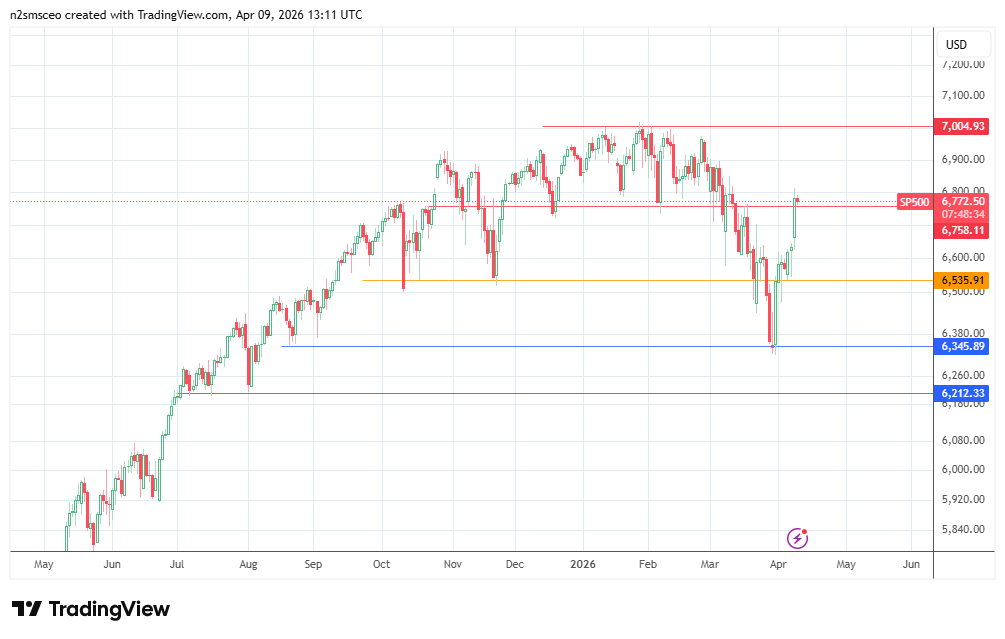
However, if the pivot collapses under bearish pressure, the stage will be set for a retest of the 6535 support and prior lows of 17 October and 21 November 2025. A further breakdown unlocks access for a retest of the weekly low at 6345, with 6212 serving as the secondary support.