- Dow Jones Index dropped to its lowest since November 2025 and went below the 47,000 psychological support
- The war in the Middle East has taken a different turn, with critical energy infrastructure targeted
- The Federal Reserve's decision to hold interest rates and oil prices above $110 could speed up the move towards bear market conditions
Markets are staring at unknown times and yesterday brought another dip for the Dow Jones Industrial Average. Down 1.63%, it settled at 46,225, its lowest point so far this year. That number also marks the lowest close since November 2025. Rough patch isn’t quite capturing what’s unfolding, really.
The immediate culprit was a toxic combination of a hotter-than-expected Producer Price Index reading, and an Israel-Iran war that refuses to de-escalate. On top of that, the central bank held its ground, opting to keep interest rates in the 3.50-3.75% band. Investors watched hopes fade with each word spoken calmly from the Federal Reserve.
Middle East War Takes A Different Turn
The key concern for the Dow isn’t only the existence of the conflict but its impact on critical energy infrastructure. Recent reports from March 18, 2026, indicate that Iran’s threats to target facilities in Saudi Arabia and the UAE are creating direct pressure on global oil supply.
Additionally, the closure of the Strait of Hormuz, a crucial passage for about 20% of the world’s oil, has driven Brent Crude prices toward $110 per barrel. Since the Dow is price-weighted and dominated by industrial and consumer sectors, higher energy costs hit profit margins hard. Notably, Goldman Sachs and Caterpillar, the two largest weighted stocks, each fell over 3.5% in a single trading session.
The Fed Just Made Everything More Complicated
The Federal Reserve’s decision to hold rates steady was never in doubt. What rattled markets was the tone around it. Fed Chair Jerome Powell acknowledged directly that the war’s impact on inflation made future rate policy harder to forecast, and that keeping rates mildly restrictive remained important.
MarketPulse by OANDA flagged that fertilizer costs have surged as a result of the war, with downstream food price increases now appearing in manufacturing data. That is the kind of sticky, non-energy inflation that the Federal Reserve finds far harder to dismiss.

Are There Genuine Buying Opportunities?
Regarding potential buying opportunities, the typical instinct to “buy the dip” may underestimate underlying risks. With the index dipping under its 200-day moving average, plus losses piling up past 5% this month, conditions feel less like a temporary slump. A backdrop of slowing growth paired with stubborn inflation adds weight here. Jumping in blindly means accepting hidden dangers masked by familiar slogans.
Investors looking for safer exposure might consider defensive sectors with solid balance sheets or companies positioned to benefit from higher energy prices. Such portfolios could offer a more balanced risk-return profile for now.
Dow Jones Index Forecast
The Dow Jones Index’s RSI at 29 suggest the index is in oversold territory with the sellers in charge. The pivot is at 47,000 which serves as the psychological round-figure barrier, with the index having fallen below the 200-day MA at 46,529. Support levels are identified around 46,048 and 45,729. Reclaiming 47,000 could enable upside traction towards the first resistance at 47,428 weekly highs while an extended control by the buyers could test 48,890 points.
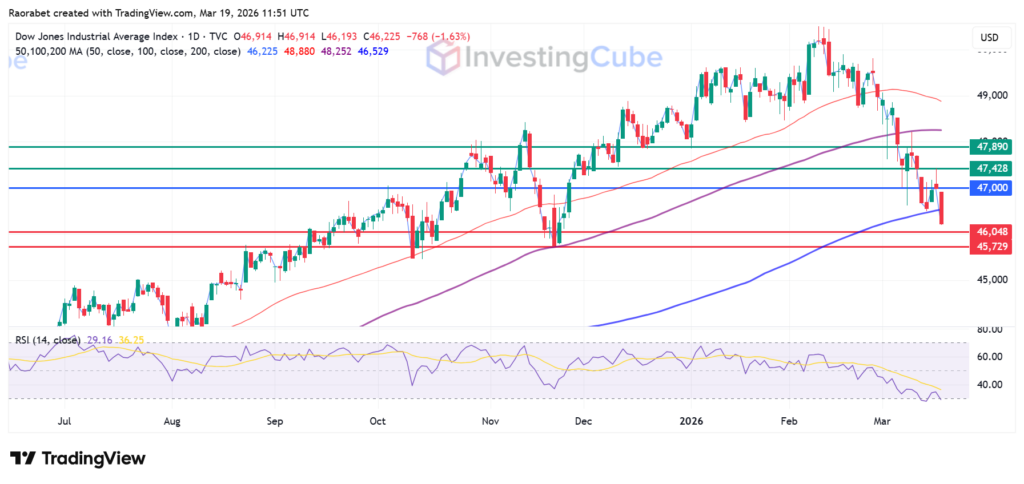
Dow Jones Index daily chart showing the key support and resistance levels for March 19, 2026. Created on TradingView
Contrarian value exists in defense and energy. While airlines and consumer discretionary stocks are bleeding, companies involved in domestic energy production and missile defense are seeing a “de-coupling” from the broader index’s decline.
Should oil prices remain above $110 per barrel for an extended period, the resulting combination of high inflation and slow growth might push the Dow into bear market territory.
Selective yes in defensive or energy beneficiaries, but consensus dip-buying overlooks recession risks if war extends. Therefore, caution is warranted.