


- The DAX index continues to trade bearishly due to the impact of the oil shock, Hormuz disruption and risk-off sentiment in the global markets.
The DAX forecast note below indicates the near-term sentiment on the DAX index, given this week’s events in the Middle East war theatre and the headlines surrounding the geopolitical situation there.
DAX Forecast: Current Setup and Live Chart
Across Europe, stock markets were lower after Brent crude surged overnight. The situation has brought growth and inflation fears back into the spotlight, meaning that near-term DAX forecasts are once more bearish.
Germany’s Xetra DAX is sliding along with other European bourses as hopes for a resolution of the ongoing US-Irana war and Hormuz disruption faded once more. Brent crude rose 8.26% overnight to trade at $108.44 as of writing, and the rising energy costs continue to constitute headwinds to global stock markets. The DAX (DE40) is now trading around ~22,828 today, off by about 2% as of writing.
What is Driving DAX Forecasts Now?
Oil prices rose after US President Donald Trump signaled that there was a chance of another 3 weeks of military operations in Iran. With no ceasefire in place and no concrete diplomatic results to end the war, the oil-shock risk premium is back in action. Swiss investment bank UBS is warning of further upside risks for energy in the near term as long as there is no resumption of flows via the Strait of Hormuz.
By extension, the DAX will face downside risks in the near term as long as the upside risks to energy exist. The DAX opened the day’s trading with a downside gap, and has remained under pressure since market open.
Key drivers of DAX forecasts and price action include the following:
1. Energy Shock: Rising energy costs pose a risk of margin compression for companies listed on any stock exchange. For DAX-listed companies, this is a real threat. Furthermore, high energy prices constitute headwinds to economic growth, thereby increasing recession risks. For a country like Germany, with a heavy industrial base, the threat to business conditions posed by higher energy costs tends to drag on the DAX directly.
2. Sector Exposure: Germany’s DAX index has a heavy mix of cyclicals, mining, and tech stocks, which are all under pressure due to the exposure of these sectors to the impact of energy costs.
DAX Forecasts: Current Catalysts
1. Oil and Hormuz disruption risk premium remains the main driver of inflation expectations and the risk appetite of investors. Continued disruption of oil shipping flows across Hormuz drives further bearish sentiment on the DAX. If flow resumes, sentiment on the DAX will vastly improve.

2. ECB rate pathway repricing: markets are now repricing the monetary policy expectations of Europe’s apex bank in the light of the inflationary risks that are now being fed by higher oil prices.
3. War headlines: Watch out for comments from US President Trump about the war, and the corresponding responses from the Iranian side. On this catalyst, the DAX’s movements will be a function of escalatory vs diplomatic/ceasefire headlines.
DAX Forecasts: Weekly Scenarios
Base case: the DAX whipsaws to the south as long as Brent crude trades well above $100 and the war headlines keep tilting towards escalation.
Bull case: the DAX bull case will be triggered by credible de-escalation headlines and oil cooling below $100 per barrel. A relief rally is likely, as the DAX is highly sensitive to energy shock-relief scenarios given its heavy weighting towards cyclicals and industrial stocks.
Bear case: A further spike in oil prices, accompanied by an escalation of the geopolitical situation in Iran, will produce a wider drawdown. If growth fears emerge, this will deepen the price move to the south.
DAX Index: Technical Outlook
Structurally, the chart indicates a transition from consolidation to a more decisive correctional tilt. This indicates a weakening of the prior bullish structure.
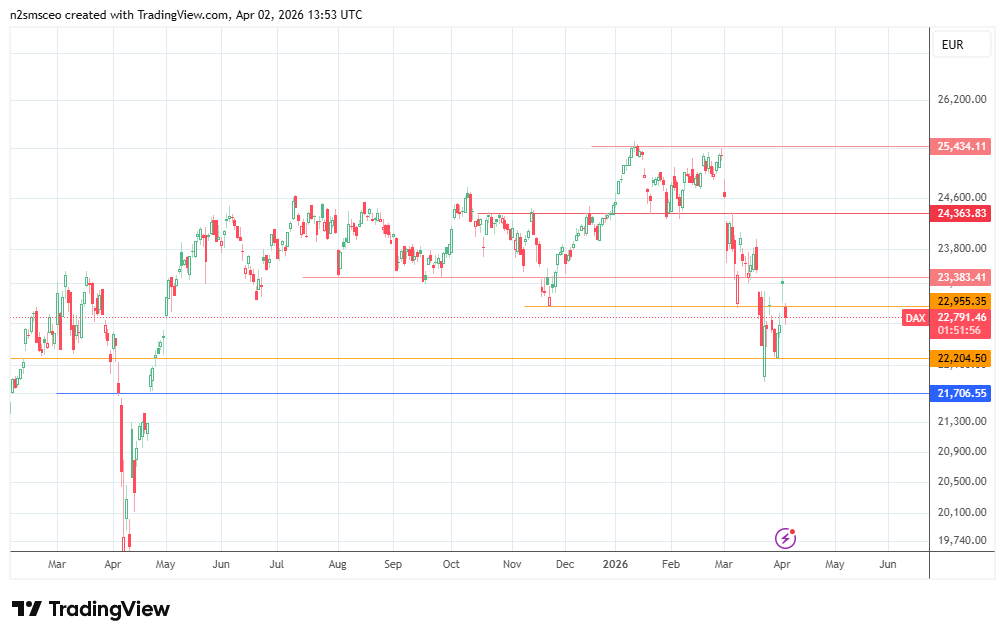
Failure to hold the 25,434 high, and the recent decline has led the DAX to accelerate past several support zones, sending the index towards its first-quarter price range as downside pressure persists. The DAX is below the 22,955 pivot, suggesting a near-term bias to the downside.
The 22,955 price mark now serves as the near-term price barrier following its breakdown and reversal. As long as the price does not reclaim this level, the bias tilts towards a further decline towards the 22,204 initial support. If this support fails to curtail the bears, a further decline towards the 21,707 major support cannot be ruled out. Further de-risking is possible if this major support collapses.
However, if the bulls reclaim 22,955, there is a potential for a relief rally towards 23,383. If the bulls uncap this barrier, 24,364 becomes the next focus point for the bulls as the next overhead resistance. Only if there is a more sustained push that retakes 25,434 can we see a restoration of bullish sentiment.