


- The South African rand has rebounded against the US dollar in April, with declining oil prices, safe haven demand and carry trade plays headlining
- USD/ZAR gains are also limited by a stronger outlook on the South African economy, with S&P Global revising its rating to BB in November 2025, the first such rating in nearly a decade
- Rising metal prices have helped South Africa improve its balance of trade, limiting the US dollar's gains
After a rough patch that sent USD/ZAR to a high of 17.23 on March 31, the pair has changed course fast. The exchange rate fell to its lowest level since March 12, dropping to about 16.48 as the South African rand gained strength. However, in the world of emerging market currencies, calm often shifts fast into storm. Traders are left wondering if this push marks real change or just a brief pause inside an ongoing slide.
The Ceasefire Catalyst Is More Than Just Relief
The immediate catalyst behind this turnaround is readily identifiable. South African assets experienced a significant rally on April 8, subsequent to the announcement of a two-week ceasefire between the US and Iran. This event led to the rand advancing by more than 2%, thereby recovering some of the considerable losses accumulated since the conflict began.
Understanding the underlying dynamics of this movement is crucial. In response, crude oil prices saw a sharp decline, with WTI and Brent dropping more than 15% to approximately $95 and $93 respectively. This situation directly advantages South Africa, given its status as a net oil importer.
While global markets continue to exhibit uncertainty, South Africa’s domestic narrative has shown signs of improvement. As per the South African Reserve Bank (SARB) March 2026 statement, inflation for February registered at precisely 3.0%, situated at the lower end of the target range.
Prior to the ceasefire, market expectations had transitioned from anticipating a minimum of two SARB rate reductions over the subsequent 18 months to factoring in four potential rate increases. The ceasefire, however, significantly altered this outlook.
Structural Tailwinds That Analysts Are Underweighting
Viewing the rand’s performance solely through a geopolitical lens might overlook a more subtle, yet enduring, narrative. S&P Global revised South Africa’s rating upward to BB in November 2025. This marked the first such upgrade in nearly two decades, signaling improvements in fiscal management, advancements within Eskom, and consistent primary budget surpluses.

Furthermore, recent data, as indicated by Business Insider Africa, suggests that the combination of increasing metals prices and sustained economic reforms has contributed to the rand’s standing as one of the leading emerging market currencies year-to-date.
USD/ZAR Forecast
USD/ZAR pivots at 16.45 and resistance at that level favours the seller to stay in control. Immediate support is located at 16.30. A break below this could see the pair slide toward 16.20. On the upside, 16.51 now acts as the first major hurdle. Breaking above that will have the next resistance at 16.58, at the 50-day EMA level.
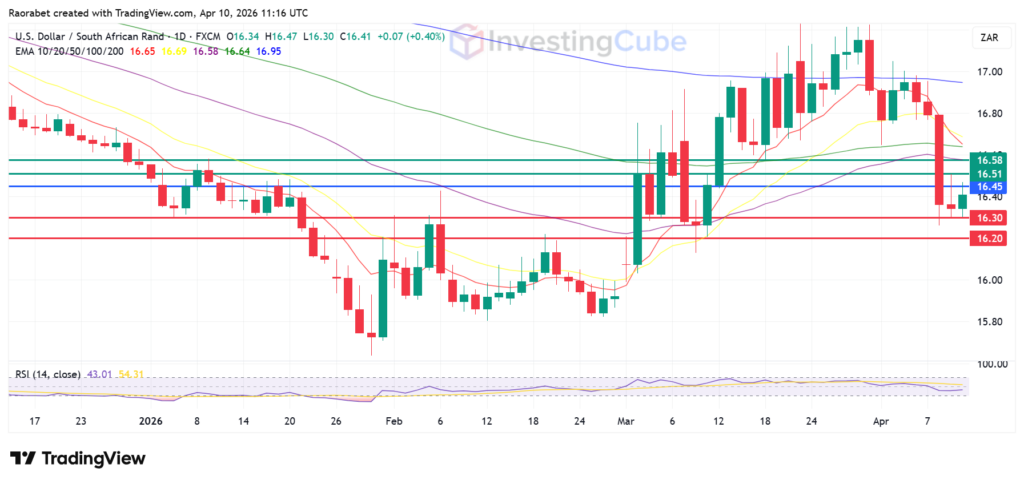
USD/ZAR forex pair on the daily chart on April 10, 2026 with the key levels of support and resistance. Created on TradingView
The rand had notably retreated by 8.6% from its peak earlier this year, a movement largely influenced by the Iran war, which drove Brent crude prices above $110 and simultaneously spurred safe-haven demand for the dollar.
Largely external. The ceasefire reduced oil-driven inflation risk and weakened the dollar, both boosting the rand. South Africa’s fiscal upgrades from S&P provide a supportive backdrop, but are not the primary driver of the April move.
If South Africa’s commodity exports, such as gold, maintain their upward valuation concurrent with oil prices, the country’s terms of trade could potentially remain sufficiently balanced to avert a significant currency depreciation.