


- Indonesia’s budget deficit nearly doubled year-on-year to IDR 240.1 trillion (0.93% of GDP) in Q1 2026, severely weakening the Rupiah’s domestic fundamental support.
- Bank Indonesia (BI) maintained its benchmark rate at 4.75% to stabilize the currency, but persistent inflation, which hit a multi-year high of 4.76%, limits the central bank's room for further maneuver.
The Indonesian Rupiah (IDR) faced a “perfect storm” of global and domestic pressures on April 7, 2026, as it tumbled to IDR 17,079 per US Dollar. The breach of the critical 17,000 handle reflects a significant shift in market sentiment, driven by a ballooning domestic budget deficit and an external energy crisis that shows no signs of cooling.
As President Donald Trump’s rhetoric regarding Iran heightens geopolitical anxiety, the Rupiah has transitioned from a high-yield favorite to a primary casualty of the current “Risk-Off” regime.
USD/IDR recap: The psychological fall of 17,000
The USD/IDR pair maintained a steep bullish trajectory this week, finally slicing through the 17,000 resistance level. Regarding price action, the pair is currently hovering at 17,079, with major institutional players like Bank Mandiri recording sell rates at IDR 17,015.
The technical structure remains aggressively bullish, supported by the safe-haven demand for Dollars as the Strait of Hormuz remains a focal point of global supply anxiety.
USD/IDR key technical levels to watch:
- Support: 16,985 This previous resistance has now flipped into a support floor where local banks are attempting to stabilize the rate.
- Resistance: 17,100 This is the immediate overhead target; a sustained break above this level could lead to a deeper run toward 17,250.
- Invalidation: 16,850 A break below this support is necessary to signal that the current panic-driven rally has peaked.

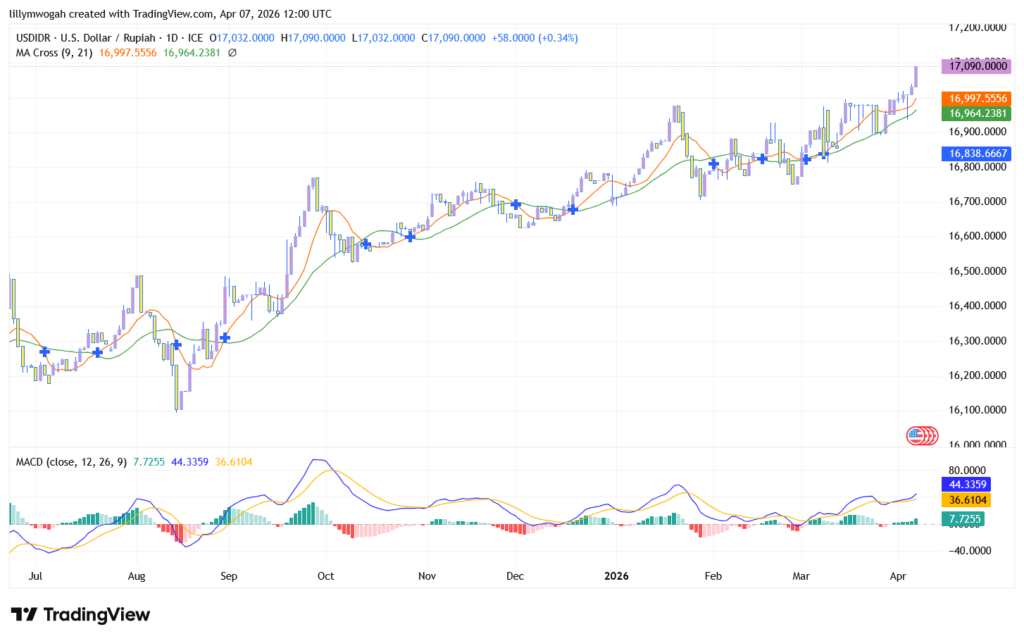
USD/IDR outlook: The short-term bias remains heavily tilted to the upside. Unless there is a significant de-escalation in the Middle East or a surprise intervention from Bank Indonesia, the USD/IDR is likely to maintain its position above 17,000 through the remainder of the week.
Indonesia fiscal deficit widens as Rupiah faces stagflation pressure
Domestic fundamentals provided no relief for the Rupiah this week. The announcement that Indonesia’s budget deficit reached IDR 240.1 trillion by March 2026, nearly double the previous year’s figure, has spooked foreign investors.
This fiscal deterioration, combined with soaring oil-driven inflation in the manufacturing and transport sectors, is creating a stagflationary drag on the local currency.
$115 oil shock and geopolitical risk weigh on Rupiah
The core driver of the Rupiah’s collapse remains the $115 WTI crude price. As a net energy importer, Indonesia is highly sensitive to the current geopolitical premium.
The high-risk global environment is forcing capital into the Greenback, as the April 6 extension for potential U.S. strikes on Iranian energy sites keeps the market in a state of high tension.
USDIDR outlook key triggers traders must watch
- Strait of Hormuz status: Any reports of unblocking would provide immediate, though perhaps temporary, relief for the IDR.
- Bank indonesia intervention: Watch for “smoothing” operations at the 17,000 handle to prevent a runaway devaluation.
- Fuel subsidy adjustments: Any move to shared burden-sharing by the government could impact inflation expectations significantly.
Final conclusion & strategic outlook
The Rupiah is currently trapped between a widening fiscal gap and an expensive global energy bill. The success of any future policy intervention will depend entirely on the stabilization of oil markets and the government’s ability to manage the growing deficit without further damaging investor confidence.