
- GBP/INR upside us driven mainly by INR weakness, not strong GBP.
- Rising oil prices are pressuring India's trade balance and currency.
- GBP remains relatively supported by higher UK rate expectations.
Currently, the GBP/INR cross is in a twisted macro environment where short-term flows are being influenced by conflicting forces between the British pound and Indian rupee. The pair was skewed to the upside because of constant weakness in Indian rupee rather than inherent strength in pound. Understanding this distinction is crucial for reading today’s outlook and near-term path.
Macro Backdrop: Oil Shock and INR Sensitivity
The main driver of GBP/INR moves today is the sustained depreciation risk on Indian rupee. Recent reports that the rupee is hovering near a record low against that U.S. dollar are a reflection of rising macro stress (Reuters, 2026).
The problem, at a fundamental level, is India’s dependence on imported crude oil that accounts for upwards of 80% of its consumption. Having crude prices recently racing above $100 dollars a barrel amid growing Middle East tensions, India’s trade deficit will widen. This dynamic instantly devalues the rupee, with more units of foreign currency required to secure receipts for imports.
Further, in today’s market position and continue to lead towards bearish tilt for INR. Reuters observed that followed by the oil price shock, traders rushed to expand their short-term bearish positions in the rupee through options markets (Reuters, 2026). The increase in hedging activities is a sign of institutions bracing for further rupee depreciation.
As such the rupee is now the weak leg of the GPP/INR pair, and this imbalance is what is driving the pair higher in the end.
GBP Outlook: Strength Relative, Not Absolute
On the flipside of the ledger, though, the British found has stayed relatively strong. GBP has made a few gains versus some of the European currencies in the last sessions, although it is not broadly stronger against the U.S. dollar. According to Reuters, “Britain’s pound has been among March’s stronger European currencies on a combination of rising gilt yields and steadfast rate expectations”.
More important than that is the Bank of England’s policy stands, and this goes a long way to explain why it has performed this way. Interest rate markets are increasingly starting to price in a higher-for-longer interest rate set up and fears of more tightening if inflation is sticky. So the increasing UK bond yields has therefore made GBP look more attractive than ever in carry terms, which is supportive for demand.
But the strength is relative, not absolute. Even broader risk-off scenarios tend to see the pound lag against haven currencies, such as the U.S. dollar. The other one was: “the pound’s gains are still limited as investors weigh Bank of England views, global risk sentimen and Middle East tensions(Reuters 2026). So GBP is a stable or rather strong currency at the moment — yet not the primary catalyst for current GBP/INR ascend.
Driving Differentials: A Super-Week Cross
The ongoing structure of GBP/INR can be categorized as a “weak currency authored rally”. This is unlikely bull trends, where the base currency rallies. Here it is largely one of “currency debasement (INR).
This distinction has important implications:
- This potential appreciation comes at the back of further INR depreciation.
- Any stabilization of oil prices or end to intervention by the Reserve Bank of India (RBI) could quickly cap advances.
- The pair will be very choppy rather than trending.
Technical Context and Price Structure
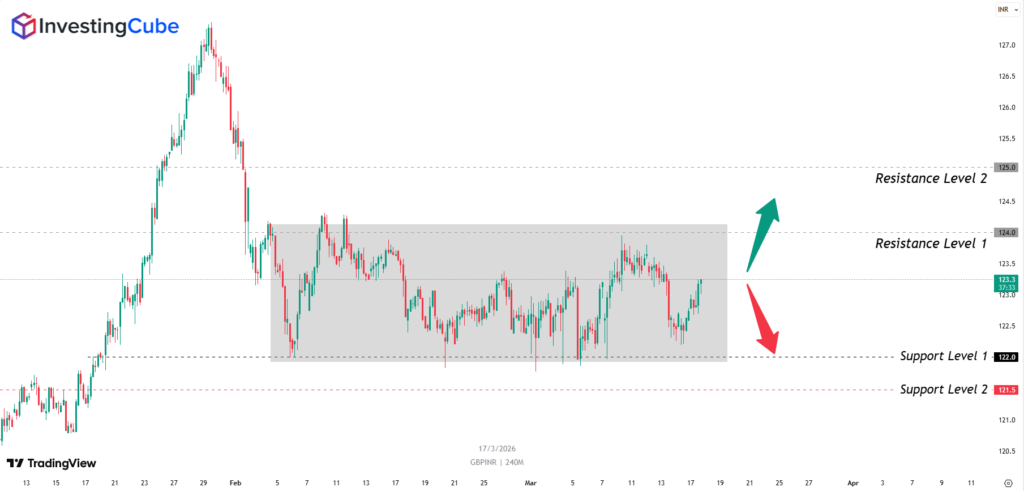
Technically, GBP/INR is trading around 123 while short-term trend indicates positive bias for an overall consolidation phase.
Key levels to watch:
- Immediate Support! 121.5 – 122.0
- Resistance Zone: 124.0
- Breakout Level: 124.0 will opens path toward 125.0
We have had the analysis to show a slow grind up and not what we call an explosive break. If macro conditions do not change, bar is inclined to retest key resistance level several times.
Short-Term Price Prediction
Bullish Scenario (Base Case)
So overall the very much pivotal scenario seems additional buy pressure on the part of GBP/INR.

Conditions:
- Oil prices do not stay elevated or rise.
- Geopolitical tensions persist.
- INR selling pressure continues.
Projection:
- Retest of 124.0.
- If resistance was going to break target extension, then on 125.0.
Neutral Scenario (Consolidation)
When oil stabilizes or risk appetite recovers:
- GBP/INR may trade in 122 – 124 range.
- Less volatility, no directional bias.
Bearish Scenario (Low Probability)
A downside move would require:
- The aggressive bid for the USD is causing risk-off flows all around.
- Unexpected GBP weakness.
- Possible RBI intervention.
Projection:
- Pullback toward 121.5.
Conclusion
Near term GBP/INR prospects remain up mildly, but again the driver is not found strength, its rupee weakness given climbing oil prices and geopolitics are supporting this. The pressures are still there but it is expected that the pair recovers on dips and buyers will be tested higher resistance levels.
But traders must brace for a jarring reversal. Immersed pairs grounded in external items (oil or geopolitics) tend to be extremely co-dependent sentiments shifts. An alteration in any of this variables could quickly alter the course.
Longer term, GBP/INR is a macro trade and seems the path of resistance still higher whilst volatile and event risky on an intraday basis.
Frequently Asked Questions
GBP/INR is rising primarily due to weakness in the Indian rupee, driven by higher oil prices and widening trade deficits, rather than strong appreciation in the British pounds.
India imports over 80% of its oil, so rising crude prices increase demand for foreign currency, weakening INR and pushing GBP/INR higher.
Key support lies around 121.5 – 122.0, while resistance is near 124. A breakout above 124 could lead to a move toward 125.