



- The EUR/USD bullish breakout failed at 1.1640 as the Strait of Hormuz blockade triggered a bearish gap-down and a structural shift toward USD safe-haven demand.
- With Brent Crude breaching $103, the EUR/USD pair faces renewed selling pressure with economic data has been sidelined by geopolitical volatility.
The EUR/USD bullish breakout didn’t even last a full week.
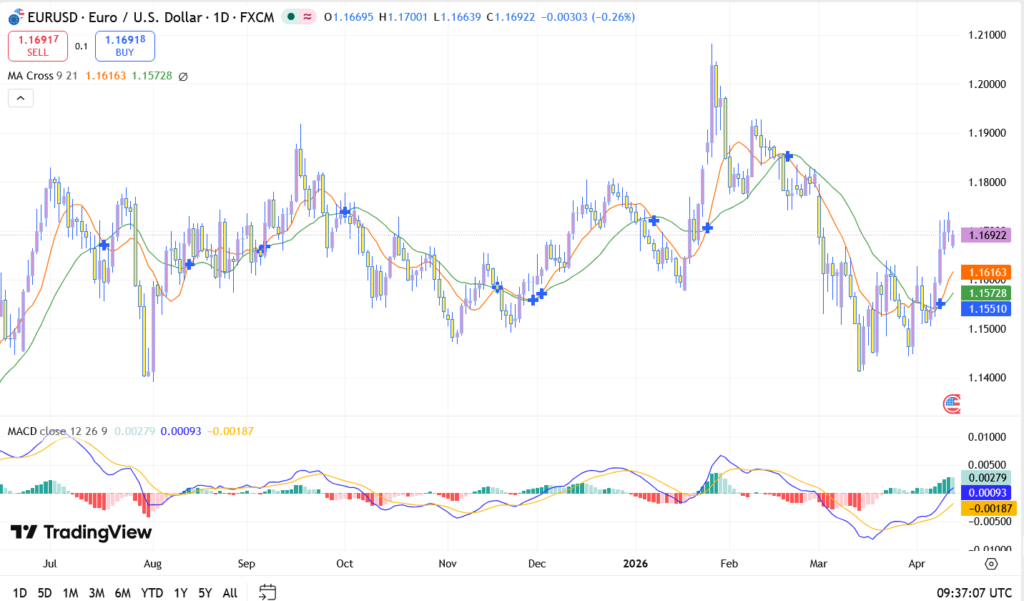
After climbing to 1.1740 on optimism that US-Iran talks would succeed, the pair gapped down overnight Sunday and is now hovering near 1.1685. Negotiations collapsed. Trump ordered a naval blockade of the Strait of Hormuz. And the dollar is back in safe-haven mode.
Here’s what happened, what the chart says, and where this pair is heading next.
Why is EUR/USD falling today?
The market has been hit by a “geopolitical rug pull.” After high-stakes talks in Pakistan failed, the U.S. response was immediate: a naval blockade of the Strait of Hormuz.
- Energy inflation re-emerges: Brent Crude’s jump to $103 is an immediate threat to the Eurozone, which is heavily reliant on Middle Eastern energy imports.
- Dollar safe-haven demand: Economic fundamentals have taken a backseat to fear. While U.S. inflation data remains in line with expectations, the market is currently ignoring interest rate differentials in favor of pure geopolitical risk aversion.
- Friday’s CPI failed the Euro: While headline inflation hit 3.3% and core inflation came in at a softer 2.7%, the market gave the Euro no lift. Normally, “cool” core inflation would be a signal for the Fed to pivot, but the market is currently ignoring rate differentials. Fear not policy is driving the U.S. Dollar, and investors are flocking to the Greenback as a safe-haven regardless of the economic data.
EUR/USD technical breakdown
The chart setup has shifted from a “bullish reversal” to a “failed breakout.” The pair’s attempt to sustain the double-bottom pattern is now under extreme duress.
Key technical levels for EUR/USD today:

- Immediate resistance: 1.1740. The “bull-trap” high. Price must reclaim this to negate the bearish signal.
- Critical support: 1.1640–1.1660. This is the “neckline” of the previous double-bottom pattern. If we see a sustained daily close below 1.1640, the pattern is invalidated, opening the door for a slide to 1.1600 and 1.1540.
- Market outlook: The pair is oscillating near 1.1690 as traders recalibrate for a prolonged period of geopolitical uncertainty and supply chain risk.
Will EUR/USD go up or down this week?
Honestly? Down. Unless headlines change fast.
- Bearish scenario (more likely) If the pair fails to close Monday’s gap and breaks below 1.1660, sellers will step in. First target is 1.1600. Second is 1.1540. That’s a clean short with a stop above 1.1740.
- Bullish scenario (needs help) Trump did say Iran “wants to return to the table.” If new talks are announced in the next 24–48 hours, expect a short squeeze back toward 1.1740 and maybe 1.1850. But that’s not the base case right now.
- Speculative range for the week: 1.1540 – 1.1770.
What traders must watch for EUR/USD this week
- Thursday’s Eurozone CPI: Markets expect 2.5% YoY. Watch closely: higher inflation in the face of an energy crisis is a negative for EUR/USD.
- ECB policy signals: Any commentary from Christine Lagarde or Philip Lane regarding energy-driven stagflation will be the Euro’s final make-or-break catalyst.
- Headlines from the Gulf.: This is the only driver that matters for EUR/USD. Headlines regarding the blockade are the primary source of intraday volatility.
EUR/USD risk management for the next 48 hours
In high-volatility regimes, chasing breakouts in EUR/USD is a losing game. Ensure you have 4-hour candle confirmation before entering positions and maintain tighter-than-usual stop-losses. This is a news-driven market, please adjust your risk tolerance accordingly.
The gap down happened because US-Iran peace talks collapsed over the weekend. After more than 20 hours of negotiations in Pakistan, the two sides couldn’t agree on Iran’s nuclear program. President Trump responded by ordering a US naval blockade of the Strait of Hormuz. Oil prices jumped back above $100, and traders rushed back into the US dollar as a safe haven. The pair had closed Friday near 1.1725 and opened Monday around 1.1685, that’s the gap
Traders are watching two zones closely today. Upside: 1.1740 is the recent high, price needs to clear this to get bulls excited again. Downside: 1.1640–1.1660 is the neckline of the double-bottom pattern from early March.
A daily close below 1.1640 would invalidate that bullish pattern and likely send the pair toward 1.1600, then 1.1540. Right now, the pair is hovering near 1.1690, right between both levels
The primary risk is the escalating conflict in the Strait of Hormuz, which remains the dominant driver of market volatility. Traders should also watch Thursday’s Eurozone CPI report and commentary from ECB officials, as rising energy costs threaten to fuel stagflation, which is a major fundamental headwind for the Euro regardless of U.S. economic data.