


- Early gains from Trump’s 120-hour strike delay were largely erased in Asia after Iranian officials called the reported negotiations "fake news," sending silver back toward $67 per ounce.
- High bond yields and a firm US Dollar continue to act as a ceiling for silver, making the non-yielding metal a "costly hold" for large-scale investors.
- All eyes are now on the $73.40 resistance; a failure to reclaim this old floor during the London/New York overlap could signal a deeper move toward the psychological $60 handle.
The silver market is currently caught in a tug-of-war between its identity as a monetary asset and its role as an industrial powerhouse. During Tuesday’s Asian session, the metal saw a localized attempt at a recovery, but the move was largely stalled by a relentlessly strong US Dollar.
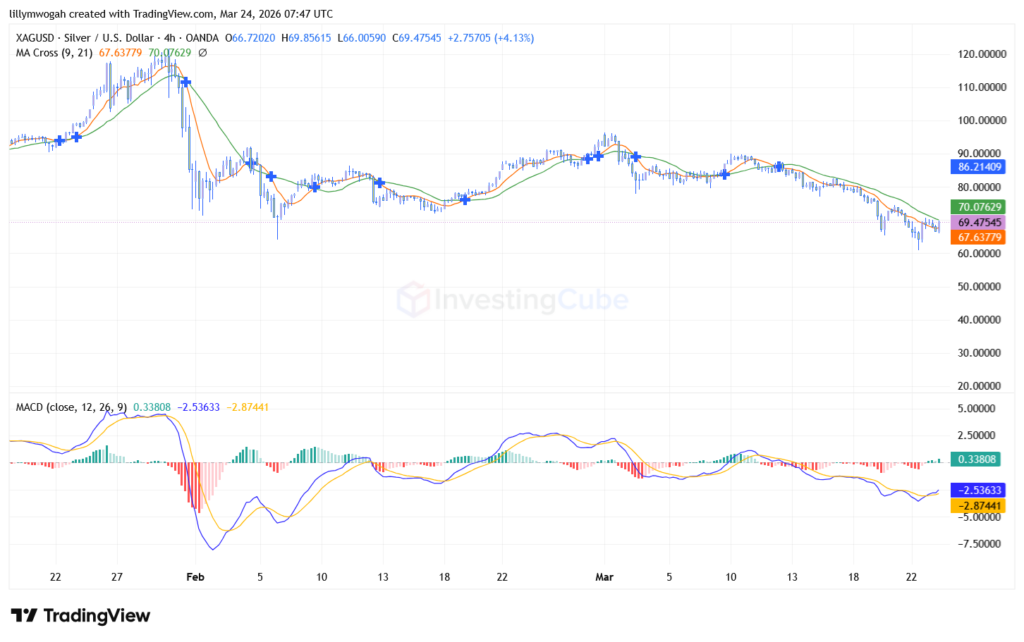
After a staggering 45% retreat from the euphoric highs of January ($121.67), XAG/USD is now trading in a volatile range between $68.20 and $69.50.
The narrative has shifted from pure war-panic to a “liquidity crunch.” As global stock markets continue to bleed, large funds are treating silver as an ATM, selling off paper silver contracts to cover losses in equities. This “forced selling” is currently overshadowing the fact that the physical market is heading into its sixth consecutive year of a supply deficit.
Silver price outlook: Rising oil costs threaten industrial demand and weigh on prices
While the headlines are dominated by the 120-hour ultimatum in the Middle East, silver traders are looking at the $103 oil price through a different lens: Manufacturing Costs. High energy prices act as a tax on the very industries that consume silver, solar panel production, EV battery manufacturing, and AI hardware.
If the “War Premium” stays baked into oil for too long, the industrial demand that was supposed to drive silver to new records in 2026 might hit a wall.
This is exactly why silver is falling harder than gold; gold doesn’t care about the cost of a semiconductor factory, but silver does.

Silver (XAG/USD) technical levels to watch
- Current price: $69.06 – The metal is treading water. We saw a minor “dead cat bounce” in Asia, but the overhead pressure is still immense.
- Support: $61.07 – This is the definitive “Line in the Sand.” This level saved silver in February, and if it fails now, we are looking at a fast slide toward the $54 zone.
- Resistance: $73.40 – This was the previous floor. To stop the “lower-highs” pattern on your 4-hour chart, silver must close a full day above this level to prove the bears are exhausted.
- Silver market sentiment – The market is “oversold,” which usually means a snap-back rally is due. However, with the MACD histogram showing increasing red bars, the momentum is still firmly with the sellers.
Conclusion: The PCE inflation “wildcard”
The market is currently in a “wait-and-see” mode ahead of the March 27 PCE inflation data. If inflation comes in lower than feared, it could trigger a massive short-covering rally as the Dollar softens. Until then, silver remains a high-beta play on geopolitical sanity.
For the patient investor, the widening Gold-Silver ratio suggests that silver is becoming historically “cheap” compared to gold, but in a liquidity crisis, “cheap” can always get cheaper before the turn.
Why did silver struggle during the Tuesday Asian session?
Despite a slight pullback in the Dollar, silver lacked the momentum to break $70. The Asian session saw a “liquidity drain” where institutional traders sold off silver to cover margin calls in the plummeting regional stock markets, preventing a meaningful recovery.
The ratio has widened to 65:1, meaning it takes 65 ounces of silver to buy one ounce of gold. This suggests that silver is being sold off much more aggressively than gold, primarily because investors fear the impact of high energy prices on silver’s industrial demand.
With the Gold-Silver Ratio widening to 65:1, silver is becoming historically “cheap” compared to gold. While gold has held up better as a safe haven, silver’s massive 67-million-ounce supply deficit suggests it could outperform gold once the current “paper market” liquidation ends and industrial demand for AI and solar tech stabilizes.