



- The gap-up by Yes Bank share price is underpinned by a leadership change, with a new CEO, Vinay Muralidhar Tonse taking charge from April 6
- Asset quality deterioration, margin pressures, rising funding costs and competition are potential problems in the coming months
Yes Bank share price gapped up on Wednesday, strengthening the reversal that began on April 1. That shift follows a long stretch of losses at the beginning of the year. Price action has picked up sharply this month, breaking clear of previous weakness. We discuss whether the current move will prove to be the start of a multi-month uptrend or short-term technical recovery.
What Is Propelling the Reversal?
The recent strength seems supported by a sharp rise in trading volume along with increased buying interest at lower price levels. Wednesday’s gap-up occurred amid volumes well above recent averages, indicating heightened market activity.
An important factor in this uptick is a leadership change. On April 6, 2026, Vinay Muralidhar Tonse, an experienced executive from the State Bank of India, assumed the role of MD and CEO. His appointment comes alongside Sumitomo Mitsui Banking Corporation increasing its stake to 24.22%, adding a layer of strategic support from a global investor. This backing provides a degree of stability and confidence in the bank’s future direction.
Additionally, broader rotation into select private sector banks amid easing concerns over systemic risks has provided a tailwind. These factors have combined to produce the gap-up move, even as the stock remains below key longer-term moving averages.
Is the Momentum Sustainable?
Sustainability in the near term is far from assured. Looking ahead, the sustainability of this momentum is uncertain in the near term. Despite the relief provided by the technical bounce, challenges remain, including intense competition in retail lending and lingering questions over the quality of loan growth.
Sustainability depends on whether the bank can maintain its asset quality. With Gross NPAs hovering around 1.6% and Net NPAs at a lean 0.3%, the toxic legacy is largely behind them.

Risks to monitor include possible asset quality deterioration if economic growth slows, margin pressures from rising funding costs, and competition from larger banks expanding their retail presence. Regulatory changes or any weakening of the credit environment could also negatively impact sentiment. Investors should watch upcoming quarterly earnings closely to gauge whether this rebound has lasting strength.
On the operational side, the bank’s efforts to shift from costly wholesale funding to more stable retail deposits could support margin improvements beyond current projections. The recent gap-up suggests that informed investors are beginning to back an operational turnaround rather than a temporary rally.
Yes Bank Share Price Forecast
Yes Bank stock pivots at ₹ 18.87 and faces immediate resistance at ₹19.24. A sustained move above this level might open the path toward ₹19.50. On the downside, support is seen around ₹18.65, with further declines potentially testing the Volume Weighted Moving Average near ₹18.40.
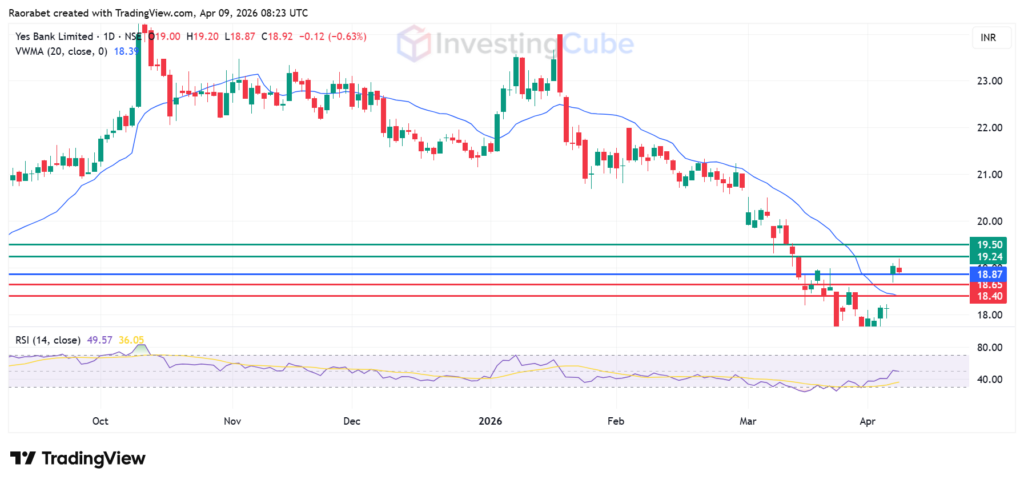
Yes Bank share price action on the daily chart on April 9, 2026, with the key levels of support and resistance. Created on TradingView
The gap-up was driven by a combination of a strong Q4 business update showing 12.1% deposit growth and the formal takeover of Vinay Muralidhar Tonse as CEO, which boosted investor confidence in the bank’s leadership.
Whether this momentum is sustainable remains in question, as the stock still trades below critical moving averages. While optimism exists, ongoing competitive and asset quality pressures suggest caution.
They appear to be the primary driver of the gap-up, with short covering playing a notable role; challenges consensus that the rebound is fundamentally driven.