- Yes Bank share price has declined sharply in the last month, losing about 11% of its value
- The sharp decline has triggered technical oversold signals, making investors to shift their focus on the Bank's fundamentals which are strong
- A return to the ₹20 psychological level in the near-term could strengthen the positive sentiment around the stock
The recent movement in Yes Bank share price has provided some relief to retail investors who had been facing a challenging period. After experiencing an 11% decline over the past month, the stock stabilized on Tuesday and continued to gain momentum with an additional 2% increase in today’s intraday trading session.
Short-term sentiment has changed as a result of these recent events, and after weeks of steady selling pressure, it is imperative to assess what has caused this abrupt rise in buying interest.
What’s Fueling the Rebound?
The recent uptrend seems supported by a noticeable increase in trading volume and indications that investors are accumulating shares at lower price points. Yes Bank stock shows signs of technical recovery from oversold levels, alongside renewed confidence in the bank’s improving fundamentals.
Q3 FY26 brought a sharp rise in profits for Yes Bank, up by 54.44% year-on-year, landing at ₹956.55 crore. That number also outperforms when measured against the previous quarter, showing growth of nearly 44% from ₹664.31 crore. Earnings have now risen back-to-back, moving from ₹9,110 crore to ₹9,270 crore across recent periods.
Net Interest Income climbed too, adding 10% versus the same period last year, reaching ₹2,223 crore. Net Interest Income widened slightly by 10 basis points, equivalent to 2.6% growth rate. On asset quality, Non-Performing Assets (NPAs) dipped just below the prior mark, settling at 1.5%, whereas net NPAs stayed flat at 0.3%.
An additional factor supporting the price is the upcoming MSCI index rebalancing. Yes Bank is scheduled to receive approximately $140 million through four monthly inflows: $91 million in December, $13 million in January, $26 million in February, and the final tranche at the end of March 2026. This type of index-driven buying is systematic and unrelated to market sentiment, providing important mechanical support just as the stock faces technical challenges.

Is the Rebound Sustainable?
In the short term, sustainability is still unclear. The stock is still trading below its key moving averages, indicating a bearish medium-to long-term trend, despite volume spikes and quarterly profit growth offering some hope. MarketsMojo’s recent downgrade to a Sell rating and a Mojo Score of 45.0 reflect ongoing concerns over asset quality and margin pressure.
A critical test for the rebound will be the stock’s ability to surpass the ₹20 psychological resistance level. For the rebound to hold, Yes Bank needs to clear this hurdle with high trading volumes. Should the price fail to break through ₹20 in the next few trading sessions, eyes will shift back down to where earlier support held firm.
Yes Bank Share Price Forecast
Yes Bank share price RSI at 38.63 is still near oversold territory, making a case for a near-term upward momentum. Immediate resistance stands at ₹18.65, with the next significant barrier positioned at ₹19. A daily close above that level may attract renewed buying interest, potentially pushing the price toward ₹20. On the downside, support levels are identified at ₹17.86 and the lower Bollinger Band level at ₹17.49.
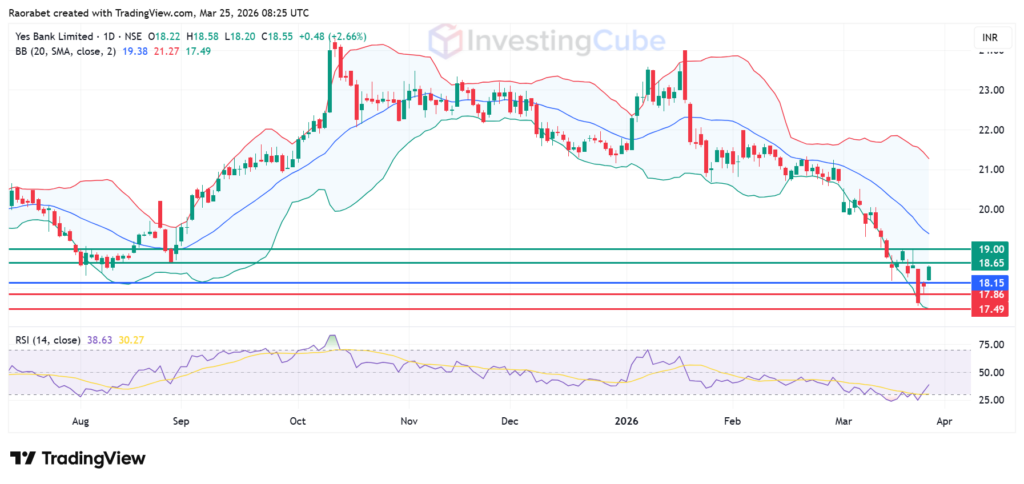
Yes Bank share price on the daily chart showing the key levels of support and resistance on March 25, 2026. Created on TradingView
A lack of new catalysts after the Q3 results and broader sectoral weakness in private banks were the main causes of the decline. After the stock dropped below its 50-day moving average, technical selling became more intense.
The recent recovery is driven by high trading volume and signs of accumulation, combined with positive Q3 profit growth and Bank Nifty rebalancing inflows.
It is possible but contingent on sustained trading volumes. The first hurdle is to surpass the ₹19.20 resistance level. If the current momentum holds, testing the ₹20 mark within the next five to seven trading days appears achievable.